GALLUP NEWS SERVICE
PRINCETON, NJ -- After 100 days in office, President George W. Bush is perceived quite favorably by the American public, a positive reaction that appears to be typical of what most recent presidents received at comparable points in their presidencies. A substantial majority of Americans hold a favorable opinion of the president and approve of the way he is performing his job overall, while smaller majorities also approve of the way he is handling the economy and foreign affairs. In addition, the public gives the president high marks on a variety of personal traits, generally higher than what they gave Bill Clinton at the same point eight years ago, with the largest rating difference found on the ability to "get things done." While this favorable public reaction is positive for Bush, a review of Gallup polls over the years suggests that such early ratings provide little predictive insight into how the president might fare when running for re-election three years hence.
According to a Gallup poll, conducted April 20-22, 62% of Americans currently approve of the way Bush is performing his job, and 29% disapprove -- one of his highest ratings since taking office. Over the past three months, his ratings have fluctuated between a low of 53% and a high of 63%.
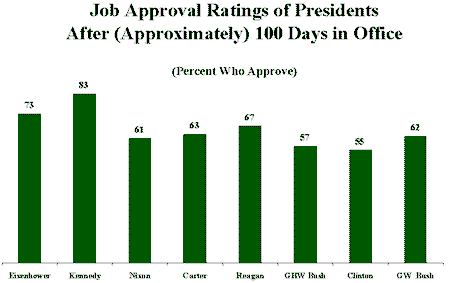
Bush's current 62% rating after three months in office places him just below the middle -- in fifth place -- among the eight presidents in the last half century who were first elected to office on their own (rather than having assumed the office through the vice-presidency because the president died or resigned). As shown in the accompanying chart, after three months in office, Kennedy received the highest approval rating at 83%, followed by Eisenhower (73%), Reagan (67%), and Carter (63%). Just behind Bush is Nixon (61%), the senior Bush (57%) and Clinton (55%).
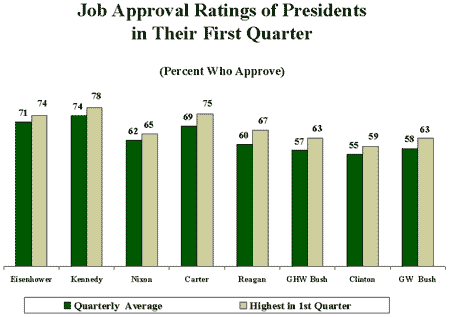
A broader insight into the approval ratings is provided by the chart below, which shows theaverageof all approval ratings for each president measured in the first quarter of their respective presidencies, along with thehighestrating they received in that time period. Note that Eisenhower and Kennedy, and then Carter, all enjoyed significantly higher average approval ratings in their first quarter -- and higher high points -- than the other presidents. The chart suggests a general downward trend in the ratings of presidents, with some fluctuations. It is not clear, however, whether the decline is due to certain special circumstances faced by the new presidents in recent years, or perhaps to a more critical public.
Bush Perceived More Favorably than Clinton at Comparable
Point in Presidency
The current poll shows that, on virtually all of the measures of
Bush's performance and personal characteristics that were also
asked about Clinton eight years ago, the current president fares
better than his predecessor. The narrowest difference is found on
the favorability measure, with 65% of Americans saying they have a
favorable opinion of Bush, compared with 63% who said that about
Clinton at the end of his first quarter in office. The two
presidents also enjoy similar ratings on foreign affairs -- 56%
approval for Bush, 53% for Clinton.
On the economy, however, the difference is much greater, as 55% of Americans say they approve of the way Bush is handling the issue, compared with 43% who felt that about Clinton. It should be pointed out that such ratings on the issues tend to reflect the public's assessment of the issue itself, often regardless of how much influence the president might have. When Clinton assumed office, for example, the economy was generally perceived as much worse than when Bush became president. Indeed, the negative perception of the economy was a major factor in Clinton's successful campaign against the current president's father. Still, three weeks after Clinton took the oath for the first time, just 45% of Americans said they approved of the way he was handling the economy -- not much different from the 43% who expressed that view two months later.
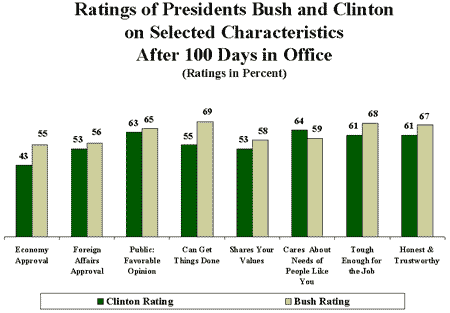
While the current state of the economy might partially account for the difference in the economy ratings, the public today holds a more positive view of Bush across other dimensions than it did of Clinton at a comparable point in his presidency. The largest difference is found on the personal characteristic described as "can get things done," with 69% of Americans saying that trait applies to Bush, while only 55% said that about Clinton eight years ago.
The difference may reflect, to some degree, the much smoother transition that Bush has experienced in assuming the office than what Clinton experienced. Several of Clinton's cabinet nominees had difficulty in getting confirmed, with an especially long and controversial fight over the position of attorney general. Furthermore, Clinton's policy agenda was soon dominated by a focus on the actions he was going to take over gays serving in the military, a controversial issue that was an outgrowth of his campaign promise, but that detracted from his desire to focus on an economic agenda. By contrast, Bush has generally avoided long controversial fights over cabinet appointments and, despite some controversy over his environmental positions, his administration generally has not been beset by a major, controversial policy fight.
On several other personal characteristics, Bush fares better than Clinton but by smaller margins. Compared with the former president eight years ago, more people today see Bush as honest and trustworthy, as tough enough for the job, and as one who shares their values. The differences, however, are slight -- by margins of five to six percentage points. The one characteristic where Clinton did slightly better than Bush does now is described as "cares about the needs of people like you," a five-point difference in favor of the former president.
Early Ratings Not Predictive
While these early positive ratings of Bush indicate how the
president is currently faring with the public, they should not be
interpreted as predictive of what might happen over the next three
years. In general, the ratings a president receives early in the
term are quite favorable, but decline over time. Both Ronald Reagan
and Bill Clinton experienced significant declines in their
popularity during the middle of their first terms, yet both went on
to win re-election. On the other hand, both George H.W. Bush and
Jimmy Carter began their presidencies at high levels of popularity,
with Bush reaching even higher levels than what he initially
experienced, but both suffered severe declines by the end of their
first terms and lost their re-election bids.
Survey Methods
Current results are based on telephone interviews with -- 1,015-- national adults, aged 18+, conducted April 20-22, 2001. For results based on the total sample of National Adults, one can say with 95% confidence that the margin of sampling error is +/- 3 percentage points.
In addition to sampling error, question wording and practical difficulties in conducting surveys can introduce error or bias into the findings of public opinion polls.