George W. Bush is the second president in U.S. history to have a father who was also president. There was, of course, no polling in 1800 when President John Adams lost his bid for re-election to Thomas Jefferson, and no polling in 1828 when Adams' son, John Quincy Adams, lost his race for a second term. So we don't know exactly how similar or different the two presidents were to one another in the eyes of the voting public.
But we do have an extensive record of public opinion during President George H.W. Bush's unsuccessful re-election bid, which helps put an empirical perspective on the similarities between the two Bushes' situations. Both men had major increases in their overall job approval ratings as a result of internationally related events, and both also suffered from bad domestic economies in their first terms. The question thus becomes: How likely is it that George W. Bush will follow in the footsteps of John Adams, John Quincy Adams, and his father and become the fourth member of the two father-son president combinations to fail in a bid for re-election?
A comparison of the current president's job approval measures suggests that George W. Bush is by no means in as negative a situation as was his father. There are significant differences. The current president's job approval rating has stabilized during the fall of the year before his re-election, while his father's continued to fall in each of the fall months of 1991. (And, with the capture of Saddam Hussein on Dec. 13, there is every reason to predict that George W. Bush's job approval rating will end the year at a significantly increased level.) Additionally, the current president is receiving job approval ratings for his handling of the economy that are over twice as high as his father's.
This analysis will compare the ratings of the two presidents in the fall of the year before their re-election bids (1991 and 2003).
Presidential Job Approval
The current President Bush is currently receiving somewhat higher job approval ratings than his father received in December 1991. Gallup conducted two polls in December 1991, in which George H.W. Bush received 52% and 50% job approval ratings. In two polls conducted in December of this year, George W. Bush has a job approval rating of 55% (Dec. 7-9) and 56% (Dec. 11-14). (This latter poll was conducted mostly before the dramatic capture of Hussein.)
Indeed, a recent Gallup analysis (see "Key Bush Ratings Remain Fairly Strong" in Related Items) shows that a job approval rating in the 50% range in December of the year before an election is the norm for incumbent presidents seeking re-election. Bill Clinton and Ronald Reagan had job approval ratings of 51% and 54% in December 1995 and December 1983, respectively. Jimmy Carter -- benefiting from a rally effect relating to the taking of hostages in Iran -- also had a job approval rating of 54% in December 1979. Richard Nixon was at 50% in December 1971. (At the same time, there have been several exceptions to this 50% rule. Gerald Ford was only at 46% in December 1975. Dwight Eisenhower, in December 1955, and Lyndon Johnson, in December 1963, both had job approval ratings in the mid-70% range.)
Job Approval Trajectory
Despite that both Bushes had job approval ratings in the 50% range in the December before an election year, there is a significant difference in the pattern of change in job approval ratings between the two presidents.
It's important to remember that the Bushes received the two highest job approval ratings in Gallup Poll history. George H.W. Bush received what was then the highest job approval rating on record -- 89% -- in late February/early March 1991 (after the successful completion of the Persian Gulf War). The current President Bush eclipsed that record by one point when he received a 90% job approval rating in September 2001 as part of the general rally effect that accompanied the terrorist attacks of Sept. 11.
It's impossible to sustain job approval ratings at those levels, so the question simply became how rapidly the drop off would occur. Bush the elder's job approval rating ultimately dropped by 60 points within a span of only 16 months, while the current Bush's job approval rating has fallen by 40 points within a period of about two years.
But a more narrow comparison of job approval rating patterns in the fall before their re-election bids shows significant differences, and leads us to the conclusion that the current President Bush is in a better situation than his father was despite the fact that both ended the year with similar ratings.
- President George H.W. Bush's ratings were basically in a free-fall through the fall of 1991, going from a high point of 70% (Sept. 5-8), to a final 1991 rating of 50% (Dec. 12-15). That's a drop of 20 points.
- The current Bush's job approval ratings, on the other hand, have stabilized throughout the fall of 2003. Bush's first September rating of this year was 52% (Sept. 8-10) and his rating in our most recent Dec. 11-14 poll was 56%.
On a month-by-month basis:
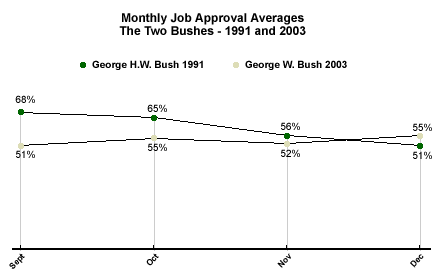
One can use the slope of existing data points on a line to project an anticipated pattern. The fall of 1991 was clearly a time of deepening trouble for President George H.W. Bush. His slide in overall job approval ratings foreshadowed the eventual collapse of his presidency in 1992 (to the point where he received a near-record low job approval rating of 29% in late July/early August 1992).
In the case of the current President Bush, this fall's trend in job approval rating projects continued stability in the coming year (in the 50%+ range) -- exactly where an incumbent president would like to be.
Current performance is no guarantee of future performance, of course. It's certainly possible that the current President Bush's ratings may begin to slide in the new year, based on a possible failure of the economy to continue its recovery and a possible fall off in the positive publicity that comes from such events in Iraq as the capture of Hussein. Alternatively, they could increase if perceptions of the economy -- which have grown more positive in recent months -- continue to ascend, and if the capture of Hussein is the beginning of the agreement that there is a much more positive situation in Iraq. But for the purposes of this analysis, suffice it to say that the path of the current Bush is on is much more positive than the path his father trod in 1991.
Job Approval on Handling the Economy
It's clear that one of the reasons the current Bush's job approval ratings have stabilized is the improved economy, evident in a comparison of the economic approval ratings of the two presidents:
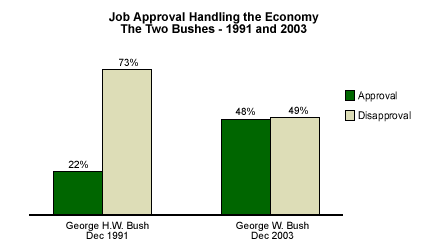
The current president's economic job approval rating is more than twice as high as his father's was in December 1991 (48% to 22%).
Indeed, the American public clearly differentiated between George H.W. Bush's overall job performance as president and his handling of the economy. Even on the heels of the successful war against Hussein, a March 1991 Gallup Poll showed that while Bush the elder was receiving an outstanding 87% overall job approval rating, his economic job rating was only 37%.
Gallup measured Bush's economic job approval rating four times in the fall of 1991, and they were very low: 32%, 29%, 28%, and 22%. The current Bush's job approval rating on the economy also trails his overall approval rating, but not by nearly as much: 45%, 42%, 47%, and 48%.
Job Approval on Handling Foreign Affairs
Foreign affairs was clearly a strength for both Bushes in their first year in office.
Bush the elder maintained a significantly higher job approval rating in December 1991 than his son had in December 2003, even while their overall job approval ratings were equal:
|
Two President Bush's |
||||
|
Bush: 1991 |
Bush: 2003 |
|||
|
Overall Job |
Job |
Overall Job |
Job |
|
|
Dec |
52% |
64 |
55 |
53 |
|
Oct |
62% |
68 |
55 |
49 |
|
Sep |
68% |
70 |
52 |
52 |
This same pattern for Bush the elder persisted into 1992. His foreign affairs job approval rating maintained at a relatively positive level, and was at 50% in the summer of 1992, when his overall job approval rating was at its low point.
Bottom Line
There is a significant difference between the trajectories of the job approval ratings of the two Bushes in the fall of the year before they sought re-election. The current president's rating is in the 50% range and showing some signs of increase as the year comes to an end. The elder Bush's ratings were at the low end of the 50% range, but were falling fast. An extrapolation of the 1991 trends correctly predicted a continued decline in ratings for Bush in 1992. The same projection for the current president suggests continued ratings above 50% in the coming year.