PRINCETON, NJ -- The latest findings from the 2004 CNN/USA Today/Gallup tracking poll -- the first findings based solely on interviewing conducted after the results of the Iowa caucuses became known -- show Massachusetts Sen. John Kerry with a 12-point lead over former Vermont Gov. Howard Dean. Kerry now receives 34% support, compared with 22% for Dean, 17% for retired Gen. Wesley Clark, and 12% for North Carolina Sen. John Edwards.
| Likely New Hampshire Voters: If the Primary Were Held Today, for Whom Would You Vote? |
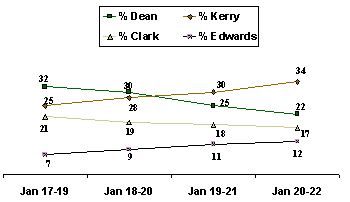 |
In the past three days, following his surprising victory in Iowa, Kerry's support has increased 9 percentage points, while Dean's support has dropped 10 points, a dramatic 19-point reversal in their standings. Clark, who did not campaign in Iowa, has experienced a 4-point drop, while Edwards, who stunned the experts by coming in second in Iowa, has seen his support increase by 5 percentage points.
Issues and the Vote
Among five issues mentioned in the poll, the economy (mentioned by 38%) and healthcare (31%) emerge as the dominant issues for New Hampshire primary voters, followed by the situation in Iraq (17%), terrorism (6%), and taxes (4%).
Which ONE of the following issues is MOST important to you when you think about your vote in the primary this year -- [ROTATED: economic conditions, healthcare, the situation in Iraq, terrorism, (or) taxes]?
|
|
Healthcare |
The situation |
Terrorism |
Taxes |
Other/ none/ |
|
38% |
31 |
17 |
6 |
4 |
4 |
Support for the candidates is modestly related to these issues. Dean, for example, gets 17% support from voters who cite the economy as the most important issue, but he gets 26% support from people mentioning healthcare as the most important, and 31% support from voters who are focused on Iraq.
|
Candidate Support |
|||
|
% Who Support: |
Economy |
Healthcare |
Situation in Iraq |
|
% |
% |
% |
|
|
Kerry |
32 |
39 |
36 |
|
Dean |
17 |
26 |
31 |
|
Clark |
19 |
14 |
19 |
|
Edwards |
19 |
8 |
5 |
Kerry's support, however, is in the 30% or better range across the board. Similarly, there is only a little variation in support for Clark by issues. For Edwards, support is highly related to the issues. Voters who are concerned about Iraq and healthcare are far less likely to support him than are people who mention the economy as their greatest concern.
Iraq and Dean Support
One of the major issues that launched Dean to front-runner status in New Hampshire before the Iowa caucuses was his opposition to the war in Iraq. The tracking poll finds New Hampshire Democratic voters still opposed to the war by a 2-to-1 margin -- 34% who approve and 64% who disapprove.
How do you feel about the United States' decision to go to war with Iraq in March 2003? Would you say you -- [ROTATED: strongly approve, approve, disapprove, (or) strongly disapprove]?
|
Strongly approve |
|
|
Strongly disapprove |
No |
|
6% |
28 |
32 |
32 |
2 |
The tracking poll also shows that the issue is still highly related to Dean's electoral support, with strong opponents of the war more likely to vote for Dean than are either lukewarm opponents or supporters of the war.
|
Candidate Support |
|||
|
% Who Support: |
Approve of War |
Disapprove of War |
Strongly Disapprove of War |
|
% |
% |
% |
|
|
Kerry |
36 |
37 |
28 |
|
Dean |
13 |
21 |
32 |
|
Clark |
16 |
22 |
15 |
|
Edwards |
15 |
12 |
10 |
Among strong opponents of the war, Dean still leads in New Hampshire, by a slight margin over Kerry (32% to 28%), with Clark (15%) and Edwards (10%) far behind. However, among opponents of the war who do not feel strongly about their opposition, Kerry leads Dean by 16 points (37% to 21%). Furthermore, these lukewarm opponents are as likely to vote for Clark (22%) as Dean.
Among the supporters of the war, Kerry is the overwhelming choice -- presumably not because of his stance on the war, but because of other issues. Dean, Clark, and Edwards all fare about equally well among the war supporters.
Beating Bush
One of the frequently heard comments in the news is that Democratic voters this year would vote for anyone, as long as he or she had a chance of beating President Bush. But the poll suggests that, at least in New Hampshire, this notion is only half right -- 49% of New Hampshire primary voters can be classified as "issue" voters and 48% as "strategic" voters.
Which type of candidate are you more likely to vote for in the New Hampshire primary -- ?
|
One who agrees with respondent on most of the issues |
One who has the best chance of |
No |
|
49% |
48 |
3 |
Strategic voters have a somewhat different priority of candidates than do issue voters. Among issue voters, Kerry (27%) enjoys only a slight lead over Dean (22%), with Clark (15%), Edwards (17%) and Lieberman (13%) not far behind.
|
Support for Candidates |
||
|
TYPE OF VOTER |
||
|
CANDIDATES: |
Issue Voter |
Strategic Voter |
|
% |
% |
|
|
Kerry |
27 |
40 |
|
Dean |
22 |
21 |
|
Clark |
15 |
20 |
|
Edwards |
17 |
8 |
|
Lieberman |
13 |
4 |
However, among strategic voters (those who say that a candidate's ability to beat Bush is more important than agreement with them on the issues), Kerry's support (40%) is roughly twice that of either Dean (21%) or Clark (20%). Edwards (8%) and Lieberman (4%) trail far behind. Thus, Edwards and Lieberman appear to be hurt because of perceptions that they may not be especially strong candidates to beat Bush, while Kerry and -- to a lesser extent -- Clark are helped by the perception that they would do well against Bush.
The Scream
It's likely that very few New Hampshire voters who have been following the election have failed to hear, read, or see Dean's speech to his Iowa supporters following the announcement of the caucus results last Monday. How much did that speech hurt Dean's image? That question is difficult to answer, because we have no pre-Iowa questions to provide a comparison. However, included in the latest poll was a question that asked whether each of the top five candidates had the appropriate presidential personality.
Do you think each of the following candidates does -- or does not -- have the kind of personality that a president should have? How about -- [RANDOM ORDER]?
|
(LV) 2004 Jan 20-22 |
|
|
|
% |
% |
|
|
John Kerry |
86 |
13 |
|
Wesley Clark |
76 |
20 |
|
John Edwards |
75 |
16 |
|
Joe Lieberman |
59 |
38 |
|
Howard Dean |
50 |
46 |
|
(LV) Likely voters |
||
The results show overwhelming majorities of voters saying that Kerry (86%), Clark (76%), and Edwards (75%) each have the appropriate personality a president should have, but only 59% saying that about Lieberman, and just 50% saying that about Dean.
Lieberman's low figures may be related to the fact that he also draws little electoral support. One might expect Dean, still a competitive candidate, to have percentages in the same range at least as Edwards and Clark. That only half the voters give Dean a positive rating on his personality suggests that the "scream" speech and the resulting publicity may have hurt his image significantly. Still, without both pre- and post-Iowa measures, these results are not definitive.
Survey Methods
New Hampshire Tracking results are based on telephone interviews with approximately 280 New Hampshire residents per night who say they plan to vote in the Democratic Primary on Jan. 27. Results are reported in three-day rolling averages.
The most recent results are based on interviews conducted Jan. 20-22, 2004 with 641 New Hampshire residents deemed most likely to vote in the Democratic primary. For this sample, the maximum margin of error attributable to sampling is ±4 percentage points.
The "likely voter" model assumes a turnout rate of 60% of those who say they plan to vote in the Democratic presidential primary, approximately 25% of New Hampshire adults. The likely voter results are weighted to match this assumption (weighted sample size is 514).
All results reported here are based on likely voters.
|
Number of Interviews |
||||
|
Plan to vote in |
Likely |
Margin of error, |
||
|
2004 Jan 20-22 |
848 |
641 |
±4 |
|
|
2004 Jan 19-21 |
852 |
646 |
±4 |
|
|
2004 Jan 18-20 |
849 |
644 |
±4 |
|
|
2004 Jan 17-19 ^ |
854 |
657 |
±4 |
|
|
^ |
NOTE: All interviews conducted on January 19th were completed before the results of the Iowa caucuses were reported. |
|||
In addition to sampling error, question wording and practical difficulties in conducting surveys can introduce error or bias into the findings of public opinion polls.
Suppose the Democratic primary for president were being held today. If you had to choose among the following candidates, which candidate would you vote for? [ROTATED: John Kerry, Joe Lieberman, John Edwards, Howard Dean, Al Sharpton, Dennis Kucinich, or Wesley Clark]
2A. As of today, to which Democratic candidate do you lean most?
|
|
|
|
Ed- |
Lieb- |
Kuc- |
Sharp- |
None/ other/ no opinion |
||
|
% |
% |
% |
% |
% |
% |
% |
% |
||
|
(LV) 2004 Jan 20-22 |
34 |
22 |
17 |
12 |
8 |
3 |
* |
4 |
|
|
(LV) 2004 Jan 19-21 ^ |
30 |
25 |
18 |
11 |
8 |
4 |
* |
4 |
|
|
(LV) 2004 Jan 18-20 ^ |
28 |
30 |
19 |
9 |
8 |
2 |
* |
4 |
|
|
(LV) 2004 Jan 17-19 ^ |
25 |
32 |
21 |
7 |
7 |
2 |
1 |
5 |
|
|
^ |
Dick Gephardt dropped out of the race for the Democratic nomination on Jan. 20 and his name is removed from this question beginning with that date's interviewing. For data collected on Jan. 17, 18, and 19, Gephardt voters' second choice is substituted. Gephardt received 4% of the vote in the Jan. 17-19 poll. |
||||||||
|
(LV) Likely voters |
|||||||||
|
* Less than 0.5% |
|||||||||
Which type of candidate are you more likely to vote for in the New Hampshire primary -- [ROTATED: a candidate who agrees with you on almost all of the issues you care about but does not have the best chance of beating George W. Bush, (or) a candidate who has the best chance of beating George W. Bush, but who does not agree with you on almost all of the issues you care about]?
|
Agrees on |
Best chance of beating Bush |
No |
|
|
(LV) 2004 Jan 20-22 |
49% |
48 |
3 |
6. Which ONE of the following issues is MOST important to you when you think about your vote in the primary this year -- [ROTATED: economic conditions, healthcare, the situation in Iraq, terrorism, (or) taxes]?
|
|
Health- |
The |
Terror- |
Taxes |
Other/ |
|
|
(LV) 2004 Jan 20-22 |
38% |
31 |
17 |
6 |
4 |
4 |
7. How do you feel about the United States' decision to go to war with Iraq in March 2003? Would you say you -- [ROTATED: strongly approve, approve, disapprove, (or) strongly disapprove]?
|
Strongly approve |
|
|
Strongly disapprove |
No |
|
|
(LV) 2004 Jan 20-22 |
6% |
28 |
32 |
32 |
2 |
8. Do you think each of the following candidates does -- or does not -- have the kind of personality that a president should have? How about -- [RANDOM ORDER]?
A. Wesley Clark
|
Yes, does |
No, does not |
No opinion |
|
|
(LV) 2004 Jan 20-22 |
76% |
20 |
4 |
B. Howard Dean
|
Yes, does |
No, does not |
No opinion |
|
|
(LV) 2004 Jan 20-22 |
50% |
46 |
4 |
C. John Edwards
|
Yes, does |
No, does not |
No opinion |
|
|
(LV) 2004 Jan 20-22 |
75% |
16 |
9 |
D. John Kerry
|
Yes, does |
No, does not |
No opinion |
|
|
(LV) 2004 Jan 20-22 |
86% |
13 |
1 |
E. Joe Lieberman
|
Yes, does |
No, does not |
No opinion |
|
|
(LV) 2004 Jan 20-22 |
59% |
38 |
3 |
SUMMARY TABLE: DOES CANDIDATE HAVE THE PERSONALITY TO BE PRESIDENT?
|
(LV) 2004 Jan 20-22 |
|
|
|
% |
% |
|
|
John Kerry |
86 |
13 |
|
Wesley Clark |
76 |
20 |
|
John Edwards |
75 |
16 |
|
Joe Lieberman |
59 |
38 |
|
Howard Dean |
50 |
46 |