GALLUP NEWS SERVICE
PRINCETON, NJ -- Although a majority of Americans continue to support the war in Iraq, U.S. military involvement in that country is not the highest priority for them when they are asked about the issues they will take into account on Election Day.
Still, former Vermont Gov. Howard Dean's meteoric rise to the top of the Democratic polls late last year showed the potential power the Iraq war issue has to activate the Democratic base. A Gallup analysis confirms that many Democrats are angry at George W. Bush's actions in Iraq and say that the war will be important in deciding their votes this fall. This focus on the war will benefit Democratic nominee John Kerry's ability to activate his base voters, but the usefulness of the war issue in his quest to win over more moderate swing voters may not be as great.
Iraq War as an Election Priority
Two broad conclusions can be drawn based on an analysis of American public opinion on the situation in Iraq:
- The Iraq war at this point in time is not the most important issue Americans indicate they will take into account in voting this year.
- The majority of Americans (albeit a relatively slim majority) still support the basic concept of the war and believe military intervention was the right thing to do.
The Iraq war is not the most important issue Americans indicate they will take into account in voting this year.
A CNN/USA Today/Gallup poll conducted in February presented Americans with a list of issues, and asked how important the candidates' positions on each would be in influencing their votes for president. While 80% said that the situation in Iraq would be extremely or very important, that was slightly below the 86% who rated a candidate's position on education and the economy as important, 85% on terrorism, and 82% on healthcare. A Newsweek poll, conducted Feb. 19-20, found essentially the same order of importance.
The Iraq situation is particularly less likely to come up spontaneously when the public is asked to name key issues off the top of their heads. A recent CBS News/New York Times poll (March 10-14) asked respondents, "Which one issue would you most like to hear the candidates for president discuss during the 2004 presidential campaign?" The answers showed that "economy and jobs" -- mentioned by 31% of respondents -- essentially dwarfed every other issue. Eleven percent of respondents mentioned the war in Iraq, while 10% mentioned healthcare, Medicare, and Medicaid.
The Gallup Poll's own "most important problem" question reflects the finding that Americans simply don't think of Iraq as the top problem facing the nation at this point in time.
The March 8-11 Gallup Poll showed that just 11% of Americans mention the war with Iraq and/or war in general as the top issue facing the country. That compares with 21% who mention the economy in general, and 19% who mention unemployment and jobs. Spontaneous mentions of the Iraq situation as the most important problem are less prevalent now than late last year; 19% of Americans in November and 17% in December said that the situation in Iraq was the nation's top problem.
The majority of Americans (albeit a relatively slim majority) still support the basic concept of the war and believe military intervention was the right thing to do.
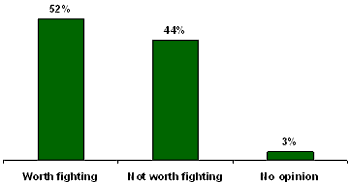
The recent data supporting this conclusion have been reviewed in detail by Gallup Poll Editor David Moore (see "On First Anniversary, Americans Divided on Impact of Iraq War" in Related Items). A majority, 55%, of Americans think the situation in Iraq made military intervention there worth it, and 55% say that things there are going at least moderately well at this point in time. A March 6-8 NBC News/Wall Street Journal poll showed that 64% agree that the United States should have "taken military action to remove Saddam Hussein from power in Iraq," and a March 4-7 ABC News/Washington Post poll showed that even when asked in a way that did not mention Hussein, but mentioned the costs, 52% agree that the war has been worth fighting:
| All in all, considering the costs to the
United States versus the benefits to the United States, do you
think the war with Iraq was worth fighting, or not? ABC News/Washington Post Poll |
 |
| March 4-7, 2004 |
Levels of support for whether the war has been worth it have been somewhat volatile. The Gallup Poll measure of support was at 50% last September, rose to 65% in December, and dropped as low as 49% in late January and early February of this year.
Still, if the decision on going to war against Iraq was put to a referendum vote, it appears that it would pass at this point in time.
Democrats Have Strikingly Distinct Views on the War
At the same time, a review of poll data reinforces the degree to which Democrats (and Kerry voters) have strikingly different and distinct views on the war from the rest of Americans, particularly Republicans. Not only are Democrats strongly likely to oppose the war, but Democrats also are at least somewhat more likely than the rest of the population to indicate that the war will be an important issue in their votes for president. And, Democrats are highly likely to indicate that the one thing Bush has done to anger them has been the situation in Iraq.
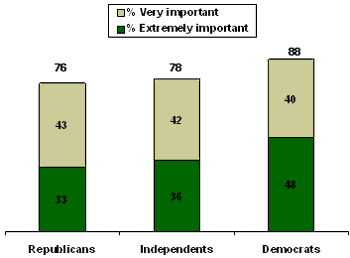
Democrats are 15 percentage points more likely than Republicans to indicate that the situation in Iraq will be extremely important in their votes for president this year:
| How Important Will the Candidates’
Positions on "The Situation in Iraq" Be in Influencing Your Vote for President? |
 |
| Feb. 6-8, 2004 |
There is, of course, little doubt about the specific candidate position they are looking for in reference to the Iraq war. Democrats strongly oppose the war and therefore it is clear that this is a driving force in their support for the Democratic nominee.
This breakout of the "worth it" question from the March 5-7 CNN/USA Today/Gallup poll shows how diametrically opposed Bush and Kerry voters are on the issue:
| All in All, Do You Think It Was Worth Going to War in Iraq, or Not? |
 |
| March 5-7, 2004 |
Almost identical results come from an analysis of three groups of Americans by their self-reported usual voting patterns:
|
All in All, Do You Think It Was Worth Going to
War in Iraq, or Not? |
|||
|
Those who |
Those who |
Those who |
|
|
% |
% |
% |
|
|
Worth going to war in Iraq? |
|||
|
Yes |
87 |
56 |
26 |
|
No |
12 |
39 |
72 |
|
No opinion |
1 |
5 |
2 |
The March 5-7 CNN/USA Today/Gallup poll included a question that asked Americans if Bush had done anything that "made you angry since he became president." Fifty-three percent of all Americans and 77% of Democrats said yes.
Of those Democrats who answered affirmatively to this question, 45% spontaneously said that it is the Iraq war that has angered them, far more than mentioned any other specific action the president has taken.
Implications
It is clear that the Iraq war is an issue that resonates strongly with the base Democratic vote. Hard-core Democrats and those who indicate that they will vote for Kerry are more likely to believe that the war is an issue of importance in their votes this fall, and strongly oppose it.
This provides Kerry with some distinct advantages. As evidenced by Dean's success in early Democratic nominee preference polls, fervent opposition to the war in Iraq may help Kerry maintain the fervent support of his base, and ensure maximum Democratic turnout in the fall election. Indeed, Gallup Poll analysis so far shows that Democrats are more interested in the election than are Republicans, and thus appear likely to vote in greater numbers.
But winning in November is going to require Kerry to reach out to more voters in the middle, and so far, as has been seen, this group is fairly split on its position on the war. Independents and those who usually split their votes are neither strongly likely to be opposed to the war, nor strongly in favor of it.
Along these lines, a Gallup analysis of the views of the war in the 16 states that are considered the important "battleground" states in the coming election shows that Bush maintains an edge on the war issue. Indeed, sentiment on the war varies little on a relative basis among these three groupings of states:
|
All in All, Do You Think It Was Worth Going to
War in Iraq, or Not? |
|||
|
Yes, |
No, |
No |
|
|
% |
% |
% |
|
|
"Red" states (Bush won by more than five points in 2000) |
57 |
41 |
2 |
|
"Blue" states (Gore won by more than five points in 2000) |
52 |
44 |
4 |
|
"Battleground" states (margin was within five points in 2000) |
55 |
43 |
2 |
It is reasonable to assume that Kerry is aware of these realities of life. His position on Iraq is not as strongly negative as was Dean's or the more liberal Democratic candidate Dennis Kucinich, and his focus has been proposals for dealing with the Iraq situation from this point forward.
Kerry may be on stronger ground with this emphasis on the future in his attempt to use the Iraq issue to his advantage. No matter what their position is on the rightness or wrongness of the war in general, Americans appear to be worried about what the future bodes for Iraq, given what the United States and its allies have done there so far. Forty-eight percent of Americans in the March 5-7 Gallup Poll indicate that they believe the situation in Iraq will devolve to chaos once the Americans leave, and a recent Pew Research Center poll of Americans found that 83% say that it will take longer than the next 12 months for a stable government to be established in Iraq.
It is interesting to note that this same Pew poll showed that a slight plurality of 46% of Americans believe that the United Nations would do the best job at "helping the Iraqi people form a stable government," as opposed to the 42% who say that the United States and its allies would do the best job -- a position somewhat close to that taken by Kerry.
Survey Methods
These results are based on telephone interviews with a randomly selected national sample of 1,005 adults, aged 18 and older, conducted March 5-7, 2004. For results based on this sample, one can say with 95% confidence that the maximum error attributable to sampling and other random effects is ±3 percentage points. In addition to sampling error, question wording and practical difficulties in conducting surveys can introduce error or bias into the findings of public opinion polls.