Now that Massachusetts Sen. John Kerry has all but sewn up the Democratic Party's presidential nomination, much attention is being paid to his campaign's search for a running mate. While the media have speculated about a variety of candidates, North Carolina senator and former Democratic presidential candidate John Edwards is most commonly mentioned, according to results from a March 5-7 Gallup Poll*.
Americans were asked if there is any Democrat they would like to see Kerry choose as a running mate. Those who said "yes" were asked to name the person they have in mind. Twenty-three percent of Americans named Edwards, far outnumbering any other potential running mate. Among Democrats and Democratic leaners, 30% named Edwards. New York Sen. Hillary Clinton was mentioned by 4%, followed by two of Kerry's other primary opponents -- retired Gen. Wesley Clark (3%) and former Vermont Gov. Howard Dean (3%). Former Vice President Al Gore was also named by 3% of Democrats and Democratic leaners.
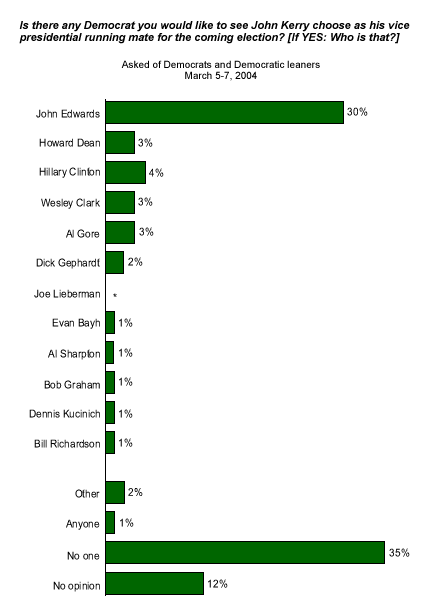
At this point, Americans are apt to name the people with whom they are most familiar, and with the focus on the primaries for the earlier part of the year, Edwards' name was probably most accessible in respondents' minds when they answered this open-ended question.
Most of the speculation about Kerry's possible running mate involves the political capital that each person would bring to the table. The ability to help deliver battleground states in the South and Midwest, or a key voting bloc such as the country's Hispanic population, are factors being considered by the Kerry camp. Many of the people that Kerry may be considering simply are not well known to the public yet.
*These results are based on telephone interviews with a randomly selected national sample of 1,005 adults, aged 18 and older, conducted March 5-7, 2004. For results based on this sample, one can say with 95% confidence that the maximum error attributable to sampling and other random effects is ±3 percentage points. In addition to sampling error, question wording and practical difficulties in conducting surveys can introduce error or bias into the findings of public opinion polls.
Results are based on telephone interviews with 545 Democrats and Democratic leaners, aged 18 and older, conducted March 5-7, 2004. For results based on the total sample of national adults, one can say with 95% confidence that the margin of sampling error is ±5 percentage points.