Several measures of consumer confidence, from Gallup Poll economic measures to the latest readings from The Conference Board, indicate that consumer confidence is declining. In mid-March, fewer Americans told Gallup that they thought economic conditions in the United States were getting better than had said so just the month before. The February 2004 reading of The Conference Board's Consumer Confidence Index registered a decline of more than 9 points to 87.3, and the Expectations Index registered a decline of 11 points to 96.8.
These numbers confirm that Americans are less upbeat about America's short-term economic future than they were just a few weeks ago. At a time when economic uncertainties abound and consumers are becoming more pessimistic about economic prospects, additional opinion research from the latest Gallup Poll provides some interesting insights into where Americans currently see several dimensions of the economy headed.
Stock Market: A Decline in Sentiment
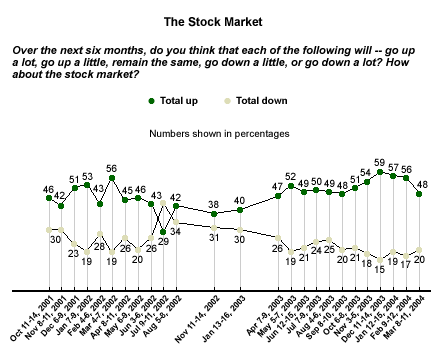
According to a March 8-11 Gallup Poll*, positive sentiment among Americans regarding prospects for the stock market experienced a significant decline, compared with last month. The eight-point decrease in the percentage of Americans expecting the stock market to go up in the near future is the largest decline in 15 months, since a drop of 14 points from June to July 2002. Optimism about the stock market reached a record high in December 2003, when 59% of Americans were of the opinion that the stock market would increase in the next six months. In February, 56% of Americans believed so -- but barely a month later, only 48% share the same enthusiasm.
Inflation, Interest Rates, and Economic Growth
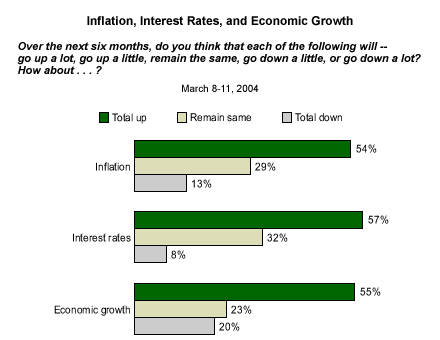
The Federal Reserve Board remains committed to patience in its monetary policy, and weak job growth seems to ensure that interest rates are not headed north any time soon. Americans' predictions about interest rates have not showed any decisive change since the beginning of the year. Fifty-seven percent of Americans say that interest rates will increase in the next six months, about a third of Americans (32%) believe that interest rates will remain the same, and 8% believe rates will go down a little or a lot. Since October, the percentage of Americans expecting interest rates to increase has been in the mid-50s.
Opinions on the inflation rate have also held fairly steady since last August. Currently, slightly more than half of Americans, 54%, expect inflation to move upward in the next six months, 29% expect it to remain the same, and 13% believe it will come down in the next six months.
Unlike opinion on interest rates and inflation, public opinion on prospects for economic growth has shifted substantially downward since the last quarter of 2003. In December 2003, 65% of Americans said that they expected the economy to grow in the next six months; that number has since fallen to 55%.
Bottom Line
As the data seem to point out, consumers are less confident in prospects for the economy. If Americans' views on the stock market valuation and economic growth are cause for concern, their outlook on job growth is not comforting either. With the Bureau of Labor Statistics' payroll numbers refusing to increase in line with expectations, and the media frenzy about outsourcing only heightening, it is not surprising then that 40% of Americans believe unemployment will increase in the next six months, up from 36% in February.
*Results are based on telephone interviews with 1,005 national adults, aged 18 and older, conducted March 8-11, 2004. For results based on the total sample of national adults, one can say with 95% confidence that the margin of sampling error is ±3 percentage points.
For results based on the 479 national adults in the Form A half-sample and 526 national adults in the Form B half-sample, the maximum margins of sampling error are ±5 percentage points.
In addition to sampling error, question wording and practical difficulties in conducting surveys can introduce error or bias into the findings of public opinion polls.