The 2004 presidential election campaign is shaping up to be one of the most memorable in years. Even with the election seven months away, Gallup finds public interest in the contest extremely high, much higher than at comparable times in the past. This heightened interest was evident even before the Democratic primary season and before the recent Bush campaign ad blitz, and has only increased since those events. In fact, the levels of interest Gallup has measured in the first few months of 2004 were not found until after Labor Day in prior election years. In addition to the heightened interest, most Americans say they are more enthusiastic about voting this year compared with previous elections.
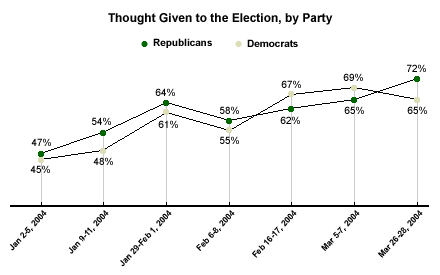
Gallup measures election year interest by asking Americans "how much thought" they have given "to the upcoming election for president -- quite a lot, or only a little." In the March 26-28 CNN/USA Today/Gallup poll*, 64% of Americans say they have given "quite a lot" of thought to the presidential election. At least 60% of Americans have given this amount of thought since mid-February. The level of interest has grown from 45% at the start of the year.
To put these figures into perspective, in late March/early April 2000, just 42% of Americans said they had given quite a lot of thought to the election. In 2000, this "thought" measure didn't surpass the 50% mark until after the Democratic convention in mid-August.

Gallup did not consistently measure election interest in the earlier part of election years until 2000. However, the available data show having more than 6 in 10 Americans paying attention to the election this early in a presidential campaign appears to be unprecedented.
Percentage Giving High Levels of Thought to Election, Early Stages of Campaign, Available Years
|
Date |
Percentage giving a lot of |
|
% |
|
|
May 1976 |
42 |
|
June 1960 |
41 |
|
March 1956 |
42 |
|
March 1952 |
50 |
|
March 1948 |
41 |
The current level of thought even rivals the measures obtained much closer to Election Day in previous years. For example, the final Gallup pre-election poll in 1996 found 64% of Americans had given "quite a lot" of thought to the election. In the final 2000 pre-election poll, it was slightly higher, at 68%.
Partisan Differences
Republicans (72%) at this point are more likely to say they have given quite a lot of thought to the election than Democrats are (65%). That is the typical pattern, because attention to politics is positively related to one's socioeconomic status (as defined by education and income), and Republicans are more likely than Democrats to come from a higher socioeconomic background.
However, 2004 deviates from the past in one other way -- during the earlier part of this year, Democrats actually were giving more thought to the election than Republicans were. For example, a Feb. 16-17 poll showed 67% of Democrats paying attention to the election, compared with 62% of Republicans and independents who lean Republican.
This was likely a result of the intense media attention focused on the Democratic presidential primaries, which only increased after John Kerry's unexpected victory in the Iowa caucuses. But as the most recent poll shows, the normal Republican advantage in election thought has apparently been restored.
Voters Enthusiastic
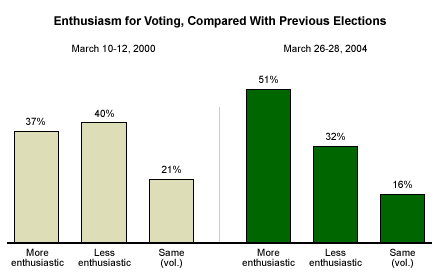
Voter enthusiasm for the election so far this year is also at the highest level Gallup has measured across three elections (although this question is asked less frequently than the thought question). Fifty-one percent of Americans say they are more enthusiastic about voting than usual, while 32% are less enthusiastic, and 16% volunteer they are as enthusiastic as usual. In March 2000, 37% were more enthusiastic, 40% were less, and 21% were the same (those are essentially the same results found in a poll of registered voters taken in October 2000).
In October 1996, using a slightly different question that made the "about the same" option explicit, only 20% of registered voters said they were more enthusiastic about voting than usual, 31% were less so, and 47% were about the same. Democrats were more enthusiastic in that election (26%) than Republicans (20%) were.
Currently, Republicans (including independents who lean toward the Republican Party, 52%) and Democrats (including independents who lean toward the Democratic Party, 51%) are about equally enthusiastic about voting. This is a bit of a change from earlier this year, similar to what has been observed with election thought. The last time the enthusiasm question was asked -- in a Jan. 29-Feb. 1 CNN/USA Today/Gallup poll -- Democrats were slightly more likely to express greater enthusiasm than Republicans were, by a 59% to 53% margin. Throughout the 2000 election, Republicans were much more likely to express enthusiasm than Democrats were.
Implications
As one would expect, interest in the election generally increases as Election Day gets nearer. It remains to be seen whether election interest will continue to increase this election year, or whether the attentive public has just been activated earlier than is usually the case in election years. Increased public interest is usually predictive of higher voter turnout. In most recent elections, voter turnout has only been about 50% of the voting age population. However, given the high level of interest in the campaign, this year's election may very well exceed the post-26th Amendment (which granted 18-year-olds the right to vote) high turnout rates of 55% in 1972 and 1992.
*Results are based on telephone interviews with a randomly selected national sample of 1,001 adults, aged 18 and older, conducted March 26-28, 2004. For results based on this sample, one can say with 95% confidence that the maximum margin of sampling error is ±3 percentage points.