GALLUP NEWS SERVICE
PRINCETON, NJ -- Consumer confidence edged upward in early April according to the latest Gallup Poll, conducted April 5-8. Consumers' ratings of current economic conditions are slightly better than March's ratings. More consumers also say economic conditions are getting better this month than say they are getting worse -- the reverse of what was true in March.
Although consumer perceptions of the overall economy showed a modest improvement in April, it doesn't look as though this will translate into increased spending in the short term. In April, consumer spending intentions declined from their record level in March. A key question for the economy as we look toward the second half of this year is whether the record March spending intentions were a tax-cut-induced aberration or an indication of better things yet to come in the way of consumer spending.
Consumers Give Slightly Better Ratings to Current Conditions
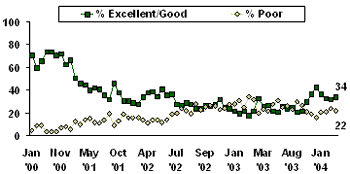
More consumers rate current economic conditions as "good" or "excellent" (34%) now than did so in March (32%), while fewer rate them as "poor" (22% now versus 24% in March). As a result, the difference between the good/excellent ratings and the poor ratings has increased from 8 percentage points in March to 12 percentage points in April.
Consumer perceptions of current economic conditions are now about where they were in February -- which also had a 12 percentage-point difference -- but are far below where they were at the beginning of the year (a 27 percentage-point difference).
| Current Economic Conditions |
 |
Consumer Optimism About Economic Direction Also Improves a Little
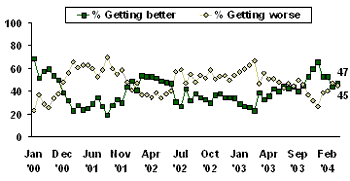
In April, the percentage of consumers saying economic conditions are getting better (47%) outnumbered the percentage saying they are getting worse (45%). This is a reversal of the situation in March, when more consumers said things were getting worse (47%) than said they were getting better (44%). Still, in both months' polls, consumers were essentially evenly split on the direction of the U.S. economy.
This stands in sharp contrast to early January, when two out of three consumers said economic conditions were getting better and only 27% said they were getting worse.
| Economic Outlook |
 |
Consumer Spending Intentions Moderate
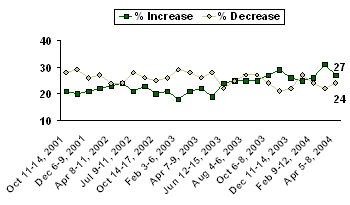
In March, consumer spending intentions hit their highest level since Gallup began tracking them in October 2001. The difference between those planning to increase their spending (31%) over the next six months and those planning to decrease their spending (22%) reached nine percentage points. This stands in sharp contrast to most other months during the past two and a half years.
In April, the difference in consumer spending intentions declined to three percentage points -- still a relatively good number, but substantially below the March record.
| Americans' Spending Intentions, Next Six Months |
 |
The Outlook for Consumer Spending
As expected, the tax cuts created larger than normal tax refunds, and in turn, this appears to have had a positive impact on consumer spending. So have today's extremely low interest rates. Add in the federal government's deficit spending, and it is not hard to see why the economy is growing.
If the strong consumer spending intentions of March can be maintained in the second half of the year, it might be possible for the economy to start creating a significant number of new jobs. On the other hand, it is far from clear that these strong numbers will be maintained in the months ahead.
Unfortunately, the tax cuts were a short-term consumer spending stimulus. Worse yet, surging gas prices are taking away from consumers much of what they gained by way of the tax cuts.
Forty-seven percent of U.S. households say that recent increases in gas prices have caused them personal financial hardship, and 58% say they expect this summer's gas prices to do so. Given these assessments, the prospects for increased discretionary consumer spending during the months ahead are not good. As a result, the March record in consumer spending intentions may well turn out to be more of an aberration than an indication of better things to come.
Survey Methods
Results are based on telephone interviews with 1,014 national adults, aged 18 and older, conducted April 5-8, 2004. For results based on this sample, one can say with 95% confidence that the margin of sampling error is ± 3 percentage points. In addition to sampling error, question wording and practical difficulties in conducting surveys can introduce error or bias into the findings of public opinion polls.