One of the myths of public opinion polls is that they simply measure what people are thinking. The truth is, of course, the very act of measuring opinion can also influence what people think. That phenomenon occurs not only in polls, but in actual elections.
In a recent study of California voting over the period from 1975-2002, researchers found that the order in which candidates' names were listed on the ballot had a significant impact on the results. In general election contests in California, ballot order affected only minor party candidates, although in party primary elections, all candidates benefited from being listed first. The authors thus recommended that "all electoral jurisdictions randomize ballot order to minimize ballot effects."
Gallup routinely rotates the names of the presidential candidates in its polls of the American electorate. Given the findings of the authors noted above, that ballot order affects only minor party candidates, one might expect to find little difference in Gallup's results from rotating the names. And generally that has been the case, with one notable exception.
In nine CNN/USA Today/Gallup surveys conducted from September 2003 to April 2004, respondents were asked their presidential preference between President George W. Bush and Massachusetts Sen. John Kerry. In each poll, half the sample was asked about Kerry and then Bush, while in the other half of the sample, the names were read in reverse order.
If Massachusetts Senator John Kerry were the Democratic Party's candidate and George W. Bush were the Republican Party's candidate, who would you be more likely to vote for – [FORM A: John Kerry, the Democrat (or) George W. Bush, the Republican; FORM B: George W. Bush, the Republican, or John Kerry, the Democrat]?
Overall, Kerry led Bush among likely voters in that March 5-7 poll by 52% to 44% -- an 8-point lead that was somewhat smaller than the 12-point lead Kerry enjoyed in the previous poll, conducted Feb. 16-17. While the name rotation produced essentially identical results in the February poll, the rotation in the March poll showed each candidate faring much better in the contest when his name was mentioned first rather than second.
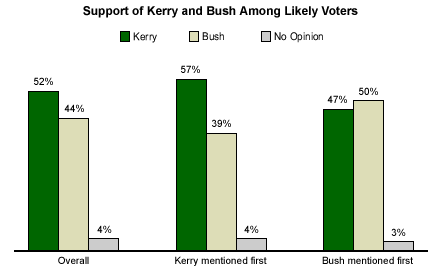
Kerry led by an 18-point margin, 57% to 39%, when his name was read first. When Bush's name was read first, Bush led by a 3-point margin, 50% to 47% -- a net swing of 21 points.
The same pattern was found when consumer advocate Ralph Nader's name was included in the ballot. The question with Nader was asked after the question that included only Kerry and Bush. Also, Nader's name was not rotated -- it was mentioned third in both versions, after the other two candidates' names.
Now suppose Ralph Nader runs as an independent candidate, who would you be most likely to vote for-- [FORM A: John Kerry, the Democrat; George W. Bush, the Republican, or Ralph Nader, the independent; FORM B: George W. Bush, the Republican; John Kerry, the Democrat; or Ralph Nader, the independent]?
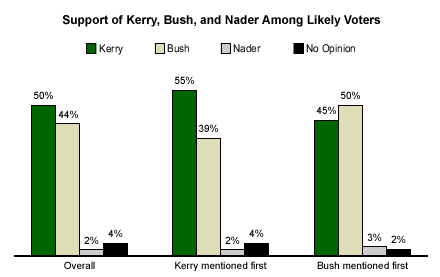
Overall, Nader received between 2% and 3% of the vote when each version of the question was asked. But as with the two-candidate question, Kerry and Bush each received more support when their names were read first rather than second. And the net swing in support was identical.
Kerry led by 16 points when his name was mentioned first (55% to 39%), but Bush led by 5 points when his name was mentioned first (50% to 45%) -- a net swing of 21 points. The major difference between the two-candidate question and the three-candidate question is that Kerry fared slightly worse against Bush when Nader was included in the ballot than when Nader was not included.
The rotation effects found among likely voters are essentially the same as the effects found among the larger group of registered voters, and the even larger group of all adults.
Implications
It is not at all clear why the rotation of names produced significant differences in just the one poll. I suspect the differences were caused by an interaction between the question rotation effect and the actual political environment.
What was that environment? The poll was conducted March 5-7, the weekend after Super Tuesday, when Democratic voters went to the polls in California, New York, Georgia, Maryland, Minnesota, Ohio, Massachusetts, Rhode Island, and Vermont -- and gave Kerry an overwhelming victory, essentially ensuring his nomination. It could be that Kerry's heightened visibility or success somehow affected the way respondents reacted to the ballot question, though I have no detailed theory that would explain this connection.
In actual election polls, ballot order can sometimes affect the results. Ideally, the poll question would mirror the ballot order in the actual election, but in practice that is difficult to accomplish. Some states, such as California, rotate names, while other states list the incumbent first, followed in alphabetical order by the other names of candidates running for that office. Other states have even different rules for ballot order.
By this November, I expect that ballot order for this race will not have much effect -- either in polls or in the actual election. But between now and then, to minimize the potential effects that ballot order can have in our polls, Gallup will continue to rotate the names. This approach assumes that the results of the rotated questions provide a more valid picture of what the public is thinking at any given time than the results based on listing just one candidate first. Of course, there is no way to prove that this assumption is either correct or false.