GALLUP NEWS SERVICE
PRINCETON, NJ -- Over the past couple of months, the situation in Iraq has deteriorated significantly -- particularly in light of the prisoner abuse scandal and the planned transfer of power at the end of June. War-related difficulties have certainly had a negative impact on the U.S. investment climate. As a result, it is not surprising that more investors now say Iraq is hurting the investment climate "a lot" than said so just two months ago, according to the May UBS/Gallup Index of Investor Optimism survey. Nor is it unexpected that the Index of Investor Optimism remained essentially unchanged in May following three straight months of decline.
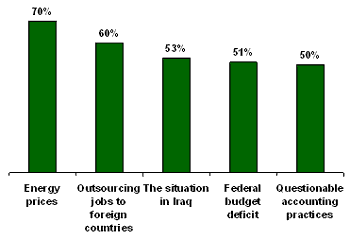
That Iraq is not at the top of the list of investor worries this month, however, is somewhat surprising. In May, as was the case in March, more investors point to both the surge in energy prices and the outsourcing of jobs to foreign countries than single out Iraq as hurting the investment climate "a lot." In fact, the situation in Iraq is in a virtual tie for third among investor worries, along with the federal budget deficit and questionable accounting practices.
Factors Hurting the Investment Climate a Lot
Seventy percent of investors say that the price of energy (including gas and oil) is hurting the current investment climate "a lot." Another 21% say the price is hurting the investment climate "a little." Similarly, 60% say the outsourcing of jobs to foreign countries is hurting the investment climate a lot, while another 20% say "a little."
Concerns about the situation in Iraq are next, with 53% of investors saying this is hurting the investment climate "a lot." At essentially the same level are investor concerns about the federal budget deficit (51%) and questionable accounting practices in business (50%).
| Situations Hurting the U.S. Investment
Climate % saying "hurting it a lot" |
 |
| May 1-16, 2004 |
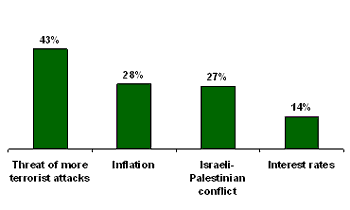
Forty-three percent of investors say the threat of more terrorist attacks is hurting the investment climate a lot. This is followed by investor worries about inflation (28%) and the Israeli-Palestinian conflict (27%). Only 14% of investors point to interest rates as hurting the investment climate a lot in May.
| Situations Hurting the U.S. Investment
Climate % saying "hurting it a lot" |
 |
| May 1-16, 2004 |
Investor Optimism Is Unchanged
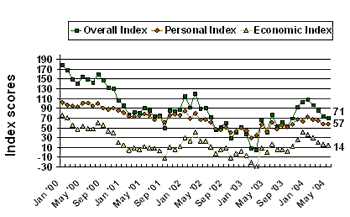
The Index of Investor Optimism remained essentially unchanged in May, at 71 -- compared to 73 in April -- ending three consecutive months of decline. The Index has fallen 37 points since January and currently stands at its lowest level since last October (69). Investor optimism continues to be higher than it was a year ago (42).
The Personal Dimension remained unchanged at 57 in May, and is currently somewhat higher than it was a year ago (42). The Economic Dimension declined 2 points to 14, compared to 0 a year ago.
| Index of Investor Optimism -- U.S. January 2000 -- May 2004 |
 |
Should We Worry About an Iraq War Malaise?
Although there appears to be a clear consensus among economists and Wall Street practitioners that the U.S. economy remains strong and will continue expanding at a good pace, investors appear to share the somewhat less optimistic view held by many consumers. One possible explanation is that investor concerns about the way things are going in Iraq have placed a pall over the U.S. investment climate. As a result, investors are not only less optimistic about the current international situation but also about virtually everything else, including the domestic economy.
In essence, investors may be so emotionally affected by the turn of events in Iraq that they are ignoring the good things happening in the domestic economy. The fact that the number of investors saying the situation in Iraq is hurting the investment climate "a lot" increased from 41% in March to 53% in May lends some support to this idea.
Or, Should We Worry About a Wage-Price Squeeze?
A more plausible explanation, however, might simply lie in the unusual nature of the current economic expansion. Although job growth seems to have improved during the past couple of months, we are still experiencing one of the slowest job-growth expansions in history. This has combined with the outsourcing of jobs to foreign countries to produce a great deal of job insecurity for the average working family. In turn, this overall insecurity in the labor market has led to a compression of middle-class wages.
Now, we have an externally generated surge in energy prices and inflation that is creating significant financial hardship for many Americans. For example, 43% of investors say that the surge in gasoline prices has created financial hardship for their households. And, three in four of those experiencing such financial hardship say it is either moderate or severe.
Whether the overall economy is doing well or not, many Americans are experiencing a severe wage-price squeeze. As a result, it is not surprising that they are much less optimistic about the economy and the investment climate than many of their financially better-off counterparts. While Iraq may continue to dominate the headlines in the months ahead, it could be this wage-price squeeze that turns out to be the most important story as the presidential election approaches later this year.
Survey Methods
Results for the Index of Investor Optimism -- U.S. are based on telephone interviews with a randomly selected U.S. sample of 806 adult investors, aged 18 and older, with at least $10,000 of investable assets, conducted May 1-16, 2004. For results based on this sample, one can say with 95% confidence that the maximum error attributable to sampling and other random effects is ±4 percentage points. In addition to sampling error, question wording and practical difficulties in conducting surveys can introduce error or bias into the findings of public opinion polls.
