GALLUP NEWS SERVICE
PRINCETON, NJ -- It doesn't appear that former president Bill
Clinton will be creating many new fans with his newly published
memoir, "My Life,"at least not directly. A June 21-23
CNN/USA Today/Gallup poll, conducted just as the 957-page
tome was arriving at bookstores, suggests that most readers of the
book will be the same Americans who have traditionally supported
Clinton. Public opinion of Clinton remains polarized, as on a
variety of measures Americans are closely split in their views of
him. The majority of Americans say they have gotten over the Monica
Lewinsky scandal, but about a third continue to say that the
president's extramarital involvement with the former White House
intern bothers them.
Interest in Reading "My Life"
Overall, interest in reading Clinton's new book is mixed. About a third of Americans say they will definitely or probably read the book, while the rest say they definitely or probably will not read it.

There are sharp differences among subgroups in interest in reading the book. Here is a list of subgroups in the American population, rank ordered by the percentage saying they are definitely or probably going to read the book:
|
Interest in Reading Clinton's
Book |
|
|
|
|
|
|
Definitely or Probably Read "My Life" |
|
|
% |
|
|
|
|
Democrats |
48 |
|
Non-whites |
46 |
|
Adults who disapprove of Bush |
45 |
|
18- to 29-year-olds |
40 |
|
Income of $30,000-$49,999 per year |
37 |
|
Liberals |
37 |
|
Moderates |
36 |
|
Easterners |
35 |
|
Adults living in urban areas |
34 |
|
Income of $20,000-$29,999 per year |
34 |
|
Adults aged 65 and older |
33 |
|
Westerners |
32 |
|
High school education or less |
32 |
|
Women aged 18 to 49 |
32 |
|
Women aged 50 and older |
32 |
|
Women |
31 |
|
Some college education |
31 |
|
Income of $50,000-$74,999 per year |
31 |
|
Sample average |
30 |
|
Adults living in suburban areas |
30 |
|
Independents |
29 |
|
Men |
28 |
|
Midwesterners |
28 |
|
Men aged 18 to 49 |
28 |
|
Men aged 50 and older |
28 |
|
50- to 64-year-olds |
27 |
|
Southerners |
27 |
|
Income of less than $20,000 per year |
27 |
|
30- to 49-year-olds |
26 |
|
Postgraduate education |
26 |
|
Whites |
25 |
|
Adults living in rural areas |
24 |
|
College graduates |
24 |
|
Income of $75,000 per year or more |
22 |
|
Conservatives |
20 |
|
Adults who approve of Bush |
16 |
|
Republicans |
13 |
As can be seen, Americans most likely to profess interest in
reading the book are Democrats, racial or ethnic minorities, and
those who disapprove of the job being done by George W. Bush as
president. Those least likely to read the book include Republicans
and current Bush supporters.
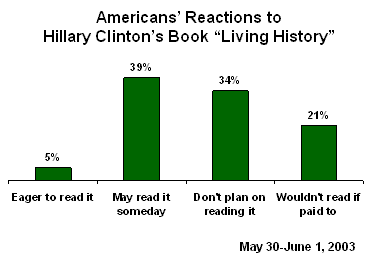
The sales of "My Life" have already been compared to sales of Hillary Clinton's book "Living History," which has sold more than 1.5 million copies to date. A late May/early June 2003 CNN/USA Today/Gallup poll found that 44% of Americans were either eager to read Hillary Clinton's book, or said that they might read it some day. Thirty-four percent said they didn't plan on reading it, and 21% said they wouldn't read it if they were paid to.
While not directly comparable to the current measure of interest in Bill Clinton's memoir, a crude comparison suggests there may have been greater initial interest in Hillary Clinton's memoir, as 44% were eager or planning to read her book as opposed to only 30% now planning to read her husband's book.
Truthful?
History shows that public figures use the publication of their memoirs to tell the story of their lives in the most advantageous way possible (General Douglas MacArthur's autobiography Reminiscences, for example, included footnoted copies of every laudatory letter, award, or telegram the general had ever received). Presumably, many observers conclude that autobiographies and memoirs aren't so much history as the writer's own attempt to tell his or her side of the story.
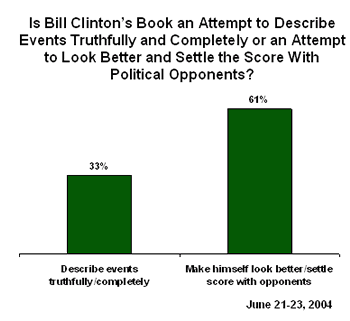
It is perhaps not surprising, then, that the majority of Americans believe that Clinton's book is "an attempt to make himself look better and settle some scores with his political opponents," while just a third say that the book is "an attempt to completely and truthfully describe the events of his life as they happened."
Clinton's Image Today
Clinton continues to have a highly polarized image with the American public, just as he did while he was president. In January 2001, just as Clinton was about to leave office, The Gallup Poll asked Americans if they were "glad he is leaving" or if they would "miss him when he is gone." The responses were roughly even, with half of Americans glad he was leaving, and 45% saying they would miss him when he was gone.
By February 2001, as Clinton was suffering from negative
publicity of his last-minute presidential pardons, the percentage
saying they would miss him fell to 38%.
Now, over three years later, attitudes about Clinton are roughly
back where they were in the beginning of January 2001:

Clinton's favorable rating today is 53%, while 44% have an unfavorable rating of the former president. (Interestingly, this image is almost identical to George W. Bush's at this point).
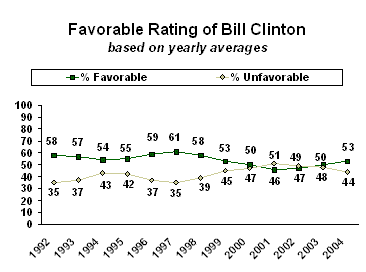
Clinton's image has changed significantly over the years since he became president. The low point for Clinton came in March 2001, when only 39% of Americans said they had a favorable opinion and 59% had an unfavorable opinion of him. The highest favorable rating Clinton received was 66% in January 1993, just as he was taking office, although he had favorable ratings in the 60% to 65% range at several other points in his administration.
What of Monica Today?
One of the major sources of interest in both Hillary Clinton's and Bill Clinton's autobiographies was curiosity over how each would handle the issue of the Monica Lewinsky scandal that threatened to bring down not only the Clinton presidency, but also the Clinton marriage.
The national debate over the Lewinsky sexual scandal occupied the nation during 1998 and early 1999. Many Republicans and conservatives were deeply bothered by the affair (and Clinton's subsequent attempts at covering it up). Democrats and other Clinton supporters indicated that they were not so bothered by what they considered to be a personal issue, albeit it a moral failing.
As is true with many other issues relating to Clinton, current public opinion about the Lewinsky crisis remains sharply divided. Forty-six percent of Americans claim that the Lewinsky controversy never really bothered them, while 24% say they were bothered at the time, but are no longer. That leaves just 30% who are still bothered by it today:
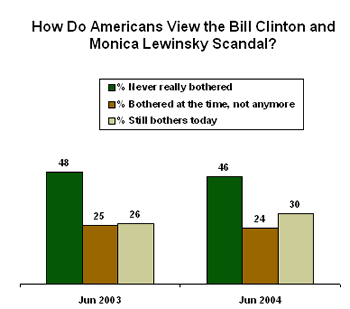
Not surprisingly, those most likely to say they are still bothered by the Lewinsky scandal include conservatives, Republicans, and older Americans.
Survey Methods
These results are based on telephone interviews with a randomly selected national sample of 1,005 adults, aged 18 and older, conducted June 21-23, 2004. For results based on this sample, one can say with 95% confidence that the maximum error attributable to sampling and other random effects is ±3 percentage points. In addition to sampling error, question wording and practical difficulties in conducting surveys can introduce error or bias into the findings of public opinion polls.