Investors make buy-and-sell decisions based on any number of factors, from their own personal financial situations, to unemployment numbers, to changes in interest rates. But while investment literature tends to focus on the business realm, the financial markets are not immune to the larger issues of the day.
The current presidential election is a case in point. Recent Gallup Polls show that Americans are largely divided on who they believe is best suited to be the next president. The same is true when investors are asked which outcome of the presidential election would be best for the market.
As part of the UBS/Gallup Index of Investor Optimism survey*, Gallup asked investors how they think the two likely outcomes of the presidential election -- a Bush win or a Kerry win -- might affect the investment climate. Respondents were given five choices:
- a Bush win will be very positive
- a Bush win will be somewhat positive
- it doesn't matter who wins
- a Kerry win will be somewhat positive
- a Kerry win will be very positive
A plurality of investors, 41%, believe that a Bush win would be "very" or "somewhat" positive for the investment climate, while a sizable percentage -- 36% -- feel that a Kerry win would be very or somewhat positive. Only about one in five investors (21%) think that the outcome won't affect the investment climate.
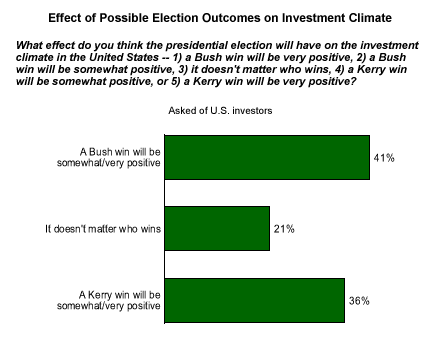
Given that the survey's margin of error is ±4 percentage points, the difference between evaluations of each candidate doesn't indicate that investors are sold on who would be better for the market. But investors' perceptions here -- which likely parallel their partisan leanings -- show a strong relationship to their economic optimism. Those who think a Bush win would be positive are more optimistic about their personal investment situations and the overall economic situation: the Index of Investor Optimism score for these investors is 184, compared with a -17 score among those who think a Kerry win would be positive.
Bottom Line
Partisanship is likely the most obvious explanation why those who feel a Bush win would be most beneficial are also the most optimistic about current economic prospects. Investors who think the economy is doing well naturally want to see the incumbent retained. Those who think the economy is performing poorly want new leadership. Of course, partisanship also influences current perceptions of the state of the economy -- as Republicans currently rate it much more positively than Democrats do.
*Results are based on telephone interviews with 804 investors, aged 18 and older, conducted in August 2004. There were 483 "average" investors and 321 "substantial" investors in the sample. For results based on the entire sample, one can say with 95% confidence that the margin of sampling error is ±4 percentage points. For results based on "average" investors, one can say with 95% confidence that the margin of sampling error is ±5 percentage points. For results based on "substantial" investors, one can say with 95% confidence that the margin of sampling error is ±7 percentage points.