GALLUP NEWS SERVICE
PRINCETON, NJ -- Vice President Dick Cheney grabs the spotlight at the Republican National Convention tonight to accept the party's nomination for a second term. In addition to officially beginning his quest for four more years as the second-highest-ranking officeholder in the United States, Cheney has an opportunity to boost his declining popularity. A new CNN/USA Today/Gallup poll finds Cheney's popularity ratings at a new low, with about as many Americans rating him unfavorably as favorably. Not surprisingly, views of Cheney are sharply partisan, with Republicans generally viewing him positively and Democrats negatively. The public is also divided as to whether Cheney has given President Bush good or bad advice over the last four years. Cheney has a lower favorability rating than Democratic vice presidential nominee John Edwards, and when the poll pits the two against each other in a hypothetical election for vice president, Edwards prevails.
Cheney Favorable Ratings
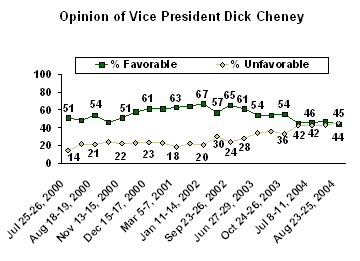
The poll, conducted Aug. 23-25, finds 44% of Americans with a favorable view and 45% with an unfavorable view of the vice president. This is the first time that Cheney does not have a higher favorable than unfavorable rating in a Gallup Poll. Until this year, Cheney's favorable ratings had always been above 50% since he took office in January 2001. The decline could be attributed to typically more partisan views of politicians in an election year, as well as some controversy about Cheney's role in the Bush administration.
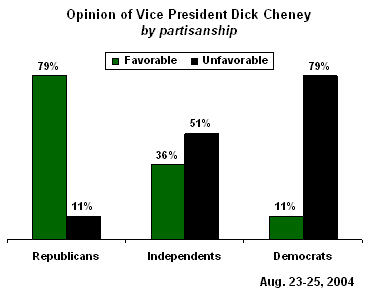
Views of Cheney are strongly influenced by partisan leanings. In fact, Republican and Democratic ratings of the vice president are precise mirror images of each other -- 79% of Republicans rate him favorably and 79% of Democrats rate him unfavorably. Independents are generally more negatively (51% unfavorable rating) than positively (36% favorable rating) disposed toward Cheney.
Since last fall, when a majority of Americans still held a favorable view of Cheney, Democrats and independents have both become more negative in their views of him, while Republicans have held steady. An Oct. 24-26, 2003, CNN/USA Today/Gallup poll found 82% of Republicans, 49% of independents, and 32% of Democrats giving Cheney a positive rating.
Cheney vs. Edwards
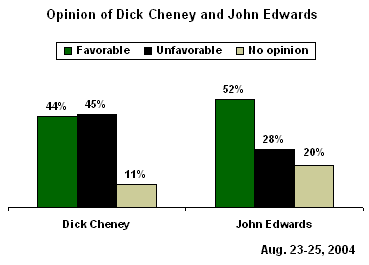
The public rates Edwards more favorably than Cheney -- 52% of Americans have a favorable opinion of the Democratic vice presidential candidate, slightly higher than Cheney's 44%. But Edwards' unfavorable rating of 28% is substantially lower than Cheney's 45%. Put differently, Edwards has a net favorable rating of +24, compared with Cheney's –1.
A hypothetical matchup between Cheney and Edwards for the vice presidency underscores Edwards' more positive image. Fifty-two percent of registered voters say they would choose Edwards if they could vote separately for vice president, while 42% would pick Cheney. Responses are predictably partisan -- as Democrats overwhelmingly support Edwards and Republicans Cheney -- with independents tilting more toward Edwards.
Cheney's Advice
Some have called Cheney the most influential vice president the nation has known. While that is a matter of debate, clearly he is a trusted adviser to Bush. But the public is divided as to whether Cheney has generally done more to help or to hurt the administration when he has given Bush advice. Forty-one percent of Americans say that Cheney has "generally given good advice that has helped the administration" while 39% believe he has "generally given bad advice that has created problems for the administration." About one in five Americans do not have an opinion on the matter. Like most views of Cheney, this one follows a partisan path -- most Republicans think Cheney has typically given good advice while most Democrats take the opposite view.
Survey Methods
These results are based on telephone interviews with randomly selected national samples of approximately 500 adults, aged 18 and older, conducted Aug. 23-25, 2004. For results based on these samples, one can say with 95% confidence that the maximum error attributable to sampling and other random effects is ±5 percentage points. In addition to sampling error, question wording and practical difficulties in conducting surveys can introduce error or bias into the findings of public opinion polls.
6. Next, we'd like to get your overall opinion of some people in the news. As I read each name, please say if you have a favorable or unfavorable opinion of these people -- or if you have never heard of them. First, ... How about ... ? [ITEMS A-B READ, HALF SAMPLE READ ITEMS C-F ROTATED, HALF SAMPLE READ ITEMS G-H ROTATED AND THEN ITEMS I-J ROTATED]
C. Dick Cheney
BASED ON -- 525 -- NATIONAL ADULTS IN FORM C
|
|
|
|
Never |
No |
|
|
% |
% |
% |
% |
|
2004 Aug 23-25 ^ |
44 |
45 |
2 |
9 |
|
|
|
|
|
|
|
2004 Jul 19-21 ^ |
47 |
43 |
2 |
8 |
|
2004 Jul 8-11 |
46 |
42 |
3 |
9 |
|
2004 Feb 16-17 |
45 |
42 |
3 |
10 |
|
2003 Oct 24-26 |
55 |
33 |
3 |
9 |
|
2003 Sep 19-21 |
54 |
36 |
3 |
7 |
|
2003 Jun 27-29 ^ |
54 |
34 |
3 |
9 |
|
2003 Jan 31-Feb 2 |
61 |
28 |
2 |
9 |
|
2002 Sep 23-26 |
65 |
24 |
4 |
7 |
|
2002 Jul 26-28 |
57 |
30 |
3 |
10 |
|
2002 Jan 11-14 |
67 |
20 |
3 |
10 |
|
2001 Apr 20-22 |
64 |
22 |
3 |
11 |
|
2001 Mar 5-7 |
63 |
18 |
5 |
14 |
|
2001 Jan 15-16 |
61 |
23 |
5 |
11 |
|
2000 Dec 15-17 |
61 |
23 |
6 |
10 |
|
2000 Dec 2-4 |
58 |
23 |
8 |
11 |
|
2000 Nov 13-15 |
51 |
22 |
9 |
18 |
|
2000 Nov 13-15 |
53 |
22 |
8 |
17 |
|
2000 Sep 15-17 |
46 |
24 |
8 |
22 |
|
2000 Aug 18-19 |
54 |
21 |
5 |
20 |
|
2000 Aug 4-5 |
48 |
21 |
9 |
22 |
|
2000 Jul 25-26 |
51 |
14 |
12 |
23 |
|
|
||||
|
^ Asked of a half sample. |
||||
D. John Edwards
BASED ON -- 525 -- NATIONAL ADULTS IN FORM C
|
|
|
|
Never |
No |
|
|
% |
% |
% |
% |
|
2004 Aug 23-25 ^ |
52 |
28 |
4 |
16 |
|
|
|
|
|
|
|
2004 Jul 30-Aug 1 |
59 |
27 |
3 |
11 |
|
2004 Jul 19-21 ^ |
52 |
26 |
5 |
17 |
|
2004 Jul 8-11 |
55 |
24 |
6 |
15 |
|
2004 Jan 29-Feb 1 |
54 |
21 |
10 |
15 |
|
2004 Jan 2-5 † |
24 |
24 |
27 |
25 |
|
2003 Nov 10-12 † |
22 |
18 |
37 |
23 |
|
|
|
|
|
|
|
† Wording: North Carolina Senator John Edwards |
||||
|
^ Asked of a half sample. |
||||
28. If you could vote separately for vice president, would you be more likely to vote for -- [ROTATED: John Edwards, the Democrat, (or) Dick Cheney, the Republican]?
BASED ON -- 460 -- REGISTERED VOTERS IN FORM A
BASED ON -- 524 -- NATIONAL ADULTS IN FORM A
|
|
|
|
NEITHER (vol.) |
OTHER |
No |
|
|
|
|
|
|
|
|
Registered Voters |
|
|
|
|
|
|
2004 Aug 23-25 |
52% |
42 |
2 |
* |
4 |
|
|
|
|
|
|
|
|
National Adults |
|
|
|
|
|
|
2004 Aug 23-25 |
51% |
41 |
2 |
1 |
5 |
|
(vol.) Volunteered response |
|||||
|
* Less than 0.5% |
|||||
29. Which comes closer to your view about the advice Vice President Dick Cheney has given to President George W. Bush over the past four years -- [ROTATED: Cheney has generally given good advice that has helped the administration, (or) Cheney has generally given bad advice that has created problems for the administration]?
BASED ON -- 480 -- NATIONAL ADULTS IN FORM B
|
|
Good advice |
Bad advice |
BOTH (vol.) |
No opinion |
|
|
|
|
|
|
|
2004 Aug 23-25 |
41% |
39 |
3 |
17 |
|
(vol.) Volunteered response |
||||