GALLUP NEWS SERVICE
PRINCETON, NJ -- The third and final presidential debate takes place tonight in Tempe, Arizona. While John Kerry has been perceived as the victor in the first two debates (although initial opinion after the second debate showed a tie), the third debate may play even more to Kerry's strengths given its exclusive focus on the economy and domestic issues. The latest CNN/USA Today/Gallup poll, conducted Oct. 9-10, shows Americans perceive Kerry as better able to handle the economy by a slight margin and better able to handle most domestic issues by larger margins. Indeed, the poll shows Americans expect Kerry to do better in the economic/domestic policy debate by a 54% to 36% margin over George W. Bush. However, many Americans doubt Kerry's second debate pledge not to raise federal income taxes on the middle class, and for the first time this year, Bush has an advantage over Kerry on the tax issue.
The Economy
When asked to choose which one among four issues is the most important to their vote, 28% of likely voters say the economy, putting it on par with terrorism (28%) and Iraq (25%), with fewer (16%) indicating healthcare is most important. The economy has been the first or second most frequently chosen issue among likely voters since July.
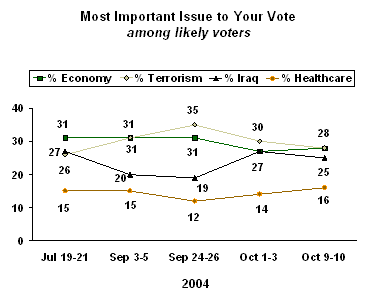
The economy tends to be an even greater relative concern among the general adult population. In the latest poll, 29% of all Americans say the economy is the most important issue, followed by terrorism (26%), Iraq (22%), and healthcare (21%).
Public assessments of the national economy at the present time are not very positive. Thirty-five percent describe conditions as excellent or good, 40% as fair, and 24% as poor. Those ratings are less positive than was the case in October 1996 (just before Bill Clinton won a second term), at which time 47% described the economy as excellent or good. The current economic ratings are, however, much more positive than in October 1992, just before Clinton defeated the elder George Bush in the latter's re-election attempt. That poll showed just 11% of Americans describing the economy as excellent or good, while 45% said it was fair and 43% said poor.
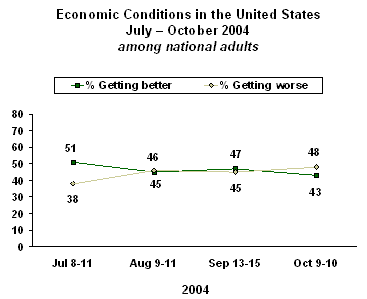
Perceptions of the economy's direction are more negative than positive -- 48% say it is getting worse and 43% better. That represents a slight downturn compared with the last two months, when the number saying the economy was getting better was about equal to the number saying it was getting worse, and is a further downturn from a net-positive assessment in July.
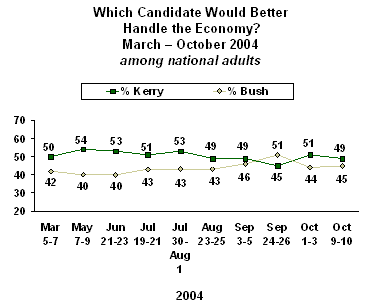
Kerry has typically had the perceptual advantage over Bush on the economy this year. The only exception to that came in a late September poll that also showed Bush with a statistically significant eight-point lead in vote intention over Kerry among likely voters. Currently, 49% of Americans say Kerry would better handle the economy, compared with 45% who say Bush. It should be pointed out that Kerry's current four-point advantage over Bush on this issue is slightly smaller than a seven-point advantage he had before the second debate.
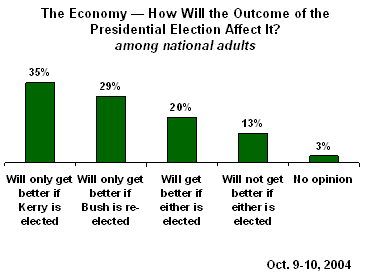
Kerry's advantage on the economy is supported further by data showing that 35% of Americans say the economy would get better only if Kerry is elected, while 29% say it would improve only if Bush is re-elected. The remaining 36% indicate that the outcome of the election would make no difference as to the health of the economy.
Taxes
The 2001, 2002, and 2003 tax cuts passed by Congress were the centerpiece of Bush's economic plan during his first term in office. In the second debate, Bush argued that the tax cuts helped the economy recover quickly from the recession in 2001 and promoted job creation over the last year. The public, however, is divided as to the effect the tax cuts have had on the economy. Thirty-nine percent of Americans say the tax cuts have mostly helped the economy, 23% say they have had no effect, and 35% say they have mostly hurt the economy.
The plurality of Americans, 48%, say the tax cuts have had no effect on their families' financial situations, although by a better than 2-to-1 margin, the public is more likely to say they have helped (34%) rather than hurt (16%) their families.
Despite this lukewarm assessment of Bush's tax cuts, the public gives Bush an advantage over Kerry on the tax issue. Fifty-one percent of Americans say Bush would better handle the issue of taxes, compared with 44% who say Kerry. Importantly, this is the only domestic issue of the 10 tested in the poll on which Bush has an advantage over Kerry. Also, the recent poll marks the first time this year that Bush has had an edge over Kerry on the tax issue.
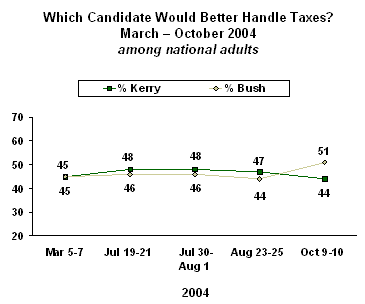
Bush's advantage on the tax issue may be due to significant doubts about Kerry's pledge, made during the second debate, not to raise taxes on the middle class if he is elected president. Forty-eight percent of Americans believe their income taxes would be increased if Kerry is elected president, 13% say they would be decreased, and 34% say they would remain the same. A majority of Americans who make at least $50,000 and less than $100,000, and a plurality of those who make below $50,000, believe their income taxes would in fact be raised if Kerry were elected. Both of these groups would be exempt from any income tax increases, according to Kerry's economic plan.
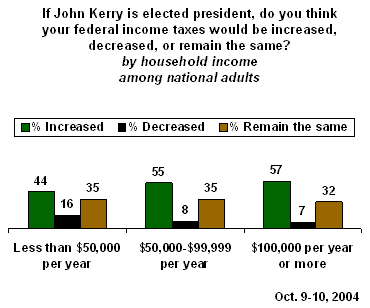
Conversely, most Americans, 57%, think their taxes would stay the same if Bush is re-elected, while 25% would expect a tax increase and 13% a tax cut.
Other Domestic Issues
As mentioned above, Kerry tends to be perceived as better than Bush on domestic issues, while Bush continues to have an advantage on the two key international issues, Iraq and terrorism. Kerry's greatest advantages are on the environment (60% to 31%), stem cell research (53% to 33%), healthcare (56% to 37%), and Medicare (53% to 38%). Bush's greatest advantage, as it has been all year, is on the terrorism issue, 56% to 39%.
|
Candidate Viewed as Better on Issues, Oct. 9-10 CNN/USA Today/Gallup Poll
|
|||
|
2004 Oct 9-10 (sorted by advantage) |
|
|
|
|
|
% |
% |
|
|
The environment |
60 |
31 |
Kerry, +29 |
|
Stem cell research |
53 |
33 |
Kerry, +20 |
|
Healthcare |
56 |
37 |
Kerry, +19 |
|
Medicare |
53 |
38 |
Kerry, +15 |
|
The federal budget deficit |
53 |
40 |
Kerry, +13 |
|
Social Security |
50 |
41 |
Kerry, +9 |
|
Education |
50 |
43 |
Kerry, +7 |
|
The economy |
49 |
45 |
Kerry, +4 |
|
Abortion |
46 |
42 |
Kerry, +4 |
|
The situation in Iraq |
44 |
51 |
Bush, +7 |
|
Taxes |
44 |
51 |
Bush, +7 |
|
Terrorism |
39 |
56 |
Bush, +17 |
Throughout this election year, Gallup has consistently measured how the two candidates stack up on the economy, Iraq, terrorism, and healthcare. The first two debates have had some effect on the way the candidates are viewed on these issues.
|
Candidate Issue Advantages, 2004 Election
|
||||
|
Time Period |
Economy |
Iraq |
Terrorism |
Healthcare |
|
|
|
|
|
|
|
March-Sept. 5 average |
Kerry +9 |
Bush +6 |
Bush +19 |
Kerry +18 |
|
Before first debate (Sept. 24-26 poll) |
Bush +6 |
Bush +14 |
Bush +27 |
Kerry +3 |
|
After first debate/before second debate (Oct. 1-3 poll) |
Kerry +7 |
Bush +7 |
Bush +17 |
N/A |
|
After second debate/before third debate (Oct. 9-10 poll) |
Kerry +4 |
Bush +7 |
Bush +17 |
Kerry +19 |
On healthcare, Kerry has restored his previous advantage over Bush that had shrunk to just 3 points in late September. Kerry has closed the gap somewhat on the Iraq issue and the terrorism issue, with much of that movement apparently taking place after the first debate. Perceptions of the economy shifted from a pro-Bush to a pro-Kerry position after the first debate, when Kerry erased Bush's lead, but that advantage narrowed slightly after the second debate. The two post-debate polls are more in line with opinion the rest of the year, though not as pro-Kerry as before.
Survey Methods
These results are based on telephone interviews with a randomly selected national sample of 1,015 adults, aged 18 and older, conducted Oct. 9-10, 2004. For results based on this sample, one can say with 95% confidence that the maximum error attributable to sampling and other random effects is ±3 percentage points. In addition to sampling error, question wording and practical difficulties in conducting surveys can introduce error or bias into the findings of public opinion polls.
15. Next, regardless of which presidential candidate you support, please tell me if you think John Kerry or George W. Bush would better handle each of the following issues. How about -- [RANDOM ORDER]?
A. The economy
|
|
Kerry |
Bush |
SAME (vol.) |
No opinion |
|
|
% |
% |
% |
% |
|
2004 Oct 9-10 |
49 |
45 |
2 |
4 |
|
2004 Oct 1-3 |
51 |
44 |
1 |
4 |
|
2004 Sep 24-26 |
45 |
51 |
1 |
3 |
|
2004 Sep 3-5 |
49 |
46 |
2 |
3 |
|
2004 Aug 23-25 ^ |
49 |
43 |
1 |
7 |
|
2004 Jul 30-Aug 1 |
53 |
43 |
1 |
3 |
|
2004 Jul 19-21 |
51 |
43 |
1 |
5 |
|
2004 Jun 21-23 ^ |
53 |
40 |
1 |
6 |
|
2004 May 7-9 ^ |
54 |
40 |
1 |
5 |
|
2004 Mar 5-7 |
50 |
42 |
2 |
6 |
|
|
||||
|
^ Asked of half sample |
||||
|
(vol.) Volunteered response |
||||
B. The situation in Iraq
|
|
Kerry |
Bush |
SAME (vol.) |
No opinion |
|
|
% |
% |
% |
% |
|
2004 Oct 9-10 |
44 |
51 |
1 |
4 |
|
2004 Oct 1-3 |
44 |
51 |
1 |
4 |
|
2004 Sep 24-26 |
41 |
55 |
1 |
3 |
|
2004 Sep 3-5 |
41 |
54 |
1 |
4 |
|
2004 Aug 23-25 ^ |
43 |
49 |
1 |
7 |
|
2004 Jul 30-Aug 1 |
48 |
47 |
2 |
3 |
|
2004 Jul 19-21 |
44 |
49 |
1 |
6 |
|
2004 Jun 21-23 ^ |
46 |
47 |
1 |
6 |
|
2004 May 7-9 ^ |
45 |
48 |
1 |
6 |
|
2004 Mar 5-7 |
39 |
54 |
2 |
5 |
|
|
||||
|
^ Asked of half sample |
||||
|
(vol.) Volunteered response |
||||
C. Terrorism
|
|
Kerry |
Bush |
SAME (vol.) |
No opinion |
|
|
% |
% |
% |
% |
|
2004 Oct 9-10 |
39 |
56 |
2 |
3 |
|
2004 Oct 1-3 |
39 |
56 |
2 |
3 |
|
2004 Sep 24-26 |
34 |
61 |
1 |
4 |
|
2004 Sep 3-5 |
34 |
61 |
1 |
4 |
|
2004 Aug 23-25 ^ |
37 |
54 |
2 |
7 |
|
2004 Jul 30-Aug 1 |
41 |
54 |
2 |
3 |
|
2004 Jul 19-21 |
38 |
56 |
1 |
5 |
|
2004 Jun 21-23 ^ |
40 |
54 |
1 |
5 |
|
2004 May 7-9 ^ |
38 |
55 |
1 |
6 |
|
2004 Mar 5-7 |
33 |
60 |
2 |
5 |
|
|
||||
|
^ Asked of half sample |
||||
|
(vol.) Volunteered response |
||||
D. Healthcare
|
|
Kerry |
Bush |
SAME (vol.) |
No opinion |
|
|
% |
% |
% |
% |
|
2004 Oct 9-10 |
56 |
37 |
1 |
6 |
|
2004 Sep 24-26 |
49 |
46 |
1 |
4 |
|
2004 Sep 3-5 |
53 |
40 |
1 |
6 |
|
2004 Jul 30-Aug 1 |
57 |
36 |
2 |
5 |
|
2004 Jul 19-21 |
54 |
37 |
2 |
7 |
|
2004 Mar 5-7 |
55 |
36 |
2 |
7 |
|
|
||||
E. Abortion
BASED ON 484 NATIONAL ADULTS IN FORM A
|
|
Kerry |
Bush |
SAME (vol.) |
No opinion |
|
|
|
|
|
|
|
2004 Oct 9-10 ^ |
46% |
42 |
2 |
10 |
|
|
|
|
|
|
|
^ Asked of half sample |
||||
F. Education
BASED ON 484 NATIONAL ADULTS IN FORM A
|
|
Kerry |
Bush |
SAME (vol.) |
No opinion |
|
|
% |
% |
% |
% |
|
2004 Oct 9-10 ^ |
50 |
43 |
2 |
5 |
|
2004 Sep 24-26 |
44 |
50 |
2 |
4 |
|
2004 Aug 23-25 ^ |
48 |
43 |
1 |
8 |
|
2004 Jul 19-21 |
50 |
43 |
1 |
6 |
|
2004 Mar 5-7 |
47 |
43 |
3 |
7 |
|
|
|
|
|
|
|
^ Asked of half sample |
||||
|
(vol.) Volunteered response |
||||
G. The environment
BASED ON 484 NATIONAL ADULTS IN FORM A
|
|
Kerry |
Bush |
SAME (vol.) |
No opinion |
|
|
|
|
|
|
|
2004 Oct 9-10 ^ |
60% |
31 |
2 |
7 |
|
|
|
|
|
|
|
^ Asked of half sample |
||||
|
(vol.) Volunteered response |
||||
H. The federal budget deficit
BASED ON 531 NATIONAL ADULTS IN FORM B
|
|
Kerry |
Bush |
SAME (vol.) |
No opinion |
|
|
|
|
|
|
|
2004 Oct 9-10 ^ |
53% |
40 |
2 |
5 |
|
2004 Mar 5-7 |
53% |
37 |
2 |
8 |
|
|
|
|
|
|
|
^ Asked of half sample |
||||
|
(vol.) Volunteered response |
||||
(I. and J. NOT ASKED)
K. Medicare
BASED ON 484 NATIONAL ADULTS IN FORM A
|
|
Kerry |
Bush |
SAME (vol.) |
No opinion |
|
|
|
|
|
|
|
2004 Oct 9-10 ^ |
53% |
38 |
3 |
6 |
|
2004 Aug 23-25 ^ |
50% |
38 |
1 |
11 |
|
|
|
|
|
|
|
^ Asked of half sample |
||||
(L. and M. NOT ASKED)
N. Social Security
BASED ON 531 NATIONAL ADULTS IN FORM B
|
|
Kerry |
Bush |
SAME (vol.) |
No opinion |
|
|
|
|
|
|
|
2004 Oct 9-10 ^ |
50% |
41 |
1 |
8 |
|
2004 Mar 5-7 |
51% |
36 |
5 |
8 |
|
|
|
|
|
|
|
^ Asked of half sample |
||||
|
(vol.) Volunteered response |
||||
O. Stem cell research
BASED ON 531 NATIONAL ADULTS IN FORM B
|
|
Kerry |
Bush |
SAME (vol.) |
No opinion |
|
|
|
|
|
|
|
2004 Oct 9-10 ^ |
53% |
33 |
* |
14 |
|
|
|
|
|
|
|
^ Asked of half sample |
||||
|
* Less than 0.5% |
||||
P. Taxes
BASED ON 531 NATIONAL ADULTS IN FORM B
|
|
Kerry |
Bush |
SAME (vol.) |
No opinion |
|
|
% |
% |
% |
% |
|
2004 Oct 9-10 ^ |
44 |
51 |
1 |
4 |
|
2004 Aug 23-25 ^ |
47 |
44 |
1 |
8 |
|
2004 Jul 30-Aug 1 |
48 |
46 |
2 |
4 |
|
2004 Jul 19-21 ^ |
48 |
46 |
1 |
5 |
|
2004 Mar 5-7 |
45 |
45 |
2 |
8 |
|
|
|
|
|
|
|
^ Asked of half sample |
||||
|
(vol.) Volunteered response |
||||