GALLUP NEWS SERVICE
PRINCETON, NJ -- On this Inauguration Day, Americans are much less likely to say that George W. Bush accomplished a series of objectives in his first term than they were to expect he would do so in January 2001. Despite this gap, Americans' views that Bush will accomplish similar objectives in his second term, such as keeping the country prosperous and improving education, are still relatively optimistic.
Several questions included in the latest CNN/USA Today/Gallup poll suggest that Americans do not think Bush has a mandate to pursue an exclusively Republican agenda in the coming years; a majority wants him to work with Democrats.
In terms of the inauguration itself, the public feels that it would have been best to have toned down the celebrations because the nation is at war. Americans also perceive that the event is more of a partisan political celebration than a celebration by all Americans of democracy in action. Although few Americans believe that the inauguration ceremonies will do much to help heal the political divisions in this country, the majority also does not believe it is appropriate to protest at the ceremonies.
Expectations for Bush's Second Term
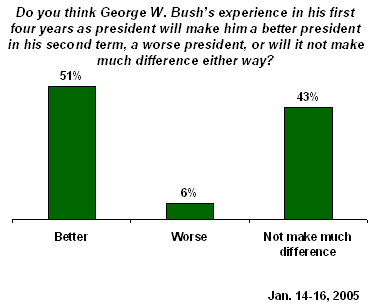
A slight majority of Americans, 51%, say Bush's experience in his first four years as president will make him a better president over the next four years, while 43% say it will not make much difference. Only 6% say his experience will make him a worse president.
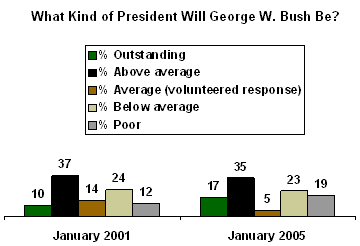
When asked what kind of president Bush will be in his second term, a slight majority of respondents say he will be either outstanding (17%) or above average (35%). More than 4 in 10 say he will be below average (23%) or poor (19%). These results show an increase in extreme views of the president -- at both ends of the spectrum -- compared with what Gallup found in a Jan. 15-16, 2001, poll, suggesting some polarization of attitudes. At that time, only 10% said he would be outstanding, while only 12% said he would be a poor president. Now, as noted, 17% say he will be outstanding while 19% say he will be poor.
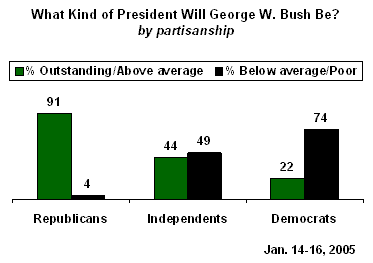
The data confirm the hypothesis that Republicans are much more likely than Democrats to say Bush's second term will be outstanding or above average.
More Specifics on Expectations for Bush's Second Term
Out of a list of 12 objectives, there is only 1 that a majority of Americans say Bush accomplished in his first term: improving military security for the country. Exactly half say he improved moral values; less than half say he accomplished any of the others.
This negative report card on the president's first term in office stands in contrast to the high expectations the public had when Bush started out on his presidential journey four years ago. At that time -- in January 2001 -- Americans were more positive across the board about his chances of accomplishing the objectives than they are today about how well he did, in retrospect.
|
Expectations Versus Reality: |
|||
|
January 2005: |
January 2001: |
Difference |
|
|
% |
% |
pct. pts. |
|
|
Improve military security for the country |
62 |
81 |
-19 |
|
Improve moral values in the United States |
50 |
55 |
-5 |
|
Cut your taxes |
46 |
49 |
-3 |
|
Keep America prosperous |
46 |
63 |
-17 |
|
Increase respect for the presidency |
45 |
61 |
-16 |
|
Improve education |
42 |
66 |
-24 |
|
Improve respect for the United States abroad |
32 |
58 |
-26 |
|
Improve the quality of the environment |
31 |
42 |
-11 |
|
Ensure the long-term strength of the Medicare system |
28 |
49 |
-21 |
|
Heal political divisions in this country |
27 |
41 |
-14 |
|
Improve the healthcare system |
26 |
46 |
-20 |
|
Ensure the long-term strength of the Social Security system |
18 |
50 |
-32 |
The average difference between what people expected of Bush as his first term began and what they say he actually accomplished during that term is –17 percentage points.
The highest discrepancy between the public's expectations of Bush and its views of his accomplishments is in reference to Social Security, followed by improving respect for the United States abroad and improving education. In other words, these three issues appear to be the ones on which Bush most failed to meet expectations, as far as the public is concerned.
The lowest discrepancies are in terms of cutting taxes and improving moral values in this country. Almost as many Americans say Bush accomplished these objectives as thought he would prospectively in January 2001.
Still, Americans continue to be quite optimistic about Bush's prospects in his second term. More Americans believe Bush will succeed, rather than fail, in accomplishing 6 out of the 11 policy and political goals tracked. In fact, Americans are only slightly less positive today than they were four years ago about Bush's chances for success.
|
Retrospective Views and Expectations in January 2005 |
|||
|
January 2005: |
January 2005: |
Difference |
|
|
% |
% |
pct. pts. |
|
|
Improve military security for the country |
62 |
73 |
-11 |
|
Improve moral values in the United States |
50 |
57 |
-7 |
|
Keep America prosperous |
46 |
62 |
-16 |
|
Increase respect for the presidency |
45 |
54 |
-9 |
|
Improve education |
42 |
58 |
-16 |
|
Improve respect for the United States abroad |
32 |
50 |
-18 |
|
Improve the quality of the environment |
31 |
39 |
-8 |
|
Ensure the long-term strength of the Medicare system |
28 |
42 |
-14 |
|
Heal political divisions in this country |
27 |
33 |
-6 |
|
Improve the healthcare system |
26 |
44 |
-18 |
|
Ensure the long-term strength of the Social Security system |
18 |
40 |
-22 |
Across the board, there is a 13-point difference between the percentage of Americans who say Bush will be able to accomplish the list of objectives in his second term, and those who say he did accomplish them in his first term.
This "optimism gap" is highest in terms of Social Security, improving the healthcare system, improving respect for the United States abroad, improving education, and keeping America prosperous. In other words, the public is apparently most willing to overcome its perceptions of failure on the part of the Bush administration on these issues, and to believe that, whatever the obstacles that stood in the way of accomplishing these objectives, they will be surmounted in Bush's second term.
To be sure, the perceptions that Bush will be able to accomplish these objectives have decreased, but only slightly, as noted, compared to the same perceptions measured in January 2001. More specifically, the average optimism rating is about 5.5 percentage points lower now than it was then.
A Mandate to Advance the Republican Agenda?
Americans are not inclined to believe that Bush's victory over Democratic challenger John Kerry provides him with a mandate to advance the Republican agenda. A majority of Americans, 58%, say that despite his popular and electoral vote victory, Bush should emphasize programs that both parties support. Only about one in three Americans, 36%, say Bush has a mandate.
Gallup asked Americans this question twice in November after the election. At that time, a slightly higher percentage of Americans (63% in both polls) said the president should emphasize programs supported by both parties.
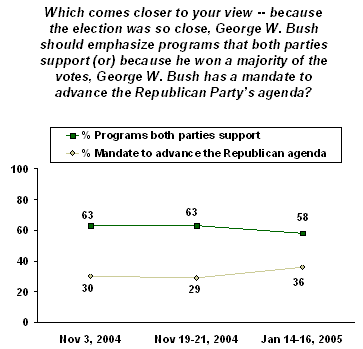
As would be expected, Republicans are more likely than Democrats to say Bush has a mandate, although half of Republicans still say Bush should emphasize bipartisan programs.
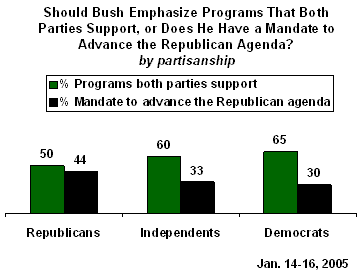
Bush's current job approval ratings also underscore the argument that Bush does not have a mandate to advance the Republican agenda in his second term. Only a slight majority of Americans, 51%, approve of the way Bush is handling his job as president, while almost as many -- 46% -- disapprove. (Those who disapprove feel more strongly about their attitudes toward Bush than do those who approve, yielding a situation in which 34% of the public now strongly disapproves of the way the president is handling his job, while only 30% strongly approve.)
Key Points About This Year's Inaugural Ceremonies
The CNN/USA Today/Gallup poll asked for the public's perspective on this year's inaugural ceremonies:
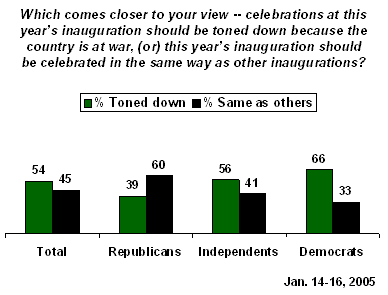
- A majority of Americans, 54%, say this year's inaugural celebrations should be "toned down" because the country is at war, while 45% say the inauguration should be celebrated in the same way as other inaugurations. Most Republicans say the inauguration should be celebrated in the same way as other inaugurations, while most Democrats feel this year's festivities should be toned down.
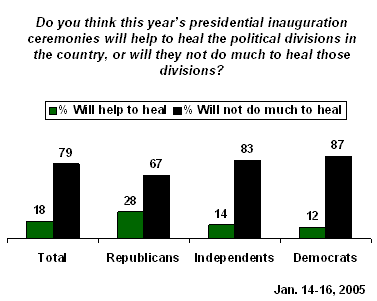
- Nearly 8 in 10 Americans (79%) say this year's ceremonies will not do much to heal the political divisions in the country. Eighteen percent say the ceremonies will help to heal them. Republicans are more inclined to say the ceremonies will help to heal the nation's political divisions than are Democrats, but a majority of both groups do not think the ceremonies will help.
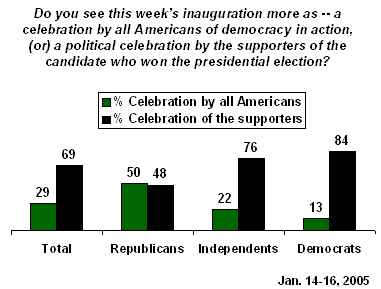
- By a 69% to 29% margin, Americans say this week's inauguration is more of "a political celebration by the supporters of the candidate who won the presidential election" than it is "a celebration by all Americans of democracy in action." Republicans are essentially divided in their views about this week's inauguration, while most Democrats say it is a celebration by the winning candidate's supporters.
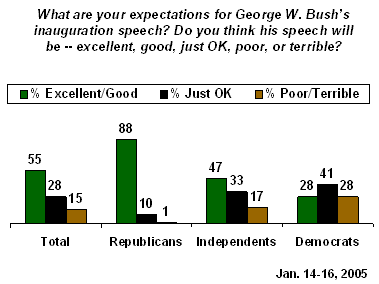
- Fifty-five percent of Americans expect Bush's inauguration speech to be excellent (17%) or good (38%), while 28% say it will be just OK, and 15% say it will be either poor or terrible. Republicans are much more optimistic about Bush's speech than are Democrats. Current expectations for Bush's inaugural speech are slightly lower than were expectations in January 2001, before his first inauguration.
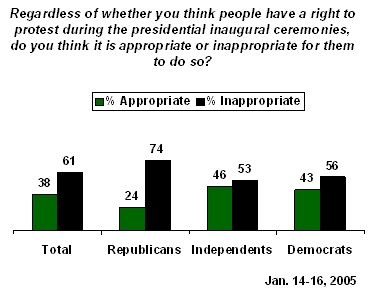
- Six in 10 Americans (61%) say it is inappropriate for people to protest during the presidential inaugural ceremonies, while 38% say it is appropriate. Democrats are more likely than Republicans to say it is appropriate to protest. In 2001, Gallup found 71% of Americans saying it was inappropriate to protest, while 28% said it was appropriate.
Survey Methods
These results are based on telephone interviews with randomly selected national samples of approximately 1,000 adults each, aged 18 and older, conducted Jan. 15-16, 2001, and Jan. 14-16, 2005. For results based on these samples, one can say with 95% confidence that the maximum error attributable to sampling and other random effects is ±3 percentage points. In addition to sampling error, question wording and practical difficulties in conducting surveys can introduce error or bias into the findings of public opinion polls.