GALLUP NEWS SERVICE
PRINCETON, NJ -- Economists expect employers to have hired 220,000 more workers this month in addition to the 262,000 new hires in February -- the strongest back-to-back months since March-April 2004 -- according to the median forecast in a new Bloomberg News survey conducted prior to the last week of March. The survey of economists also shows they expect only an insignificant drop in consumer confidence -- predicting the Conference Board's Index will fall from 104 in February to 103 in March and the University of Michigan's Index will fall from 94.1 in February to 92.9 in March.
Given last week's U.S. Labor Department report that consumer prices increased 0.4% in February -- the biggest increase in four months -- it is little wonder that the Federal Reserve Board focused on inflation as it commented on the seventh consecutive increase of its benchmark interest rate last week.
While the Fed has good reason to be concerned about a surge in prices, investors seem to be more concerned about "stagflation" -- increasing prices with little or no economic growth. In March, investors report less optimism about economic growth, inflation, and the stock market according to the new UBS/Gallup Index of Investor Optimism poll.
In addition, a new CNN/USA Today/Gallup poll, conducted March 21-23, shows consumer perceptions of the economy plunged last week as gas prices at the pump hit a new record high every weekday between March 16 and March 24. Right now, consumers are more pessimistic about the future direction of the economy than at any time since just prior to the beginning of the war with Iraq.
Investor Optimism Declines
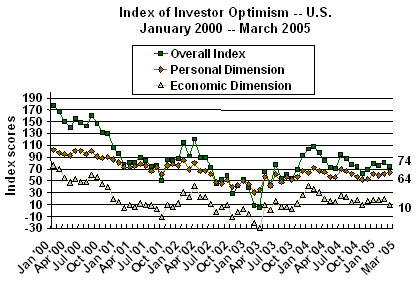
Investor optimism declined in March as the Index of Investor Optimism decreased from 82 in February to 74 in March. The Index is now two points lower than it was in January. The decrease is due to a 10-point drop in the Index's economic dimension. Currently at 10, the economic dimension is at the same level as last October and at its lowest point since September 2003. The drop in the economic dimension was slightly offset by a 2-point gain in the personal dimension.
Consumer Expectations Plunge
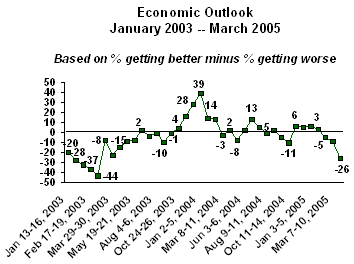
About 6 in 10 consumers (59%) say current economic conditions in the country as a whole are "getting worse," compared with only 33% who say they are "getting better." This negative difference of 26 percentage points is nearly three times the negative difference of 9 percentage points recorded just two weeks earlier in Gallup's March 7-10 poll, where 50% said conditions were getting worse and 41% said conditions were getting better. It is also the most negative consumer expectations about the future direction of the economy have been since just before the war in Iraq started in March 2003, when 67% of the public said things were getting worse and 23% of the public said things were getting better -- a negative difference of 44 percentage points.
Gas Prices Are Causing Financial Hardship
Thirty-nine percent of U.S. investors say that higher gas prices this year compared with last year have caused their households financial hardship. Not surprisingly, the impact has been greater on average investors (those having more than $10,000 but less than $100,000 in investable assets), with 46% of them reporting financial hardship compared with only 26% of substantial investors (those having $100,000 or more in investable assets). Three in four of those investors experiencing financial hardship -- whether average or substantial investors -- say they are encountering a great deal or a moderate amount of financial distress as a result of higher gas prices. Of course, an even higher percentage of the 60% of Americans who do not have at least $10,000 of investable assets are likely to be feeling some level of financial hardship as a result of increasing gas prices.
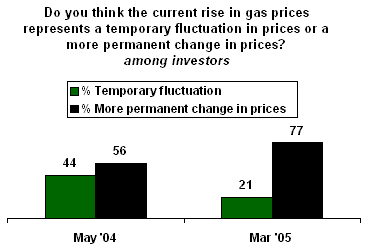
More importantly, there has been a sharp increase in the percentage of investors who feel today's higher energy prices are likely to be permanent. In March, more than three in four investors say they believe that the rise in gas prices is a permanent change and not just a temporary fluctuation -- up from 56% in May 2004. This change in perspective suggests that many consumers may begin adjusting their buying preferences, as well as their overall spending, with an eye toward a long-term decrease in the level of their disposable income.
On average, investors told Gallup that they were paying $1.98 for a gallon of gas at the time of the survey and they expected the price of gas to average $2.21 per gallon six months from now. Monday, AAA reported that gas prices averaged $2.13 nationwide, and current futures prices for gasoline are 40% higher than a year ago.
Walking the Line Between Inflation and Stagnation
Last Saturday, Wal-Mart said it expects its March U.S. sales to be similar to or greater than the 4.1% increase recorded during February. This supports economists' optimism that the economy not only remained strong during the first quarter of 2005, but that it can continue to do so even in the face of soaring oil prices.
The problem is that consumer and investor perceptions are changing so fast right now that most economic measures cannot keep up. For example, economists tend to focus on the price of a barrel of oil as a measure of energy costs. They also tend to look at such monthly measures as the Conference Board's Consumer Confidence Index and the University of Michigan's Consumer Sentiment Index in order to gauge the level of consumer well-being. As a result, many economists and business executives may look at the data and assume that consumer confidence remains solid despite record energy prices.
However, most Americans tend to relate more closely to prices at the gas pump than to oil prices in the futures market. What Gallup's most recent economic poll suggests is that the record pump prices of recent days are having both a more sudden and a more significant impact on consumer and investor optimism than previous increases in gas and oil prices that occurred when prices at the gas pump remained below $2.00 per gallon.
For the overall U.S. economy, the danger is that the Fed will not anticipate the rapid shifts taking place in consumer and investor perceptions of the economy and will instead continue to act on outdated information. The Fed could end up confirming investor expectations that economic growth will slow while prices will continue to escalate -- an example of stagflation.
The risk for business decision-makers is somewhat similar. If they focus on outdated economic data and do not anticipate the rapid changes taking place in consumer perceptions, they could allow their companies to become overextended in the face of weaker-than-expected sales during the second half of this year -- possibly resulting in little or no growth and declining margins.
Survey Methods
Results for the Index of Investor Optimism Poll are based on telephone interviews with 802 investors, aged 18 and older, conducted March 1-16, 2005. For results based on the total sample of investors, one can say with 95% confidence that the maximum margin of sampling error is ±4 percentage points.
Consumer poll results are based on telephone interviews with 1,001 national adults, aged 18 and older, conducted March 21-23, 2005. For results based on the total sample of nation adults, one can say with 95% confidence that the maximum margin of sampling error is ±3 percentage points.
In addition to sampling error, question wording and practical difficulties in conducting surveys can introduce error or bias into the findings of public opinion polls.
