GALLUP NEWS SERVICE
PRINCETON, NJ -- Americans express a desire for political leaders to move more quickly on Social Security legislation, but at the same time assign a higher priority to several other issues, including terrorism, gas prices, and healthcare costs. Those who think political leaders are moving too slowly on Social Security are slightly more likely to blame George W. Bush and the Republicans in Congress than the Democrats in Congress. Bush's approval rating on Social Security remains low, as does support for the idea of allowing private investment of Social Security taxes.
To date, neither President Bush nor the congressional leaders of either party have made a formal legislative proposal on Social Security. The April 1-2 CNN/USA Today/Gallup poll gauged public reaction to the lack of legislative progress on the Social Security issue. Sixty-one percent of Americans say political leaders are moving "too slowly" in taking up legislation to change the Social Security system, while 29% say they are moving at an appropriate pace. Seven percent volunteer that leaders are moving too quickly.
This generally negative assessment of the progress is shared about equally by most key demographic groups. Republicans (64%) are about as likely as Democrats (61%) and independents (58%) to feel that political leaders are moving too slowly on the issue.
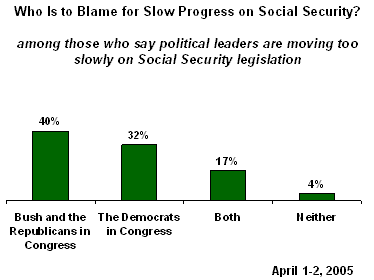
Those who say leaders are moving too slowly are slightly more likely to assign blame for this to Bush and the Republicans in Congress (40%) rather than the Democrats in Congress (32%). Seventeen percent say both are to blame, and 4% say neither is.
Overall, nearly 8 in 10 Americans say it is very important for Congress and the president to deal with Social Security in the next year, including 37% who say it is "extremely important." However, Americans assign higher priorities to several other issues, including terrorism, healthcare costs, gas prices, and the economy.
|
Rated Issue Importance |
||
|
2005 Apr 1-2 |
Extremely |
Extremely/ |
|
% |
% |
|
|
Terrorism |
47 |
88 |
|
Healthcare costs |
46 |
88 |
|
Gas prices |
44 |
79 |
|
The economy |
41 |
87 |
|
Social Security |
37 |
79 |
|
Changes to how the federal |
20 |
47 |
The percentage (37%) who say Social Security is an extremely important issue represents a slight decline from early February. Immediately after Bush's State of the Union address, 41% of Americans rated the issue as extremely important. Forty percent said it was extremely important in December.
Private Investment
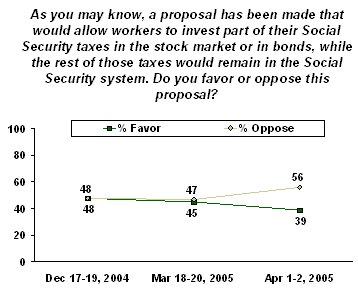
Despite a desire for more action on Social Security, Americans show only limited support for the most talked-about reform proposal -- allowing workers to invest a portion of their Social Security taxes in stocks and bonds. Thirty-nine percent favor such a proposal and 56% are opposed, a decline from 48% support in December.
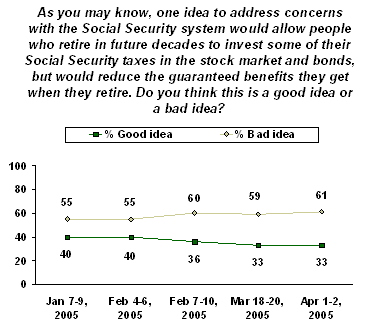
A separate question measured support for private investment of Social Security taxes but told respondents that such a proposal would entail a reduction in future guaranteed Social Security benefits. Just 33% of Americans say this proposal is a "good idea," while 61% say it is a bad one.
Bush's Handling of the Issue
Just 35% of Americans approve of the way George W. Bush is handling the Social Security issue, while 57% disapprove. That ties for the lowest rating of his administration on this issue to date.
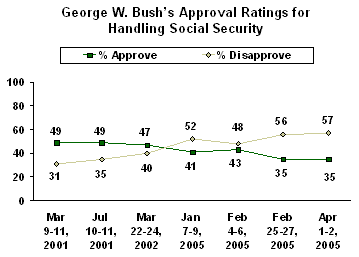
Bush is rated more positively on most other issues tested in the poll, except for his handling of the Terri Schiavo case. However, only on terrorism do a majority of Americans approve of Bush. His latest overall job approval rating is 48%, a slight improvement from 45% the previous week.
Do you approve or disapprove of the way George W. Bush is handling -- [RANDOM ORDER]?
|
2005 Apr 1-2 |
Approve |
Disapprove |
|
% |
% |
|
|
Terrorism |
57 |
40 |
|
His job as president (overall job approval) |
48 |
48 |
|
The situation in Iraq |
43 |
54 |
|
The economy |
41 |
55 |
|
Social Security |
35 |
57 |
|
The Terri Schiavo case |
34 |
53 |
Bush's low marks on Social Security are understandable given the lack of progress on the issue as well as his public support for the relatively unpopular idea of private investment accounts. Some critics have charged that those accounts will seriously harm the Social Security system, because funds needed to pay for them would have to be borrowed from the existing Social Security trust fund. While the accounts hold out the promise of paying higher benefits to retirees than what may be possible under the current system, they also entail the risk of lower benefits if the investments do not pan out.
The poll asked Americans for their sense of what Bush's intentions are for Social Security. Generally speaking, the public is divided, with 50% saying Bush is trying to ensure the long-term stability of the system, while 46% say he is trying to dismantle it. These opinions are strongly partisan in nature -- 84% of Republicans believe Bush is trying to ensure the stability of Social Security, while 77% of Democrats believe he is trying to dismantle it. Independents are more likely to say Bush is trying to dismantle Social Security (51%) than to say he is trying to ensure its long-term stability (43%).
Survey Methods
These results are based on telephone interviews with a randomly selected national sample of 1,040 adults, aged 18 and older, conducted April 1-2, 2005. For results based on this sample, one can say with 95% confidence that the maximum error attributable to sampling and other random effects is ±3 percentage points.
For results based on the 519 national adults in the Form A half-sample and 521 national adults in the Form B half-sample, the maximum margins of sampling error are ±5 percentage points. For results based on the sample of 612 adults who say the political leaders in this country are moving too slowly in taking up legislation to change the Social Security system, the maximum margin of sampling error is ±4 percentage points.
In addition to sampling error, question wording and practical difficulties in conducting surveys can introduce error or bias into the findings of public opinion polls.
2. Do you approve or disapprove of the way George W. Bush is handling -- [RANDOM ORDER]?
Social Security
|
|
Approve |
Disapprove |
No opinion |
|
% |
% |
% |
|
|
2005 Apr 1-2 |
35 |
57 |
8 |
|
|
|
|
|
|
2005 Feb 25-27 |
35 |
56 |
9 |
|
2005 Feb 4-6 |
43 |
48 |
9 |
|
2005 Jan 7-9 |
41 |
52 |
7 |
|
2002 Mar 22-24 ^ |
47 |
40 |
13 |
|
2001 Jul 10-11 |
49 |
35 |
16 |
|
2001 Mar 9-11 |
49 |
31 |
20 |
|
^ Asked of a half sample |
|||
5. How important is it to you that the president and Congress deal with each of the following issues in the next year -- is it -- extremely important, very important, moderately important, or not that important? How about -- [ITEMS A-F ROTATED]?
C. Social Security
|
|
Extremely |
Very |
Moderately |
Not that |
No |
|
% |
% |
% |
% |
% |
|
|
2005 Apr 1-2 |
37 |
42 |
15 |
5 |
1 |
|
|
|
|
|
|
|
|
2005 Feb 4-6 |
41 |
38 |
15 |
5 |
1 |
|
2004 Dec 17-19 ^ |
40 |
42 |
14 |
4 |
* |
|
2003 Jan 3-5 ^ |
41 |
36 |
20 |
3 |
* |
|
2002 May 28-29 ^ |
41 |
39 |
16 |
3 |
1 |
|
* Less than 0.5% |
|||||
|
^ Asked of a half sample |
|||||
Thinking about Social Security,
Q.12-13 SPLIT SAMPLED
12. As you may know, one idea to address concerns with the Social Security system would allow people who retire in future decades to invest some of their Social Security taxes in the stock market and bonds, but would reduce the guaranteed benefits they get when they retire. Do you think this is a good idea or a bad idea?
BASED ON 519 NATIONAL ADULTS IN FORM A
|
|
Good idea |
Bad idea |
No opinion |
|
% |
% |
% |
|
|
2005 Apr 1-2 |
33 |
61 |
6 |
|
|
|
|
|
|
2005 Mar 18-20 |
33 |
59 |
8 |
|
2005 Feb 7-10 |
36 |
60 |
4 |
|
2005 Feb 4-6 |
40 |
55 |
5 |
|
2005 Jan 7-9 |
40 |
55 |
5 |
13. As you may know, a proposal has been made that would allow workers to invest part of their Social Security taxes in the stock market or in bonds, while the rest of those taxes would remain in the Social Security system. Do you favor or oppose this proposal?
BASED ON 521 NATIONAL ADULTS IN FORM B
|
|
Favor |
Oppose |
No opinion |
|
% |
% |
% |
|
|
2005 Apr 1-2 |
39 |
56 |
5 |
|
|
|
|
|
|
2005 Mar 18-20 |
45 |
47 |
8 |
|
2004 Dec 17-19 |
48 |
48 |
4 |
14. Do you think political leaders in this country are -- [ROTATED: moving too slowly, (or) moving at an appropriate pace] -- in taking up legislation to change the Social Security system?
|
|
Moving |
Moving at |
MOVING |
No |
|
2005 Apr 1-2 |
61% |
29 |
7 |
3 |
|
(vol.) = Volunteered response |
||||
15. Who do you think is mostly to blame for this -- [ROTATED: George W. Bush and the Republicans in Congress, (or) the Democrats in Congress]?
BASED ON 612 ADULTS WHO SAY POLITICAL LEADERS ARE MOVING TOO SLOWLY IN TAKING UP LEGISLATION TO CHANGE THE SOCIAL SECURITY SYSTEM
|
|
Bush and |
Democrats |
BOTH |
NEITHER |
No |
|
|
|||||
|
2005 Apr 1-2 |
40% |
32 |
17 |
4 |
7 |
|
(vol.) = Volunteered response |
|||||
16. Just your best guess, if you had to choose, do you think George W. Bush is -- [ROTATED: trying to ensure the long-term stability of the Social Security system, (or is he) trying to dismantle the Social Security system]?
|
|
Trying to ensure |
Trying to dismantle |
No |
|
|
|
|
|
|
2005 Apr 1-2 |
50% |
46 |
4 |