GALLUP NEWS SERVICE
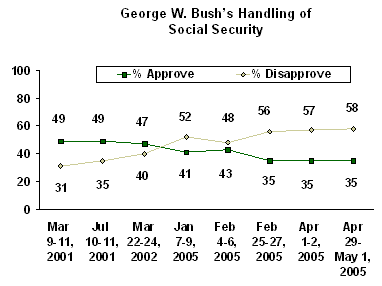
PRINCETON, NJ -- Using a live, nationally televised address and a cross-country barnstorming tour, President George W. Bush has been putting his all into building public support for his Social Security plan in recent weeks, but to little avail so far. The latest CNN/USA Today/Gallup poll finds little change in Americans' opinions about Bush's substantive positions on Social Security. There has also been no change in the percentage of Americans approving of the job Bush is doing on the issue compared with a month ago.
The overall picture for Bush remains lackluster. In particular, only 27% of Americans would like to see Congress pass a Republican-backed plan for Social Security this year. Nearly as many would prefer to see a Democratic-backed plan passed (22%), but the plurality of Americans (46%) say it would be better for them if no plan were passed this year. Also, just 35% of Americans today approve of the job Bush is doing on Social Security, while 58% disapprove. Those approval figures are nearly identical to the previous measures, taken in early April and late February.
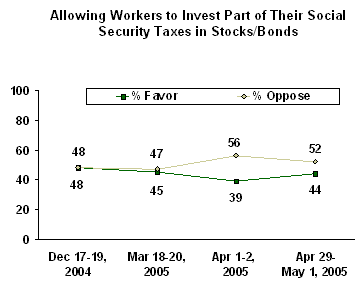
Public reaction to the centerpiece of Bush's reform plan -- private accounts -- remains more negative than positive. About half of Americans (52%) say they oppose allowing workers to invest part of their Social Security taxes in stocks or bonds; just 44% favor this. There has been no statistically significant change in support for private investment accounts since Gallup first tested this in December.
Americans are even more resistant to the idea of indexing Social Security benefits for future retirees -- an idea conceived by a Democratic financier and promoted by Bush at his press conference last week -- whereby benefits would be curbed along a sliding scale for middle- and upper-income Americans. Only 38% favor this proposal, while 54% oppose it.
Americans are so opposed to this means-testing proposal that, when given a choice, the majority, 53%, say they would rather see taxes raised than have benefits cut (38%).
Americans Would Postpone Changes
Underlying all of these attitudes is a basic belief among Americans that the Social Security system needs to be fixed, and that it will require some hard choices. Bush has failed to capitalize on this sentiment in part because a majority of Americans don't believe the need for action is that urgent.
- While 81% say major changes in Social Security are needed in the foreseeable future, only 45% think such changes are needed in the next year or two. Thirty-six percent say changes should be made within the next 10 years and 16% believe they are not necessary.
- There has been a slight increase since late February -- from 38% to 45% -- in the percentage of Americans saying that reform should occur in the next year or two. This change might be due to Bush's recent efforts to promote his plan. However, the current level is still slightly lower than the 49% who favored quick action in January.
- Only 35% of Americans believe it is possible to ensure the long-term future of Social Security without either raising their taxes or cutting their Social Security benefits. Most (62%) think such a painless solution is not possible.
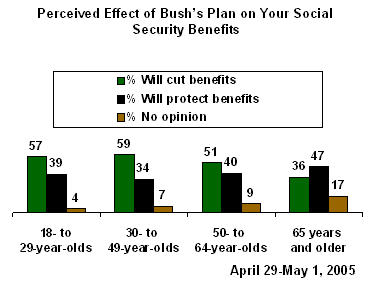
- A slim majority of Americans (53%) believe that the system of changes Bush is proposing will result in a reduction in their own Social Security benefits.
Democrats Fail to Persuade
It is clear that President Bush's proposal to restructure Social Security has been met with a resounding thud. But Democrats may be overreaching with their contention that Bush wants to "dismantle" the system. Only 41% of Americans believe Bush wants to dismantle Social Security, as some Democrats have charged; the majority (55%) says he is trying to ensure its long-term stability. There has even been a slight increase this month (from 50% to 55%) in the percentage of Americans crediting Bush with pure motives.
By contrast, Americans are about evenly divided over whether the Democrats are mainly trying to preserve Social Security (49%) or are trying to use the issue to hurt Republicans (46%) in the next elections.
While Washington politicos are playing a game of charge and countercharge over who has Americans' best interests at heart, the public has a fairly balanced reaction to the two parties' approaches to Social Security reform. The percentage of Americans who say they are worried that the Republicans will go too far in changing the Social Security system and the percentage who are worried that the Democrats will not go far enough are about equal (62% and 61%, respectively).
Naturally, Democrats tend to be the ones worried that the Republicans will go too far. What's interesting is that Democratic respondents are nearly as likely as Republican respondents to say they are worried that the Democrats won't go far enough.
|
% Very/Somewhat Worried About Each
Party's Approach to Social Security |
|||
|
Republicans |
Independents |
Democrats |
|
|
|
|
|
|
|
Worried Republicans will go too far |
35% |
66% |
86% |
|
Worried Democrats won't go far enough |
66% |
58% |
58% |
More generally, however, by a 46% to 36% margin, Americans have more faith in Democrats than in Republicans to handle Social Security.
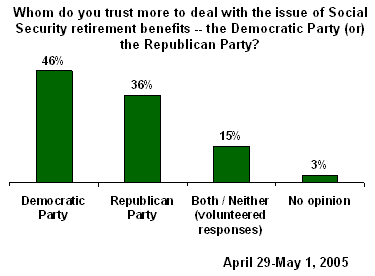
This is not new, however. Not only are these figures nearly identical to where they stood two months ago, but Gallup polling for the past decade or so has shown that Democrats have consistently had about a 10- to 15-point advantage over Republicans on this issue. So, rather than expanding their advantage, Democrats are at the low end of their historical advantage on Social Security.
Cynical Seniors
Of the various age groups, America's seniors are the most critical of Bush on the Social Security issue, and the least likely to support his various reform proposals.
- Only 29% of those 65 and older, compared with 36% of those under 65, say they approve of Bush's handling of Social Security.
- Though there are no significant differences by age with respect to Bush's means-testing proposal, the percentage favoring Bush's privatization plan falls from 51% among those 18 to 49, to 39% among those 50 to 64, to 30% among those 65 and older.
- The majority of Americans under 65 believe that Bush's plan would result in a cut in their Social Security benefits. While only 36% of seniors hold that view, this figure could be viewed as significant, given the extent to which Bush has emphasized that his plan would not affect current retirees in any way.
These results are based on telephone interviews with a randomly selected national sample of 1,006 adults, aged 18 and older, conducted April 29-May 1, 2005. For results based on this sample, one can say with 95% confidence that the maximum error attributable to sampling and other random effects is ±3 percentage points. In addition to sampling error, question wording and practical difficulties in conducting surveys can introduce error or bias into the findings of public opinion polls.
Next, turning to the issue of Social Security retirement benefits,
12. Do you think the federal government should make major changes in the Social Security system to ensure its long-term future -- in the next year or two, within the next 10 years, or do you think major changes are not needed within the next 10 years?
|
|
In the next |
Within |
Changes |
No |
|
% |
% |
% |
% |
|
|
2005 Apr 29-May 1 |
45 |
36 |
16 |
3 |
|
|
|
|
|
|
|
2005 Feb 25-27 ^ |
38 |
37 |
22 |
3 |
|
2005 Jan 7-9 |
49 |
39 |
9 |
3 |
|
^ Asked of a half sample |
||||
13. As you may know, a proposal has been made that would allow workers to invest part of their Social Security taxes in the stock market or in bonds, while the rest of those taxes would remain in the Social Security system. Do you favor or oppose this proposal?
|
|
Favor |
Oppose |
No opinion |
|
% |
% |
% |
|
|
2005 Apr 29-May 1 |
44 |
52 |
4 |
|
|
|
|
|
|
2005 Apr 1-2 ^ |
39 |
56 |
5 |
|
2005 Mar 18-20 ^ |
45 |
47 |
8 |
|
2004 Dec 17-19 ^ |
48 |
48 |
4 |
|
|
|||
|
^ Asked of a half sample |
|||
14. As you may know, a proposal has been made that would curb Social Security benefits for middle-income workers in the future, curb them even more for higher-income workers, but would not affect benefits for lower-income workers and those born before 1950. Do you favor or oppose this proposal?
|
|
Favor |
Oppose |
No opinion |
|
2005 Apr 29-May 1 |
38% |
54 |
8 |
15. Who do you trust more to deal with the issue of Social Security retirement benefits -- [ROTATED: the Democratic Party (or) the Republican Party]?
|
|
|
|
BOTH |
|
|
|
|
|
|
|
|
|
|
2005 Apr 29-May 1 |
46% |
36 |
3 |
12 |
3 |
|
|
|
|
|
|
|
|
2005 Feb 25-27 |
47% |
37 |
2 |
9 |
5 |
|
(vol.) = Volunteered response |
|||||
16. If you had to choose, which of the following do you think would be best for you in the long run -- [ROTATED: Congress passes a Social Security reform plan this year that most Republicans support, (or) Congress passes a Social Security reform plan this year that most Democrats support], or Congress does not pass a plan this year?
|
|
Pass plan most |
Pass plan most |
|
|
|
2005 Apr 29-May 1 |
27% |
22 |
46 |
5 |
17. If you had to choose one of the following approaches to ensuring Social Security's long-term future, would you rather -- [ROTATED: raise Social Security taxes (or) curb the amount of benefits for future Social Security recipients]?
|
|
Raise taxes |
Curb benefits |
No opinion |
|
2005 Apr 29-May 1 |
53% |
38 |
9 |
18. Do you think it is possible to ensure the long-term future of the Social Security system without either raising YOUR taxes or cutting YOUR Social Security benefits, or is that not possible?
|
|
Yes, possible |
No, not possible |
No opinion |
|
|
|
|
|
|
2005 Apr 29-May 1 |
35% |
62 |
3 |
19. Based on what you have heard or read, do you think the proposals for Social Security made by George W. Bush would -- [ROTATED: cut the amount of Social Security benefits you, personally, will receive, (or) protect the amount of Social Security benefits you, personally, will receive]?
|
|
Cut benefits |
Protect benefits |
No opinion |
|
|
|
|
|
|
2005 Apr 29-May 1 |
53% |
38 |
9 |
Q.20-21 ROTATED
20. How worried are you that the Republicans will go too far in changing the Social Security system -- very worried, somewhat worried, not too worried, or not at all worried?
|
|
Very |
Some- |
Not too |
Not |
No |
|
2005 Apr 29-May 1 |
28% |
34 |
21 |
15 |
2 |
21. How worried are you that the Democrats will not go far enough to change the Social Security system -- very worried, somewhat worried, not too worried, or not at all worried?
|
|
Very |
Some- |
Not too |
Not |
No |
|
2005 Apr 29-May 1 |
22% |
39 |
26 |
11 |
2 |
Q.22-23 ROTATED
22. Just your best guess, if you had to choose, do you think the Democrats are -- [ROTATED: mainly trying to use the Social Security issue to hurt the Republican Party in the next elections, (or are they) mainly trying to ensure the long-term stability of the Social Security system]?
|
|
Trying to use |
Trying to ensure |
No |
|
2005 Apr 29-May 1 |
46% |
49 |
5 |
23. Just your best guess, if you had to choose, do you think George W. Bush is -- [ROTATED: trying to ensure the long-term stability of the Social Security system, (or is he) trying to dismantle the Social Security system]?
|
|
Trying to ensure |
|
|
|
|
|
|
|
|
2005 Apr 29-May 1 |
55% |
41 |
4 |
|
|
|
|
|
|
2005 Apr 1-2 |
50% |
46 |
4 |
Historical Ratings on Social Security
17. Do you think the Republican Party or the Democratic Party would do a better job of dealing with each of the following issues and problems? How about -- [RANDOM ORDER]?
F. Social Security
|
|
Republican |
Democratic |
No difference/ |
|
|
|
|
|
|
2001 Aug 24-26 |
37 |
52 |
11 |
|
|
|
|
|
|
1998 Oct 9-12 |
33 |
54 |
13 |
|
1997 Oct 27-29 ^ |
35 |
46 |
19 |
|
^ Asked of half sample |
|||