GALLUP NEWS SERVICE
PRINCETON, NJ -- A new CNN/USA Today/Gallup poll, conducted July 22-24, shows that Americans are about as supportive of U.S. involvement in Iraq currently as they have been for the past year, with little change in the public's optimism regarding successful completion of the mission.
This finding may seem contrary to the continued violence from insurgency forces in Iraq and the release of grim statistics about the ill-preparedness of Iraq's internal security forces. But the maintenance of public opinion at previous levels perhaps reflects some tempering of the negative news from Iraq by news of the forthcoming Iraqi elections. It is even more likely that these public opinion levels are evidence that there is a partisan structure to views about Iraq -- with most Republicans defending the war and most Democrats opposing it -- that is quite fixed, and not particularly susceptible to volatile events.
A slim majority of Americans are supportive of President George W. Bush's administration's decision to enter the Iraq war, even though more than half are doubtful the United States will win the conflict, and nearly 6 in 10 are doubtful that the United States will establish a stable democracy in Iraq.
Iraq War "Not a Mistake"
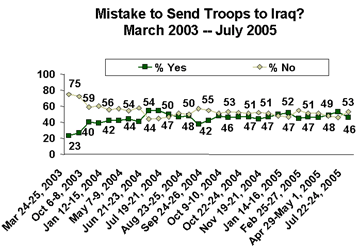
Fifty-three percent of Americans say that it was not a mistake to send troops to Iraq, while 46% say it was. This represents a slight improvement compared with a June Gallup poll, when the majority (53%) said sending troops was a mistake.
However, the current result is consistent with the general range of support for the war that has been evident since last fall. Throughout this period, Americans have been closely divided in their assessments of the United States' involvement in Iraq, with the slight majority usually saying that sending troops was not a mistake.
Doubt Democracy Will be Achieved
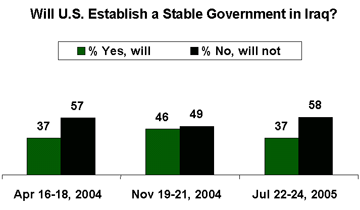
Americans are no more -- or less -- confident today than they were last April about the United States' chances for creating a stable democratic government in Iraq. Only 37% think this will happen, while 58% say it will not.
Optimism on this question was slightly higher last November in polling conducted after a major U.S. military offensive in Fallujah, Iraq; but even then, less than half of the public felt the U.S. would achieve its goal of helping Iraq develop a stable democracy.
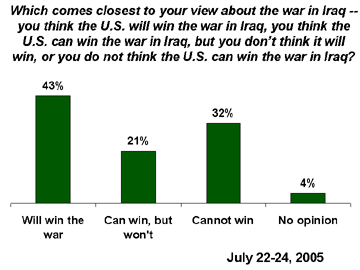
Americans are slightly more confident about the chances that the United States will win the war in Iraq than they are about democracy succeeding, but the majority (53%) predicts the U.S. will not win. Specifically, 43% think America will win the war, 21% say the U.S. can win but won't, and 32% think victory is not possible.
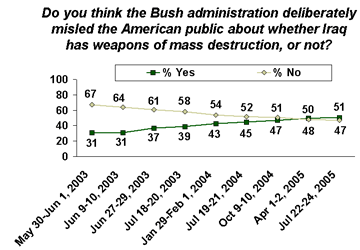
Americans are closely divided on the question of whether the Bush administration deliberately misled Americans about the threat of an armed Iraq. Fifty-one percent say the administration misled the public about whether Iraq has weapons of mass destruction; 47% say it did not.
This is not the first time that public opinion has tilted against the Bush administration on this measure. Public doubts about the administration's candor in leading America to war have been building gradually since the beginning of June 2003, and finally reached the 50% mark this past April. Prior to this spring, the majority believed the administration did not mislead the public.
Partisan Divide
Partisan attitudes continue to be the public's most notable distinctions about the Iraq war. Republicans tend to see the war in a positive light, while Democrats are mostly critical of the conflict. Independents also tend to be more negative than positive about the venture.
The strongest partisan differences in the four questions from the latest poll which measure opinions about the Iraq war are the perceptions of whether the Bush administration misled the public about the security threat posed by Iraq. More than four in five Republicans (85%) defend the administration on this charge, compared with only 15% of Democrats -- a 70 percentage-point difference.
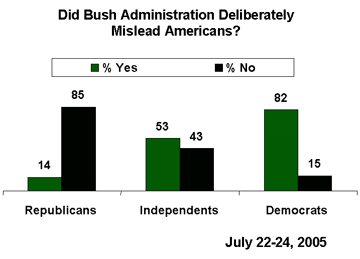
Republicans and Democrats are slightly closer in their views on whether sending U.S. troops to Iraq was a mistake (a 52 percentage-point gap). They are much closer in their outlooks for winning the war and establishing democracy, mostly because Republicans tend to be less positive on these dimensions of the Iraq war than they are on the other two.
|
Summary of Pro-Bush Iraq Views |
|||
|
Republican |
Democratic |
Percentage- |
|
|
% |
% |
|
|
|
Did not deliberately mislead |
85 |
15 |
70 |
|
No, Iraq war not a mistake |
82 |
30 |
52 |
|
U.S. will win Iraq war |
63 |
26 |
37 |
|
Will establish democracy in Iraq |
61 |
22 |
39 |
Bush's Image
Although a majority of Americans now say the Bush administration misled the public about the existence of weapons of mass destruction in Iraq, a slim majority of Americans still believe that President Bush is generally honest and trustworthy.
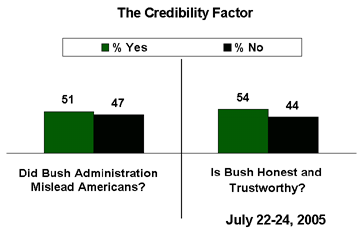
A comparison of the two questions shows most of those who think the administration misled the public (77%) also believe Bush is not honest and trustworthy, while a sizable minority of this group (21%) believes he is. Naturally, there is closer to a one-to-one correlation in the views of those who defend the administration's position on the justification for attacking Iraq. Nearly 9 in 10 (89%) of those that think the Bush administration didn't mislead the public think Bush is honest and trustworthy, while just 9% say he is not.
Survey Methods
These results are based on telephone interviews with a randomly selected national sample of 1,006 adults, aged 18 and older, conducted July 22-24, 2005. For results based on this sample, one can say with 95% confidence that the maximum error attributable to sampling and other random effects is ±3 percentage points. In addition to sampling error, question wording and practical difficulties in conducting surveys can introduce error or bias into the findings of public opinion polls.27. In view of the developments since we first sent our troops to Iraq, do you think the United States made a mistake in sending troops to Iraq, or not?
|
Yes, |
No, |
No |
|
|
Iraq |
% |
% |
% |
|
2005 Jul 22-24 |
46 |
53 |
1 |
|
|
|
|
|
|
2005 Jun 24-26 |
53 |
46 |
1 |
|
2005 Apr 29-May 1 ^ |
49 |
48 |
3 |
|
2005 Mar 18-20 ^ |
46 |
51 |
3 |
|
2005 Feb 25-27 |
47 |
51 |
2 |
|
2005 Feb 4-6 |
45 |
55 |
* |
|
2005 Jan 14-16 |
52 |
47 |
1 |
|
2005 Jan 7-9 |
50 |
48 |
2 |
|
2004 Nov 19-21 |
47 |
51 |
2 |
|
2004 Oct 29-31 ^ |
44 |
52 |
4 |
|
2004 Oct 22-24 |
47 |
51 |
2 |
|
2004 Oct 14-16 |
47 |
52 |
1 |
|
2004 Oct 9-10 ^ |
46 |
53 |
1 |
|
2004 Oct 1-3 |
48 |
51 |
1 |
|
2004 Sep 24-26 |
42 |
55 |
3 |
|
2004 Sep 3-5 ^ |
38 |
57 |
5 |
|
2004 Aug 23-25 ^ |
48 |
50 |
2 |
|
2004 Jul 30-Aug 1 |
47 |
51 |
2 |
|
2004 Jul 19-21 |
50 |
47 |
3 |
|
2004 Jul 8-11 ^ |
54 |
45 |
1 |
|
2004 Jun 21-23 ^ |
54 |
44 |
2 |
|
2004 Jun 3-6 ^ |
41 |
58 |
1 |
|
2004 May 7-9 ^ |
44 |
54 |
2 |
|
2004 Apr 16-18 ^ |
42 |
57 |
1 |
|
2004 Jan 12-15 ^ |
42 |
56 |
2 |
|
2003 Nov 3-5 ^ |
39 |
60 |
1 |
|
2003 Oct 6-8 ^ |
40 |
59 |
1 |
|
2003 Jul 7-9 ^ |
27 |
72 |
1 |
|
2003 Mar 24-25 ^ |
23 |
75 |
2 |
|
|
|
|
|
|
^ Asked of a half sample |
|||
|
* Less than 0.5% |
|||
28. Which comes closest to your view about the war in Iraq -- [ROTATED: you think the U.S. will win the war in Iraq, you think the U.S. can win the war in Iraq, but you don't think it will win, or you do not think the U.S. can win the war in Iraq]?
|
|
|
Can win, |
|
|
|
|
|
|
|
|
|
2005 Jul 22-24 |
43% |
21 |
32 |
4 |
29. Do you think the United States will -- or will not -- be able to establish a stable democratic government in Iraq?
|
Yes, will |
No, will not |
No opinion |
|
|
% |
% |
% |
|
|
2005 Jul 22-24 |
37 |
58 |
5 |
|
|
|
|
|
|
2004 Nov 19-21 |
46 |
49 |
5 |
|
2004 Apr 16-18 |
37 |
57 |
6 |
30. Do you think the Bush administration deliberately misled the American public about whether Iraq has weapons of mass destruction, or not?
|
|
Yes, |
|
No |
|
% |
% |
% |
|
|
2005 Jul 22-24 |
51 |
47 |
2 |
|
|
|
|
|
|
2005 Apr 1-2 |
50 |
48 |
2 |
|
2004 Oct 9-10 |
47 |
51 |
2 |
|
2004 Jul 19-21 ^ |
45 |
52 |
3 |
|
2004 Jan 29-Feb 1 |
43 |
54 |
3 |
|
2003 Jul 18-20 |
39 |
58 |
3 |
|
2003 Jun 27-29 |
37 |
61 |
2 |
|
2003 Jun 9-10 |
31 |
64 |
5 |
|
2003 May 30-Jun 1 |
31 |
67 |
2 |
|
^ Asked of a half sample |
|||