GALLUP NEWS SERVICE
PRINCETON, NJ -- New Gallup Poll data show that Americans continue to have generally bleak perceptions of the economy, as they have since late August -- even before Hurricane Katrina hit the Gulf Coast. A majority of Americans predict that inflation, unemployment, and interest rates will increase over the next six months, and more believe the stock market will decline than go up during that time. The economy remains a concern to a significant proportion of Americans, according to Gallup's "most important problem" question, but the war in Iraq is still the top specific concern.
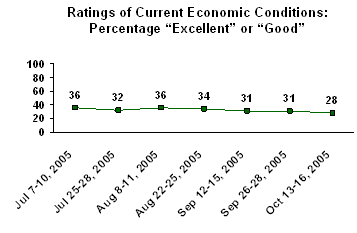
Gallup's Oct. 13-16 poll finds that economic ratings continue to be fairly negative, with only 28% of Americans rating current conditions as excellent (3%) or good (25%). Twenty-six percent rate them as poor. While the current figures show a slight drop in positive ratings of the economy compared with September (31%) and late August (34%), the ratings were already quite negative before Hurricane Katrina struck Louisiana, Mississippi, and Alabama.
Americans also remain pessimistic about the direction in which the economy is headed -- just 24% say it is getting better and 68% say it is getting worse. Those numbers are slightly more negative than they were in late August (63% said the economy was getting worse before Hurricane Katrina).
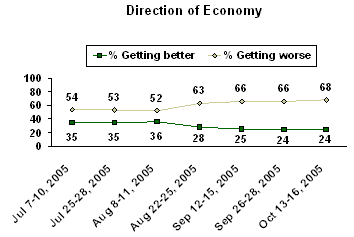
The last time Gallup measured ratings this negative was just before the start of the Iraq war in March 2003, when 67% viewed the economy as getting worse.
Pessimism is also evident in the public's expectations about different aspects of the economy.
- Seventy-five percent expect inflation to increase in the next six months.
- A majority, 52%, believes unemployment will increase during that time.
- Seventy-eight percent expect interest rates to increase in the next six months.
- More believe the stock market will go down (33%) than go up (29%). Thirty percent expect no change in the stock market. This is the first time since July 2002 that more Americans have been pessimistic rather than optimistic about the stock market.
- About as many expect "economic growth" to decrease (37%) as predict it will increase (36%). This is the first time since Gallup began tracking this measure in October 2001 that there haven't been significantly more optimists than pessimists on growth.
Additionally, 62% of Americans believe it is a "bad time to find a quality job," while 35% believe it is a good time. Those numbers have been fairly steady this year.
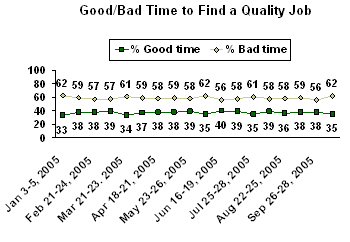
Generally speaking, Americans tend to be more pessimistic than optimistic about the job market. Since Gallup began its monthly tracking of this measure in October 2001, all polls have shown more Americans saying the job market was bad than saying it was good.
However, readings on this measure during the boom years of 1998 to 2000, measured in joint surveys by the University of Connecticut and Rutgers University, found Americans much more positive about jobs. In those surveys, 69% to 78% of those who were employed or who were unemployed and looking for work, said it was a good time to find a job.
Most Important Problem
The war in Iraq continues to be cited more than any other specific issue as the most important problem facing the country. Twenty-one percent of Americans mention this in response to the open-ended question. That's a slight increase from 16% in September, when concerns about natural disasters were more prevalent (13% in September) than they are today (6%). Fifteen percent mention the economy in general terms as the most important problem, and another 7% say fuel prices. Five percent mention unemployment.
Most Commonly Mentioned Specific Issues
as Nation's Most Important Problems,
Oct. 13-16 Poll
|
Problem |
Percentage |
|
War in Iraq |
21% |
|
Economy in general |
15 |
|
Poor government leadership |
9 |
|
Fuel/Oil prices |
7 |
|
Dealing with natural disasters |
6 |
|
Moral decline, breakdown of family |
5 |
|
Terrorism |
5 |
|
Unemployment |
5 |
In all, 36% of Americans mention some aspect of the economy in their responses, including general mentions of the economy, unemployment, fuel prices, and other issues such as taxes and the federal budget deficit. That represents a slight increase from 32% in both August and September, and 27% in July.
Survey Methods
These results are based on telephone interviews with a randomly selected national sample of 1,012 adults, aged 18 and older, conducted Oct. 13-16, 2005. For results based on this sample, one can say with 95% confidence that the maximum error attributable to sampling and other random effects is ±3 percentage points. In addition to sampling error, question wording and practical difficulties in conducting surveys can introduce error or bias into the findings of public opinion polls.
