GALLUP NEWS SERVICE
PRINCETON, NJ -- According to the latest Gallup poll, conducted over this past weekend, 57% of Americans approve of the way George W. Bush is handling his job as president, while 25% disapprove and 18% have no opinion. The approval percentage is comparable to what Bill Clinton received in his initial rating -- 58% -- and somewhat higher than the 51% rating received by both George H.W. Bush in 1989 and Ronald Reagan in 1981, shortly after each assumed office for the first time. But the 25%disapprovalthat President George W. Bush receives is the highest initial disapproval that any president has received since Gallup began measuring approval over half a century ago, although just modestly higher than the 20% that Bill Clinton received shortly after he first took office. Bush's disapproval is 19 points higher than what his father, George H.W. Bush, received in January, 1989.
The number of Americans who were "unsure" how to rate George W. Bush's job performance is the lowest ever recorded, and considerably lower than that recorded for George H.W. Bush 12 years earlier. The great public attention paid to the Florida recount controversy may have stimulated stronger feelings about the current president than is normally the case, and could also partially account for the higher disapproval rating as well.
|
INITIAL APPROVAL RATINGS OF PRESIDENTS WHO FIRST ASSUMED OFFICE AFTER BEING ELECTED*
Do you approve or disapprove of the way [NAME] is handling his job as president? |
||||
|
Initial Approval Rating |
||||
|
President |
Date of Initial Rating |
Approve |
Disapprove |
Unsure |
|
% |
% |
% |
||
|
George W. Bush |
2001, Feb 2-4 |
57 |
25 |
18 |
|
Bill Clinton |
1993, Jan 24-26 |
58 |
20 |
22 |
|
George H.W. Bush |
1989, Jan 24-26 |
51 |
6 |
43 |
|
Ronald Reagan |
1981, Jan 30-Feb 2 |
51 |
13 |
36 |
|
Jimmy Carter |
1977, Feb 4-7 |
66 |
8 |
26 |
|
Richard M. Nixon |
1969, Jan 23-28 |
59 |
5 |
36 |
|
John F. Kennedy |
1961, Feb 10-15 |
72 |
6 |
22 |
|
Dwight D. Eisenhower |
1953, Feb 1-5 |
68 |
7 |
25 |
|
*Ratings of vice-presidents who became president when the previous president died are not included. This includes Harry Truman, Lyndon Johnson, and Gerald Ford. Franklin Roosevelt's first approval rating was not taken until 1938, more than five years after he first assumed the presidency. |
||||
Typically, ratings of presidents are highly related to Americans' partisan orientation, and Bush's ratings are no exception. While 88% of Republicans approve of the way Bush is performing his job, just over half of independents (52%) express the same sentiment, compared with only a third (32%) of Democrats.
Not surprisingly, a significant gender gap continues to characterize Americans' feelings toward Bush, as 64% of men and only 50% of women approve of his performance in office. The racial gap remains even wider, as 61% of whites, compared with 35% of non-whites, express approval.
In recent weeks, California has experienced a serious energy crisis, with the cost of electricity sky-rocketing and the utilities instituting rolling blackouts to compensate for lack of power. Neighboring states have also suffered significantly higher costs, but the Bush administration has indicated it does not support the imposition of federal price caps, preferring to let the state governments and private industry deal with the issues. These events may help to explain why Bush's approval rating is 10 points lower in the western part of the country -- 47% -- than in any other part of the country, with a 57% approval rating each in the East and Midwest, and a 64% approval rating in the South.
Honeymoon Period for New President Varies
In recent days, the press has made much of a "honeymoon" period, during which the news media generally gives the president positive coverage and the public reserves negative judgment until the president has had time to learn the new job. But a review of Gallup polls over the past half century suggests thathoneymoonmay not be the best analogy for the period following a president's assumption of office, as the periods over which different presidents have been able to sustain high levels of popularity have varied considerably and rarely have they ended quickly.
The accompanying graph shows the quarterly average approval ratings of all presidents in the past fifty years who first assumed office after being elected in their own right. The dynamics of the approval ratings for each president vary considerably, but it is true that, for all but one president, approval did decline within the first two years. The honeymoon analogy, if it applies at all, probably best applies to Clinton, Carter, Reagan and Nixon -- all of whom received considerably lower approval ratings somewhere in the seventh to tenth quarters of their presidency (two to two and a half years after assuming office) than what they first received. The decline in Clinton's approval ratings was the most sudden, falling more than 10 points in the first quarter alone, then rallying only to fall even lower by the seventh quarter. By that quarter, the patterns of Clinton's and Reagan's ratings had become almost identical, with both presidents experiencing a continued increase to the 15th quarter, the last pre-election quarter, in the mid-50% range. Carter's approval rating also seemed to be on the incline in his last year in office, but with the continued uncertainty over the Iranian hostage crisis and a worsening economy, the spring and summer months of Carter's last year witnessed a new and fatal decline in the president's approval rating.
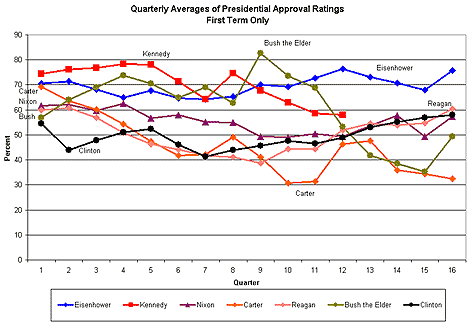
Eisenhower's first term seemed almost charmed, as his quarterly approval never slid below the 64% level, and averaged 70%. Kennedy's average quarterly approval rating started out the highest of any of the presidents, but by the time of his assassination it had dropped below the 60% level.
The most unusual pattern belongs to President George H.W. Bush, whose initial approval rating of 51% was among the lowest received by any president. Over the next several months, contrary to all expectations for a president, his approval actually increased, so that at the end of Bush's first year, it was more than 15 points higher than where it started -- the only president to experience that kind of improvement. In the second year, his rating fluctuated in the 65% to 70% range, and then soared above 80% in the wake of the Persian Gulf crisis. Not until the beginning of Bush's third year in office did his quarterly approval rating fall below the initial quarter's rating, and then it continued to sink precipitously, so that by the 15th quarter -- the three months right before the new election -- Bush's average rating was as low as Carter's had been when Carter lost re-election in 1980. Bush, of course, also lost his re-election bid to Bill Clinton in 1992.
Survey Methods
Results are based on telephone interviews with 1,003 national adults, aged 18+, conducted February 2-4, 2001. For results based on the total sample of national adults, one can say with 95% confidence that the margin of sampling error is +/- 3 percentage points.
In addition to sampling error, question wording and practical difficulties in conducting surveys can introduce error or bias into the findings of public opinion polls.