The willingness of people to take part in polls is often influenced by the way in which they are asked. It's not just a matter of politeness, however -- saying "please," for example, or speaking in a friendly tone. There are also more fundamental psychological processes at work, which pollsters need to recognize.
For the past year, Gallup has experimented with two different forms for asking survey respondents whether Gallup could call them back for further interviewing at some unspecified time in the future. Half the sample was asked:
FORM A
This completes the interview. However, as part of a continuing study, we would like to talk further with a few survey participants about the topics we have discussed. All of your responses will still be treated with complete confidentiality. Would you BE WILLING to talk with a Gallup interviewer at a later date?
FORM B
This completes the interview. However, as part of a continuing study, we would like to talk further with a few survey participants about the topics we have discussed. All of your responses will still be treated with complete confidentiality. Would you OBJECT to a Gallup interviewer calling you again at a later date?
Our original hypothesis was the "object" question would yield more positive responses (defined as saying Gallup could call them back) than the "willing" question, based on the notion that it is more difficult for people to say they "object" to being called back than it is for people to say they are "not willing" to be called back.
It's worth a moment for a silent personal experiment -- which is more difficult for you to say: you object to receiving a call, or you are not willing to receive a call?
The Gallup experiment did not ask both questions of each respondent, but rather asked half the respondents the "object" question and the other half the "willing" question. Because respondents were randomly assigned to each group, the different question wording has to be the cause of any difference in results between the two groups.
For the whole year, the average percentage of respondents who were "willing" to be called back was 74.3%, while the average percentage of respondents who did "not object" to being called back was 79.7%. Given that each group had a total sample size of about 4,800 respondents, the margin of error for each group was about ±1.2 percentage points. Thus, the difference of 5.4 percentage points is statistically significant -- meaning that the question wording definitely affected responses, even if the effect is small. People found it easier, on average, to say they would not be willing to get another call than to say they would object to receiving such a call.
More interesting is the pattern of responses over the full year. The "object" question elicited more positive responses than the "willing" question every month but one, though the differences were significant in only 6 of 11 months. Still, the differences in five months are quite substantial, exceeding eight points (January, August, October, November, and December).
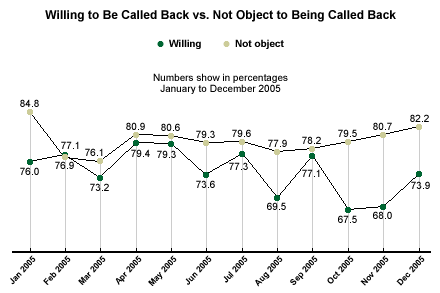
These findings suggest that when people are asked whether they "object" to being called back, or whether they are "willing" to be called back, about half the time there are question effects that make a difference, while the other half of the time the two questions obtain about the same results. It is not clear why differences are quite large in some months, and nonexistent in others. One clue may be the higher volatility of the "willing" question, which could possibly be more influenced by the questionnaire content than the "object" question. The "not object" percentages appear fairly stable, while the "willing" percentages bounce up and down.
Why didn't the "not object" percentages fluctuate as much as the "willing" percentages? Perhaps to say one "objects" to being called requires a higher threshold of contrariness than to say one is "not willing." Thus, when a questionnaire is particularly complex, it may be easier to refuse another request for an interview with the "willing" wording than with the "object" wording.
That, at least, is one hypothesis. I welcome any other ideas that any readers might be willing to send me.