GALLUP NEWS SERVICE
PRINCETON, NJ -- According to Gallup economic confidence trends, the public is in its sixth consecutive year of holding profoundly negative views about the U.S. economy. As of the latest Gallup Poll, conducted April 10-13, only 25% of Americans have a positive view of the economy while 55% have a negative view. Similarly, only 29% perceive that the economic news they have heard about lately has been mostly good, while 62% say it has been mostly bad. But if Americans are looking for someone to set a new economic course, it is not clear whom they have confidence in to do the job.
Only a handful of Americans have a "great deal" of confidence in the economic leadership of any of the national public figures with responsibility for the country's economic well-being -- including President Bush, the Republican and Democratic leaders in Congress, and the new Federal Reserve Board chairman, Ben Bernanke.
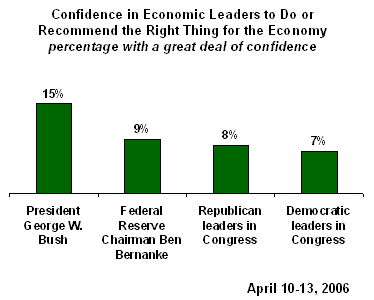
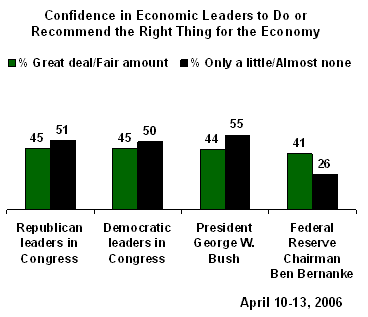
A majority of Republicans have a great deal or a "fair amount" of confidence in Bush, Bernanke, and the Republicans in Congress. A majority of Democrats have similar confidence in the Democrats in Congress. But none of these figures inspires confidence from a majority of all Americans.
When factoring in the percentage of all Americans with a fair amount of confidence in each of these leaders, the total percentage confident in any of them ranges from 41% to 45%.
Ratings Are Largely Partisan
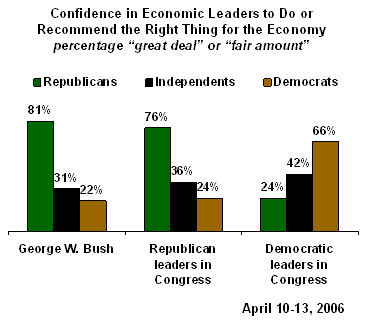
A majority of Republicans are confident in the economic leadership of President Bush and the Republican leaders in Congress, but most independents and Democrats take the opposite view. Similarly, Democrats tend to view the Democratic leaders in Congress positively, but independents and Republicans do not.
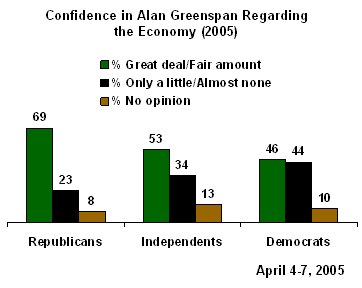
In past years, then-Fed Chairman Alan Greenspan came the closest to being a crossover economic leader. Even in 2005, when economic confidence ratings were down for all leaders, a majority of Republicans and independents, and close to half of Democrats, had at least a fair amount of confidence in Greenspan to do or recommend the right thing for the economy.
Ben Bernanke, the new Fed chairman, is less familiar to Americans than was his predecessor. With only two months on the job, about a third of Americans (34%) say they have no opinion of his job performance. But among those who do express a view, it is much more positive than negative. Forty-one percent have a great deal or fair amount of confidence in Bernanke; only 26% have only a little or almost none.
A majority of Republicans have confidence in Bernanke. However, unlike confidence in Bush and the Republican congressional leaders (and similar to Greenspan), confidence in Bernanke is less strongly polarized among independents and Democrats. About as many independents and Democrats have a positive as have a negative view of him.
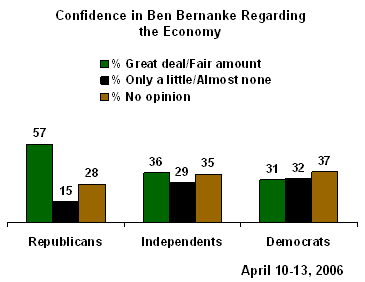
Thus, despite having been appointed by the president, it appears that Bernanke -- as was true for Greenspan and perhaps for the position of Federal Reserve chairman more generally -- is viewed in less partisan terms than are elected figures such as the president and members of Congress.
Declining Confidence Since 2001
Gallup has been tracking confidence in economic leaders each April since 2001 as part of its annual Economy and Finance Poll. Between 2001 and 2005, confidence in Bush to do or recommend the right thing for the economy fell 17 points (from 68% to 51%). It fell 24 points for the Democratic leaders in Congress, 19 points for the Republican leaders, and 18 points for Greenspan.
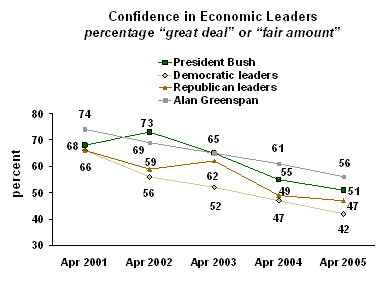
Between April 2005 and today, however, only Bush has suffered significant erosion in public confidence in his economic leadership.
Bush's confidence rating has declined by seven points, from 51% to 44%, at the same time that confidence in Republican leaders fell by only two points, and confidence in Democratic leaders increased by three points. (Greenspan was not rated in 2006 because he was replaced by Bernanke on February 1.)
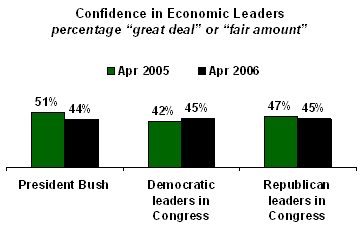
Interestingly, the long-term downward trends do not correspond with the trend in Americans' confidence in the economy itself, which has been relatively flat over the same period. For Bush, his economic confidence ratings instead appear to reflect other political dynamics, such as his "honeymoon" period in 2001, and the temporary surge in public confidence expressed in government leaders after 9/11. Reduced public support for the Iraq war over the past year -- the percentage saying it was worth going to war has fallen by 8 points -- may partly explain Americans' diminished ratings of Bush on the economy.
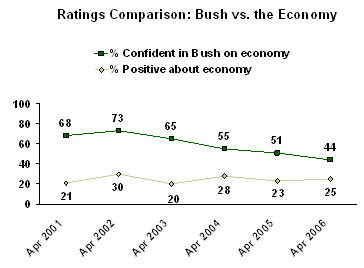
Comparing the trend in confidence about Bush's handling of the economy with the percentage of Americans rating the economy in positive terms underscores that there is little direct relation between the two perceptions. Despite minor increases and dips from one year to the next, the overall trend in ratings of the economy since 2001 has been flat, while confidence in Bush has clearly declined. The latter can be said of Republican and Democratic congressional leaders, as well as of Greenspan through 2005.
Bottom Line
With Greenspan's retirement, Americans have lost the only economic leader that might have had the necessary bipartisan public support to be a true national leader on the economy. Whether the economy needs fundamental policy changes to be implemented, or simply a respected voice to convince people that conditions are not as bad as they think, Greenspan was the closest America had to a nationally credible leader.
It is unclear how long it would take Bernanke to achieve Greenspan's prominence in the role of Fed chairman, if that's even possible. Greenspan, who was originally appointed by Ronald Reagan in 1987, held the position for nearly 20 years and served both Republican and Democratic administrations. But Bernanke's initial confidence ratings represent an auspicious beginning for him. At least they are fairly nonpartisan relative to those of Bush and congressional leaders.
Still, as seen in the trends since 2001, even Greenspan was not immune to the forces that caused public confidence in Bush and Congress on the economy to decline over the past five years. Bernanke comes into his job at a difficult time, when Americans are in a funk over both the economy and their economic leaders.
Survey Methods
These results are based on telephone interviews with a randomly selected national sample of 1,005 adults, aged 18 and older, conducted April 10-13, 2006. For results based on this sample, one can say with 95% confidence that the maximum error attributable to sampling and other random effects is ±3 percentage points. In addition to sampling error, question wording and practical difficulties in conducting surveys can introduce error or bias into the findings of public opinion polls.
13. As I read some names and groups, please tell me how much confidence you have in each to do or to recommend the right thing for the economy -- a great deal, a fair amount, only a little, or almost none. How about -- [ITEMS A-B ROTATED, THEN ITEMS C-D ROTATED]?
|
2006 Apr 10-13 |
|
|
Only a little/ |
|
% |
% |
% |
|
|
President George W. Bush |
15 |
29 |
55 |
|
Federal Reserve Chairman Ben Bernanke |
9 |
32 |
26 |
|
The Republican leaders in Congress |
8 |
37 |
51 |
|
The Democratic leaders in Congress |
7 |
38 |
50 |
Economic Confidence Trends
A. President George W. Bush
|
|
Great |
Fair |
Only |
Almost |
No |
|
% |
% |
% |
% |
% |
|
|
2006 Apr 10-13 |
15 |
29 |
16 |
39 |
1 |
|
|
|
|
|
|
|
|
2005 Apr 4-7 |
23 |
28 |
21 |
27 |
1 |
|
2004 Apr 5-8 |
24 |
31 |
20 |
24 |
1 |
|
2003 Apr 7-9 |
35 |
30 |
16 |
17 |
2 |
|
2002 Apr 8-11 |
36 |
37 |
15 |
11 |
1 |
|
2001 Apr 6-8 |
29 |
39 |
16 |
15 |
1 |
B. Federal Reserve Chairman Ben Bernanke
|
|
Great |
Fair |
Only |
Almost |
No |
|
2006 Apr 10-13 |
9% |
32 |
16 |
10 |
34 |
Trends for Comparison: Federal Reserve Chairman Alan Greenspan
|
|
Great |
Fair |
Only |
Almost |
No |
|
% |
% |
% |
% |
% |
|
|
2005 Apr 4-7 |
20 |
36 |
26 |
8 |
10 |
|
2004 Apr 5-8 |
21 |
40 |
23 |
7 |
9 |
|
2003 Apr 7-9 |
24 |
41 |
18 |
7 |
10 |
|
2002 Apr 8-11 |
25 |
44 |
15 |
5 |
11 |
|
2001 Apr 6-8 |
29 |
45 |
11 |
5 |
10 |
C. The Democratic leaders in Congress
|
|
Great |
Fair |
Only |
Almost |
No |
|
% |
% |
% |
% |
% |
|
|
2006 Apr 10-13 |
7 |
38 |
29 |
21 |
5 |
|
|
|
|
|
|
|
|
2005 Apr 4-7 |
8 |
34 |
36 |
19 |
3 |
|
2004 Apr 5-8 |
7 |
40 |
34 |
16 |
3 |
|
2003 Apr 7-9 |
11 |
41 |
26 |
19 |
3 |
|
2002 Apr 8-11 |
11 |
45 |
26 |
13 |
5 |
|
2001 Apr 6-8 |
15 |
51 |
18 |
12 |
4 |
D. The Republican leaders in Congress
|
|
Great |
Fair |
Only |
Almost |
No |
|
% |
% |
% |
% |
% |
|
|
2006 Apr 10-13 |
8 |
37 |
24 |
27 |
4 |
|
|
|
|
|
|
|
|
2005 Apr 4-7 |
12 |
35 |
26 |
24 |
3 |
|
2004 Apr 5-8 |
11 |
38 |
30 |
18 |
3 |
|
2003 Apr 7-9 |
18 |
44 |
21 |
14 |
3 |
|
2002 Apr 8-11 |
13 |
46 |
23 |
14 |
4 |
|
2001 Apr 6-8 |
15 |
51 |
18 |
12 |
4 |
14. Has the economic news you've heard or read about recently been mostly good or mostly bad?
|
|
Mostly |
Mostly |
MIXED |
No |
|
% |
% |
% |
% |
|
|
2006 Apr 10-13 |
29 |
62 |
5 |
3 |
|
|
|
|
|
|
|
2005 Apr 29-May 1 |
25 |
68 |
4 |
3 |
|
2004 Apr 5-8 |
40 |
53 |
5 |
2 |
|
2001 Aug 16-19 |
22 |
66 |
7 |
5 |
|
2001 Apr 6-8 |
16 |
75 |
6 |
3 |
|
2000 Apr 7-9 |
71 |
19 |
5 |
5 |
|
1997 Dec 18-21 |
51 |
37 |
7 |
5 |
|
1997 Jan 31-Feb 2 |
50 |
35 |
9 |
6 |
|
1996 Mar 15-17 |
37 |
50 |
9 |
4 |
|
1994 May 20-22 |
42 |
46 |
6 |
6 |
|
1993 Dec 4-6 |
39 |
48 |
9 |
4 |
|
(vol.) = Volunteered response |
||||
