GALLUP NEWS SERVICE
PRINCETON, NJ -- The war in Iraq should be the top priority for the president and Congress right now, according to a recent Gallup Panel poll. The public also says the government should be focused on immigration, the general state of the economy, energy or fuel prices, and healthcare. Republicans and Democrats differ substantially in their views of what they want the government to address, with Republicans more likely to mention immigration and terrorism, and Democrats more likely to say Iraq, the economy, or healthcare.
Overall Results
The poll was conducted Apr. 10-13, 2006 and involved interviews with 1,017 members of Gallup's household panel, which is recruited and sampled using random selection methods, and is weighted to be representative of the adult population. Respondents were asked to name -- without prompting -- what should be the "top priority for the president and Congress to deal with." The results show that nearly 3 in 10 Americans, 29%, say the war in Iraq should be the top priority. This is followed by immigration at 20%, the economy at 14%, the energy situation at 13%, and healthcare at 9%.
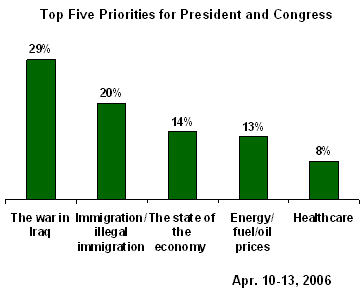
Other issues that were mentioned include national security, education, the federal budget deficit, unemployment or jobs, and terrorism. Here are the full results to the question:
|
What issue do you think should be the top priority for the |
|
|
2006 |
|
|
% |
|
|
Situation in Iraq/war |
29 |
|
Immigration/illegal aliens |
20 |
|
Economy in general |
14 |
|
Lack of energy sources; the energy crisis; fuel/oil prices |
13 |
|
Poor healthcare/hospitals; high cost of healthcare |
9 |
|
National security |
5 |
|
Education/poor education/access to education |
4 |
|
Federal budget deficit/federal debt |
3 |
|
Unemployment/jobs |
3 |
|
Terrorism |
3 |
|
Taxes |
2 |
|
International issues/problems |
2 |
|
Foreign aid/focus overseas |
2 |
|
Social Security |
2 |
|
Medicare |
2 |
|
High cost of living/inflation |
1 |
|
Lack of money |
1 |
|
Gap between rich and poor |
1 |
|
Environment/ pollution |
1 |
|
Poverty/hunger/homelessness |
1 |
|
Dissatisfaction with government/Congress/ |
1 |
|
Abortion |
1 |
|
Unifying the country |
1 |
|
Ethics/moral/religious/family decline; dishonesty; lack of integrity |
1 |
|
Judicial system/courts/laws |
1 |
|
|
|
|
Other |
2 |
|
|
|
|
No opinion |
3 |
These results are not very different from what Gallup found this month in response to its long-standing trend that asks Americans to name "the most important problem facing this country today." That survey finds 25% of Americans mention the war in Iraq as the most important problem facing the country, while 19% mention immigration, 11% fuel or oil prices, 10% the economy, and 8% dissatisfaction with government.
Partisan Views of the Nation's Priorities
Republicans (including independents who lean toward the Republican Party) and Democrats (including independents who lean toward the Democratic Party) differ significantly in their view of where the president and Congress should be focusing their attention.
Immigration and the current situation in Iraq are essentially tied as the top priority among Republicans. Among Democrats, the war in Iraq is the most salient issue.
|
Top Priorities by Party Affiliation |
||
|
Republicans |
Democrats |
|
|
% |
% |
|
|
Situation in Iraq/war |
25 |
31 |
|
Immigration/illegal aliens |
27 |
15 |
|
Economy in general |
9 |
17 |
|
Lack of energy sources; the energy crisis; fuel/oil prices |
14 |
14 |
|
Poor healthcare/hospitals; high cost of healthcare |
6 |
12 |
|
National security |
8 |
4 |
|
Education/poor education/access to education |
4 |
4 |
|
Federal budget deficit/federal debt |
3 |
3 |
|
Unemployment/jobs |
2 |
4 |
|
Terrorism |
5 |
* |
|
*Less than 0.5% |
||
Republicans are more likely than Democrats to mention immigration (27% vs. 15%) and terrorism (5% vs. <0.5%), while Democrats are more likely than Republicans to mention the economy (17% vs. 9%), healthcare (12% vs. 6%), and the war in Iraq (31% vs. 25%).
These results are consistent with what Gallup has found in analyses of recent results from its "most important problem" trend question.
Younger Americans Mention Fuel Prices, Older Americans Mention Immigration
The poll also finds some interesting differences between age groups, with fuel prices a higher priority for younger Americans; and immigration, Iraq, and national security a higher priority for older Americans.
|
Top Priorities by Age |
||||
|
18- to |
35- to |
50- to |
65 |
|
|
% |
% |
% |
% |
|
|
Situation in Iraq/war |
24 |
29 |
31 |
32 |
|
Immigration/illegal aliens |
15 |
20 |
19 |
30 |
|
Economy in general |
10 |
17 |
20 |
9 |
|
Lack of energy sources; the energy crisis; fuel/oil prices |
19 |
17 |
11 |
6 |
|
Poor healthcare/hospitals; high cost of healthcare |
7 |
10 |
12 |
7 |
|
National security |
2 |
5 |
6 |
10 |
|
Education/poor education/access to education |
5 |
2 |
4 |
4 |
|
Federal budget deficit/federal debt |
4 |
3 |
4 |
2 |
|
Unemployment/jobs |
2 |
3 |
2 |
3 |
|
Terrorism |
4 |
2 |
3 |
2 |
Overall, Iraq is the government's top priority for Americans in all age groups, but older Americans more frequently mention the war in Iraq.
Younger Americans are more likely than older Americans to say fuel prices are the government's top priority right now, with mentions of fuel or energy prices at 19% among 18- to 34-year-olds, 17% among 35- to 49-year-olds, 11% among 50- to 64-year-olds, and 6% among adults aged 65 and older.
Immigration is more frequently mentioned among Americans aged 65 and older. Thirty percent in this age group say immigration should be the top priority, compared with 15% of 18- to 34-year-olds, 20% of adults aged 35 to 49, and 19% of adults aged 50 to 64.
Ten percent of adults aged 65 and older mention national security as the government's top priority, while 2% of adults aged 18 to 34, 5% of adults aged 35 to 49, and 6% of adults aged 50 to 64, and 10% of adults aged 65 and older mention it.
Survey Methods
Results for the Gallup Panel study are based on telephone interviews with 1,017 national adults, aged 18+, conducted Apr. 10-13, 2006. Respondents were randomly drawn from Gallup's household panel, which was originally recruited through random selection methods. The panel was weighted prior to sampling so that it was demographically representative of the U.S. adult population. In addition to sampling error, question wording and practical difficulties in conducting surveys can introduce error or bias into the findings of public opinion polls.