GALLUP NEWS SERVICE
PRINCETON, NJ -- By almost any polling measure, Iraq is the top issue in this year's midterm elections. Given the close association between Iraq and the Republican administration, Democrats have the potential to capitalize on public dissatisfaction with the war in Iraq. But Gallup polling shows their ability to do so is far from certain. While Americans disapprove of Bush's handling of the war and believe that the Democrats in Congress would better handle the issue than Republicans, only one in four believe the Democrats have a clear plan on Iraq -- fewer than those who say this about the Bush administration. Also, Americans are about equally likely to say they would vote for a candidate who supports President Bush on Iraq as to vote for a candidate who opposes Bush.
Throughout the year, most polling has shown widespread dissatisfaction with the Bush administration's handling of the war in Iraq. In a Gallup Poll conducted in August of 2006, only 36% approved with George W. Bush's handling of the Iraq issue, and 61% were disapproving. These numbers are very typical of his ratings this year.
Not surprisingly, Americans have said throughout the year that the Democrats in Congress would do a better job handling the Iraq issue than the Republicans in Congress. When Gallup last asked this in late June of this year, the Democrats had a 47% to 37% advantage.
That perception is probably due more to an indictment of Republican performance than an endorsement of an alternative approach by the Democrats. Just 25% of Americans say the Democrats in Congress have a clear plan for handling the situation in Iraq. That percentage has been remarkably stable throughout the year. By comparison, 36% of American say George W. Bush has a clear plan -- still low, but significantly better than the Democrats.
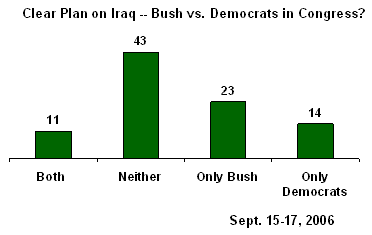
Combining the results of these questions shows the plurality of Americans, 43%, think neither Bush nor the Democrats have a clear plan on Iraq. Eleven percent of Americans think both sides have a clear plan. Of concern to the Democrats is the fact that only 14% say the Democrats have a clear plan but Bush does not, while a greater percentage (23%) says Bush has a clear plan but the Democrats do not.
Americans are divided as to whether they are more likely to vote for a candidate who supports (33%) or opposes (36%) Bush on Iraq; 29% say it makes no difference to them. This sentiment is closely related to respondents' vote intentions -- the vast majority who prefer a candidate who supports Bush on Iraq say they will vote for the Republican candidate in their district, and most who say they prefer a candidate who opposes Bush plan to vote Democratic. The Democrats have only a slight advantage among those who say the candidate's position on Iraq doesn't matter to them.
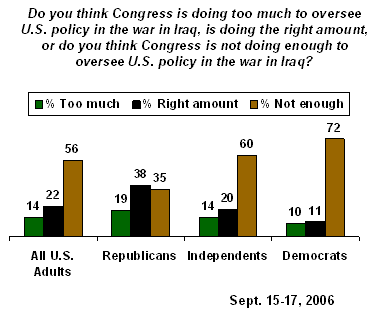
One change Americans might welcome is greater congressional involvement in Iraq policy. Fifty-six percent of Americans say Congress is not doing enough to oversee U.S. policy in this area, while 22% say it is doing the right amount, and 14% say it is doing too much.
It is unclear if the results would be the same if Democrats took control of Congress from Republicans after the midterm elections. What is clear is that Democrats strongly believe Congress should be more involved, perhaps due to their more general opposition to Bush and the Iraq war. Seventy-two percent of Democrats think Congress is not doing enough to develop Iraq policy. Republicans, on the other hand, are more divided in their views -- 38% say Congress is doing the right amount in this regard, 35% say it is not doing enough.
As Election Day draws near, one clear challenge for Democrats will be to capitalize on public dissatisfaction with the war in Iraq. It may not be sufficient to assume that unease with Republicans' handling the issue is enough to convince voters to elect Democrats in their place. Without a clear plan to demonstrate how they would do things differently, or, more importantly, the perception that they have a plan, Democrats remain vulnerable to the criticism that they would be no better, or perhaps worse, than Republicans on Iraq. This is especially the case given that Republicans are generally seen as better at handling foreign policy issues than Democrats.
One element of that plan which would likely appeal to Americans is a call for greater congressional involvement in Iraq policy, especially given Bush's low marks for handling the war. Democrats would also likely need to reinforce the perception that Bush lacks a clear plan on Iraq, and to convince people they should be electing members of Congress who would not support Bush on Iraq.
Developing a plan for Iraq that resonates with large numbers of voters is a difficult task. Recent Gallup data show that there is no public consensus on a plan for withdrawing troops from Iraq. Also, Americans are divided as to whether sending U.S. troops to Iraq in the first place was a mistake.
Survey Methods
These results are based on telephone interviews with a randomly selected national sample of 1,003 adults, aged 18 and older, conducted Sept. 15-17, 2006. For results based on this sample, one can say with 95% confidence that the maximum error attributable to sampling and other random effects is ±3 percentage points. In addition to sampling error, question wording and practical difficulties in conducting surveys can introduce error or bias into the findings of public opinion polls.9. Would you be more likely to vote for a candidate for Congress who supports President Bush on the war in Iraq, more likely to vote for a candidate who opposes President Bush on the war in Iraq, or would that not make much difference to your vote?
|
Supports |
Opposes |
Not much |
No |
|
|
Likely Voters |
% |
% |
% |
% |
|
2006 Sep 15-17 |
39 |
40 |
20 |
2 |
|
|
|
|
|
|
|
Registered Voters |
|
|
|
|
|
2006 Sep 15-17 |
34 |
37 |
27 |
2 |
|
2006 Aug 18-20 |
26 |
35 |
37 |
2 |
|
|
|
|
|
|
|
National Adults |
|
|
|
|
|
2006 Sep 15-17 |
33 |
36 |
29 |
2 |
|
2006 Aug 18-20 |
25 |
35 |
38 |
1 |
23. Do you think George W. Bush does -- or does not -- have a clear plan for handling the situation in Iraq?
|
Yes, |
No, |
No |
|
|
% |
% |
% |
|
|
2006 Sep 15-17 |
36 |
61 |
3 |
|
|
|
|
|
|
2006 Jun 23-25 |
31 |
67 |
2 |
|
2006 Mar 10-12 |
32 |
67 |
2 |
|
2005 Jun 29-30 |
38 |
58 |
4 |
|
2005 Jun 24-26 |
37 |
61 |
2 |
|
2005 Jan 14-16 ^ |
49 |
50 |
1 |
|
2004 Oct 1-3 |
49 |
49 |
2 |
|
2004 Sep 24-26 |
52 |
44 |
4 |
|
2004 Jul 30-Aug 1 |
42 |
56 |
2 |
|
2004 Jul 19-21 |
45 |
54 |
1 |
|
2003 Dec 15-16 † |
51 |
45 |
4 |
|
2003 Sep 8-10 † |
40 |
59 |
1 |
|
2003 Aug 25-26 † |
44 |
54 |
2 |
|
^ Asked in a rotation with other issues. |
|||
|
† WORDING: Do you think the Bush administration does -- or does not -- have a clear plan for handling the situation in Iraq? |
|||
24. Do you think the Democrats in Congress do -- or do not -- have a clear plan for handling the situation in Iraq?
|
Yes, |
No, |
No |
|
|
% |
% |
% |
|
|
2006 Sep 15-17 |
25 |
67 |
8 |
|
|
|
|
|
|
2006 Jun 23-25 |
25 |
68 |
7 |
|
2006 Mar 10-12 |
25 |
68 |
7 |
25. Do you think Congress -- [ROTATED: is doing too much to oversee U.S. policy in the war in Iraq, is doing the right amount, or do you think Congress is not doing enough to oversee U.S. policy in the war in Iraq]?
|
Too |
Right |
Not |
No |
|
|
% |
% |
% |
% |
|
|
2006 Sep 15-17 |
14 |
22 |
56 |
7 |