GALLUP NEWS SERVICE
PRINCETON, NJ -- A new USA Today/Gallup poll reflects very positive positioning for the Democrats in the minds of the American public -- at least for the moment. Americans are almost twice as likely to have a favorable opinion of Democrats as they do of Republicans, and a strong majority says they want the Democrats in Congress to have more influence over the direction of the country than President Bush.
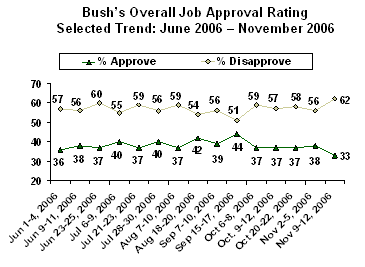
Additionally, Bush's job approval rating, now at 33%, is just two points away from being the lowest of his administration.
Who Should Control?
Data from the weekend USA Today/Gallup poll ratified the basic results of the election: Americans want Democrats to be in control.
Asked who they want to have more influence over the direction the nation takes in the next year, Americans by a two to one margin said the Democrats in Congress rather than Bush:
Who do you want to have more influence over the direction the nation takes in the next year -- [ROTATED: George W. Bush (or) The Democrats in Congress]?
|
Bush |
Democrats |
BOTH/NEITHER |
No |
|
|
% |
% |
% |
% |
|
|
2006 Nov 9-12 |
31 |
61 |
6 |
2 |
|
|
|
|
|
|
|
2002 Jan 11-14 ^ |
59 |
36 |
2 |
3 |
|
2001 Jul 10-11 |
50 |
38 |
9 |
3 |
|
2001 Jun 8-10 |
48 |
41 |
6 |
5 |
|
2001 Feb 9-11 |
48 |
41 |
8 |
3 |
|
(vol.) = Volunteered response |
||||
|
^ Asked of a half sample |
||||
Answers to this question are predictably different by the partisan orientation of the respondent, although Republicans are not quite as strong in their preference for Bush being the influencer as are Democrats for the Democrats in Congress. Independents are much more likely to say that Democrats in Congress should be in charge.
About half of Americans believe that the country will be better off with the Democrats in control of Congress. This is not a majority, but is higher now than prior to the election, when 39% held this sentiment. Now, only 16% of Americans say the country will be worse off under the Democrats, compared with 27% prior to the election. Currently, about a third of Americans perhaps somewhat cynically say that the change in control of Congress will make no difference.
Now that the Democrats have won control of Congress in this November's elections, do you think the country will be better off, worse off, or will it not make any difference?
|
Better off |
Worse off |
No difference |
No opinion |
|
|
|
|
|
|
|
|
2006 Nov 9-12 |
48% |
16 |
33 |
3 |
Trends for Comparison: Suppose the Democrats win control of Congress in this November's elections. Do you think the country would be better off, worse off, or would it not make any difference?
|
Better off |
Worse off |
No difference |
No opinion |
|
|
% |
% |
% |
% |
|
|
2006 Oct 20-22 |
39 |
27 |
32 |
2 |
|
2006 Sep 15-17 |
38 |
25 |
33 |
5 |
Trends for Comparison: If the Republicans win control of Congress, do you think the country will be better off, worse off, or will it not make any difference?
|
Better off |
Worse off |
No difference |
No opinion |
|
|
1994 Oct 7-9 |
34% |
18 |
45 |
3 |
Images of Parties, Key Players
The image of the Democratic Party remains significantly more positive in the eyes of Americans than the image of the Republican Party:
|
Image of the Democratic Party |
|||
|
Favor- |
Unfavor- |
No opinion |
|
|
2006 Nov 9-12 |
57% |
33 |
9 |
|
Image of the Republican Party |
|||
|
Favor- |
Unfavor- |
No opinion |
|
|
2006 Nov 9-12 |
35% |
58 |
7 |
The relatively high favorable ratings for the Democratic Party are a continuation of a pattern observed throughout the summer and fall. In similar fashion, the more negative ratings for the Republican Party also reflect what has been seen in previous months.
At the same time, this post-election poll shows that Americans have become slightly more positive about the Democrats and slightly less positive about the Republicans -- suggesting that the attitudes of Americans toward the two parties have become slightly more differentiated in the immediate aftermath of the election.
The last time in Gallup's measures that the Republican Party had a majority favorable image was in April 2005. The last time that the Democratic Party had less than a majority favorable image was in April of this year.
Cooperation?
Americans were greeted last week by extraordinary television and newspaper images of the Democratic leaders in the House and Senate sitting with President Bush in the Oval Office. Both the president and the Democratic leaders promised high levels of bipartisan cooperation in attempting to solve the issues facing the American public going forward.
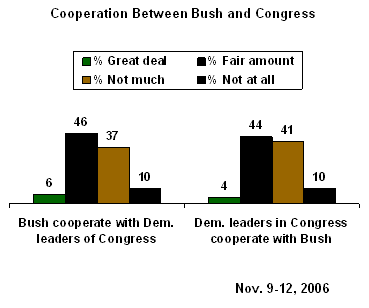
But the new weekend poll finds a certain degree of cynicism on the part of the American public. A sizable group of Americans doubt that such bipartisan cooperation will continue in the two years remaining before the 2008 election.
Just about half of Americans believe that Bush will put out a great deal or a fair amount of cooperation with the Democratic leaders in Congress, and slightly fewer say the same about the Democrats cooperating with Bush.
Bush Job Approval
It might have been hypothesized that President Bush's job approval rating would go up after last Tuesday's election, given the fact that immediately after the election, Bush fired Secretary of Defense Donald Rumsfeld, declared openness to new approaches to the war in Iraq, and engaged in the aforementioned bipartisan meetings with the new Democratic leadership in Congress.
But the president's job approval rating has fallen rather than increased. This perhaps reflects an alternative hypothesis that the president's role in the loss of his party's control of Congress has stuck in Americans' minds regardless of what he may have done in the days after the election.
At any rate, the new poll shows that Bush's job approval rating has dropped to 33% -- within two points of the lowest of the Bush administration. That compares to 38% in the USA Today/Gallup poll conducted just prior to the election:
Survey Methods
Results are based on telephone interviews with 1,004 national adults, aged 18 and older, conducted Nov. 9-12, 2006. For results based on the total sample of national adults, one can say with 95% confidence that the maximum margin of sampling error is ±3 percentage points. In addition to sampling error, question wording and practical difficulties in conducting surveys can introduce error or bias into the findings of public opinion polls.