GALLUP NEWS SERVICE
PRINCETON, NJ -- The majority of Americans have not been closely following news of the newly released report from the Iraq Study Group -- a group led by James Baker and Lee Hamilton -- and do not have a specific opinion about whether or not the Bush administration should adopt the group's recommendations. Among those Americans who do have an opinion, however, there is a very strong sentiment that the Bush administration should follow the group's recommendations.
Regardless of their familiarity with the Iraq Study Group, more than 7 in 10 Americans support three of the group's key recommendations in principle: withdrawing most combat troops from Iraq by 2008, negotiating directly with the Iranians and Syrians about regional security, and jumpstarting peace talks between the Israelis and the Palestinians. A significantly higher percentage of Americans say they trust the Iraq Study Group to make recommendations about Iraq than say they trust President George W. Bush. Americans have the most trust in the military when it comes to decisions about doing what is right in Iraq.
Iraq Study Group Report
Only 18% of Americans have followed news about the Iraq Study Group report released in early December very closely, and another 36% have followed news about the report somewhat closely.
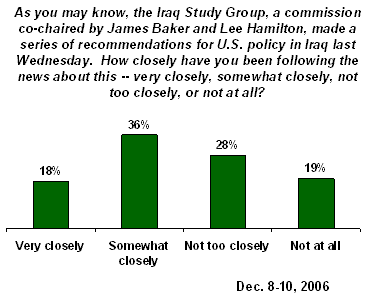
This level of attention being paid to the Iraq Study Group report is well below average by Gallup's historic measures of news events over the past decade and a half. Of about 170 news events included in Gallup's database, the average percent of Americans saying they are following particular news events very closely is 28%, while 71% have been following the events very or somewhat closely.
Perhaps because of the lower level of attention paid to the group's report, nearly two in three Americans say they do not know enough about the report to have an opinion about whether or not the Bush administration should follow its recommendations. But among those who do have an opinion, sentiment is clear. By almost a five to one margin, 29% to 6%, this group says that President Bush should implement the group's recommendations.
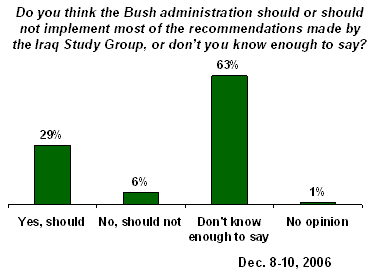
The relatively small group of those who claim to have followed the report very closely say by a 64% to 13% margin that Bush should implement the Iraq Study Group's recommendations.
Who Do You Trust About Iraq?
Americans were asked to rate their perceived trust in a list of six individuals and organizations in terms of recommending the "right thing for the United States to do in Iraq" The list included Bush, the Iraq Study Group, the U.S. military and defense department, Arizona Sen. John McCain, the U.S. State department, and the Democratic leaders in Congress.
Still thinking about Iraq, how much do you trust each of the following to recommend the right thing for the United States to do in Iraq -- a great deal, a fair amount, not much, or not at all? [RANDOM ORDER]
|
2006 Dec 8-10 |
Great Deal/Fair Amount |
Great deal |
Fair amount |
Not much |
Not |
No |
|
% |
% |
% |
% |
% |
% |
|
|
The U.S. military and defense department |
81 |
40 |
41 |
14 |
3 |
1 |
|
The Iraq Study Group |
66 |
20 |
46 |
19 |
7 |
8 |
|
Arizona Sen. John McCain |
63 |
19 |
44 |
23 |
6 |
9 |
|
The U.S. State department |
62 |
14 |
48 |
26 |
8 |
4 |
|
The Democratic leaders in Congress |
58 |
14 |
44 |
26 |
13 |
3 |
|
President George W. Bush |
46 |
18 |
28 |
24 |
28 |
1 |
The results show that Americans at this point have the least amount of trust in President Bush to do the right thing in Iraq (46% say they have a great deal or a fair amount of trust), and the most trust in the U.S. military and defense department (81%).
Americans have a good deal more trust in the Iraq Study Group to recommend the right thing to do in Iraq than they do in Bush, by a 66% (fair or great deal of trust) to 46% margin.
Specific Recommendations
The poll included a question asking Americans whether or not the Bush administration should follow each of three key recommendations from the Iraq Study Group. Gallup asked respondents about withdrawing most U.S. combat troops by 2008, negotiating directly with the Iranians and Syrians to promote regional security, and jumpstarting peace talks between the Israelis and the Palestinians. For each of the three choices given, about three-quarters of Americans say that the Bush administration should follow the group's recommendation.
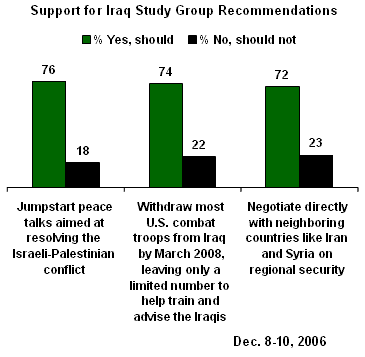
There are some partisan differences, but a majority of Republicans also favor each of these three recommendations.
Do you think the Bush administration should or should not follow each of these recommendations made by the Iraq Study Group?
|
Republicans |
Democrats |
|||||
|
Should |
Should |
No |
Should |
Should |
No |
|
|
% |
% |
% |
% |
% |
% |
|
|
Negotiate directly with neighboring countries like Iran and Syria on regional security |
62 |
32 |
6 |
80 |
17 |
3 |
|
Jumpstart peace talks aimed at resolving the Israeli-Palestinian conflict |
72 |
18 |
9 |
80 |
17 |
3 |
|
Withdraw most U.S. combat troops from Iraq by March 2008, leaving only a limited number to help train and advise the Iraqis |
68 |
27 |
5 |
80 |
17 |
3 |
Discussion
Overall, the poll results suggest that while Americans are not too familiar with the specifics of the initial Iraq Study Group report, they appear to be strongly sympathetic to its recommendations. In particular, Americans favor the idea of removing most combat troops from Iraq by 2008, negotiating with Iran and Syria, and jumpstarting the Israeli-Palestinian peace process.
The data suggest that President Bush is in a generally weak position with the American public in terms of making decisions about the Iraqi situation going forward. Less than half of Americans are willing to say that they have a great deal or a fair amount of trust in Bush to recommend the right actions for Iraq, some 20 percentage points lower than the percentage of Americans who trust the Iraq Study Group.
Survey Methods
Results are based on telephone interviews with 1,009 national adults, aged 18 and older, conducted Dec. 8-10, 2006. For results based on the total sample of national adults, one can say with 95% confidence that the maximum margin of sampling error is ±3 percentage points. In addition to sampling error, question wording and practical difficulties in conducting surveys can introduce error or bias into the findings of public opinion polls.