GALLUP NEWS SERVICE
PRINCETON, NJ -- Gallup's monthly update on key trends and indicators finds congressional job approval ratings down five percentage points this past month to 21%. This approval rating ties for the lowest of the year and is lower than the average for 2006. Americans' overall satisfaction with the way things are going in the country shows little change this month, with 30% of Americans saying they are satisfied. This satisfaction rating is on par with the average for the year. Americans continue to say the war in Iraq is the most important problem facing the country.
Congressional Job Approval
The Dec. 11-14, 2006 poll finds that only 21% of Americans approve and 74% disapprove of the job Congress is doing. Americans' ratings of Congress have declined slightly over the past two months, from 26% in October and November to 21% now. The current rating ties with this year's low point measured in early May.
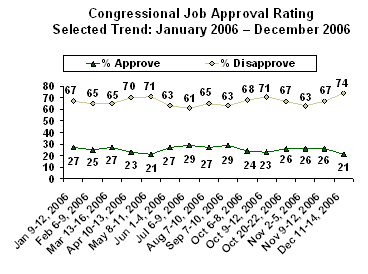
Congressional job approval ratings have been below 30% since October 2005. Prior to that, ratings of Congress had not been this low since 1994. The historic low point for Congress' approval rating was 18% in a March 1992 Gallup poll.
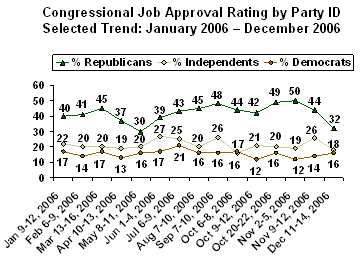
Over the course of the year, Republicans have been much more likely than independents and Democrats to approve of the job Congress is doing. In the current poll, 32% of Republicans approve of Congress' job performance, compared with 18% of independents and 16% of Democrats. Republicans' approval decreased substantially this month, from 44% in November to 32% now -- most likely reflecting the November midterm election results which will put the Democrats back in charge of the U.S. House and Senate next year for the first time in 12 years. Still, Republicans ratings were at this 30% level earlier this year, so the decline may not be entirely due to partisan factors. Approval of Congress among Democrats and independents has shown more modest variation since the start of the year.
Mood of the Nation
Thirty percent of Americans say they are satisfied with the way things are going in the country right now, while the majority of Americans, 69%, say they are dissatisfied. The current results are similar to the 31% satisfaction average since the start of the year and show little change over the past month. Satisfaction levels were higher at the beginning of the year, in the mid-30% range, but declined to as low as 25% in May. The percentage of Americans saying they were satisfied started to improve in June and climbed to 35% prior to the midterm elections in November, but since that time, Americans' satisfaction with the state of the nation has declined once again.
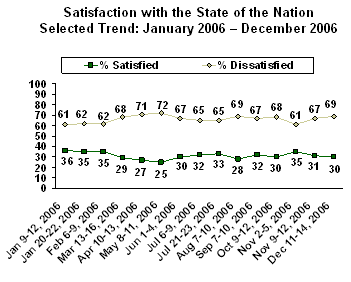
Gallup's current 30% satisfaction reading is quite low historically. Since 1979, the average percentage of Americans saying they are satisfied with conditions in the country has been 43%. In historical Gallup polls, satisfaction was lowest in July 1979 at 12% and highest in February 1999 at 71%.
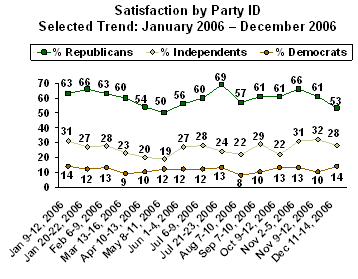
Fifty-three percent of Republicans say they are satisfied with the way things are going, while 28% of independents and only 14% of Democrats feel this way. Since the beginning of the year, Republicans have expressed a higher level of satisfaction than independents or Democrats. But, Republicans' satisfaction declined eight percentage points this month, from 61% to 53%. The current rating among Republicans is roughly the same Gallup found in April and May. As with Congress approval, general satisfaction with the direction of the country has shown less variation in 2006 among independents and Democrats than it has among Republicans.
Most Important Problem
The poll also asked Americans to name, in their own words, the "most important problem facing this country today." The war in Iraq continues to rank at the top of the list, with 29% of Americans mentioning this as the nation's most salient problem. Recent results are lower than the 36% recorded in November but is still roughly in line with what Gallup has measured since March. Following next on the list is dissatisfaction with government and politicians (9%), immigration (8%), ethics and morality (6%), terrorism (6%), healthcare-related issues (6%), and the general state of the economy (5%).
The war in Iraq is the top-named issue among Republicans, independents, and Democrats, but Democrats (39%) mention it much more frequently than do Republicans (22%). Republicans are more likely than Democrats to mention terrorism (14% vs. 3%), immigration (13% vs. 3%), and morality (8% vs. 1%). There are only modest variations between Republicans' and Democrats' mentions of government dissatisfaction and corruption, healthcare, or the general state of the economy.
|
Most Important Problem by Party
Affiliation |
|||
|
Republicans |
Independents |
Democrats |
|
|
% |
% |
% |
|
|
Situation in Iraq/war |
22 |
27 |
39 |
|
Terrorism |
14 |
4 |
3 |
|
Immigration/illegal aliens |
13 |
9 |
3 |
|
Ethics/moral/ |
8 |
8 |
1 |
|
Dissatisfaction with |
7 |
11 |
9 |
|
Poor healthcare/ |
4 |
5 |
8 |
|
Economy in general |
4 |
4 |
8 |
Survey Methods
Results are based on telephone interviews with 1,010 national adults, aged 18 and older, conducted Dec. 11-14, 2006. For results based on the total sample of national adults, one can say with 95% confidence that the maximum margin of sampling error is ±3 percentage points. In addition to sampling error, question wording and practical difficulties in conducting surveys can introduce error or bias into the findings of public opinion polls.