GALLUP NEWS SERVICE
PRINCETON, NJ -- As the GOP convention on Wednesday shifts its focus to the economy, Republicans may be reveling in the irony of recent Gallup polls that show that, while record numbers of Americans give the U.S. economy positive ratings, they have more confidence in George W. Bush to handle the economy than they do in Al Gore. Bush also does better than Gore on the issue of taxes, one of the centerpieces of the Bush campaign. Gallup polling shows that Americans tend to give both the Federal Reserve and Congress significant credit for the economy, blunting a major Democratic argument that a Gore election in November is necessary in order to continue the robust economic times.
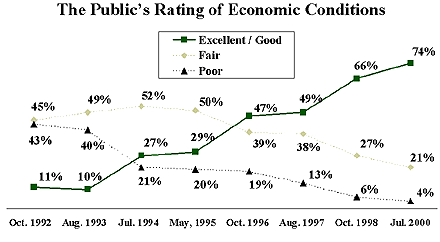
A Gallup poll conducted July 25-26 shows that Americans give the economy one of its highest ratings of the past eight years, with 74% saying the economic conditions in the country are either excellent (26%) or good (48%), while just 4% say they are poor. Eight years ago, shortly before George W. Bush's father, President George Bush, was ousted from office largely on the basis of a poor economy, the situation was dramatically different. At that time, only 11% of Americans rated the economy as good (less than 1% as excellent), and 43% as poor.
The ratings are even higher now than they were four years ago, when Bill Clinton and Al Gore were re-elected by a decisive margin. At that time, 47% of Americans rated the economy as excellent or good, 27 percentage points lower than now. And 19% said the economy was poor, 15 points higher than the current reading.
One might expect that, with such high economic ratings and the Democrats holding power in the White House, voters would see Vice President Gore rather than Governor Bush as better able to continue the economically good times. But the current Gallup poll shows that, in fact, voters are slightly more likely -- by a margin of 47% to 40% -- to say Bush rather than Gore would better handle the economy. In March and April this year, Gallup polls showed a virtual dead heat on this issue, with Gore enjoying a one-point lead in both months. Still, it is clear that Gore is not getting much benefit from the positive economic ratings, which increased during the Clinton administration. Indeed, the latest poll shows that even among those who say the economy is in excellent shape, Gore and Bush are virtually tied -- with 48% saying the vice president would handle the economy better, and 45% opting for Bush.
Perceived ability to handle the economy is not a trivial issue to Americans. In a poll completed last week, 86% of Americans said that the economy was an important factor in their decision on whom to vote for president, making this the second most important issue of those rated, just slightly behind education.
One reason Gore doesn't get more credit for the good economy may be that, in general, Americans give only partial credit to the Clinton administration for the positive economic changes over the past several years. In a Gallup poll conducted June 22-25, Americans gave about equal credit to Congress (44%) and to the administration (42%) for the good economic times, and by 53% to 38% they gave more credit to the Federal Reserve under Alan Greenspan than to the Clinton administration.
Issue of Taxes Traditional Strength of
Republicans
On Wednesday, Governor Jim Gilmore of Virginia is scheduled to
address the GOP convention on the subject of lowering taxes, a
major element of Bush's campaign proposals and an area typically
where Republicans have been perceived more favorably than
Democrats. The current poll reaffirms that pattern, showing Bush
with a 15-point advantage over Gore in the public's perceptions of
which candidate can better handle the issue. Earlier this year,
Bush's advantage was smaller, besting Gore by 9 points in April
(47% to 38%) and by 7 points in March (48% to 41%).
The tax issue, however, is not viewed quite as importantly as the economy, with 77% of Americans saying the candidates' positions on taxes will have at least a very important influence on their vote for president, compared with the 86% who characterize the economy that way. In addition, a poll last January suggests some complexities to this issue, as Americans said they would prefer more emphasis on reducing the national debt than cutting taxes, by a 54% to 41% margin, a position that appears at odds with Bush's proposals. On the other hand, Americans also favor Bush over Gore in handling the budget surplus, by a margin of 49% to 38%.
Cheney to Address Convention
The highlight Wednesday evening at the GOP convention will be an
address by Bush's choice for vice president, former Defense
Secretary Dick Cheney. A Gallup poll conducted the night before
Bush made his announcement official, but after much publicity about
who the choice would be, found Americans generally positive about
the selection. Fifty-five percent of registered voters rated
Cheney's selection as either excellent or pretty good, compared
with 34% who said the choice was either fair or poor. By 57% to
18%, voters said he was qualified to be president, and by 64% to
15% voters said the choice reflected favorably, rather than
unfavorably, on Bush.
It is clear that some of these views are based on little information about the vice presidential candidate, however. In the latest Gallup poll, conducted a couple of days after Cheney's selection, about four in ten Americans did not know enough about Cheney to give him either a favorable or unfavorable rating. But among those who did, the favorable outnumbered the unfavorable ratings by a 3-to-1 ratio, 46% to 15%.
The various recent ratings of Cheney suggest that his help to the Republican ticket will be considerably greater than that of Dan Quayle, former President Bush's choice in 1988. But Gallup polls also suggest that Cheney is unlikely to be as helpful to his ticket as was Jack Kemp to the Republican ticket in 1996, or Al Gore to the Democratic ticket in 1992.
Survey Methods
Results are based on telephone interviews with --1,035 -- national
adults, aged 18+, conducted July 25-26, 2000. For results based on
the total sample of national adults, one can say with 95%
confidence that the margin of sampling error is +/- 3 percentage
points.
Results based on likely voters are based on the subsample of --632 -- survey respondents deemed most likely to vote in the November 2000 General Election, according to a series of questions measuring current voting intentions and past voting behavior. For results based on the total sample of Likely Voters, one can say with 95% confidence that the margin of sampling error is +/- 4 percentage points.
In addition to sampling error, question wording and practical difficulties in conducting surveys can introduce error or bias into the findings of public opinion polls.