GALLUP NEWS SERVICE
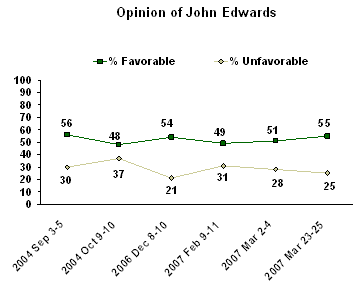
PRINCETON, NJ -- The majority of Americans, including two-thirds of Democrats, agree with former Senator John Edwards' decision to continue his presidential candidacy despite the recurrence of cancer affecting his wife, Elizabeth. Edwards' favorable rating did not increase significantly after the announcement. Similarly, there is no evidence that Edwards' announcement hurt his standing in the Democratic horse race, nor is there evidence that it has helped him significantly. A little more than one-third of Americans believe that Edwards will ultimately be forced to withdraw because of his wife's illness.
Basic Support
The basic reaction Americans give to Edwards' announcement that he will remain in the race is clear; they support it.
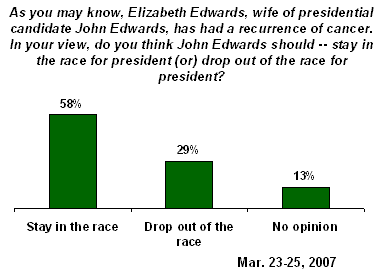
According to the Mar. 23-25, 2007, USA Today/Gallup poll, Democrats are significantly more likely than Republicans to say Edwards should remain in the race. This likely reflects the underlying reluctance of Republicans to say that any Democratic candidate should stay in the race.
|
"As you may know, Elizabeth Edwards, wife of presidential candidate John Edwards, has
|
|||
|
Should
|
Should
|
No
|
|
|
% |
% |
% |
|
|
Republicans |
43 |
40 |
17 |
|
Independents |
60 |
27 |
13 |
|
Democrats |
68 |
22 |
10 |
Will Edwards Withdraw?
Edwards has been firm that his campaign is running full speed ahead. However, there is a risk for Edwards that voters may shy away from supporting him because they assume his departure from the race over his wife's health is inevitable.
In fact, 38% of Americans believe Edwards will ultimately be forced to withdraw while half of Americans are confident he will remain in the race. There are few differences by partisanship in this perception.
|
"As you may know, Elizabeth Edwards, wife of presidential candidate John Edwards, has
|
|||
|
Will
|
Will Not
|
No
|
|
|
% |
% |
% |
|
|
TOTAL |
38 |
50 |
11 |
|
|
|
|
|
|
Republicans |
39 |
50 |
11 |
|
Independents |
40 |
45 |
14 |
|
Democrats |
35 |
58 |
7 |
Impact on Edwards' Image
Some may have expected at least a temporary uptick in favorable opinions of Edwards as a result of the news coverage he and his wife received last week. However, the new poll does not find this. Edwards' favorable rating edged up four points but this level of change is not statistically significant.
Impact on Edwards' Trial Heat Standing
Edwards now receives 14% of the vote from Democrats when asked whom they support for their party's nomination. This is up from the 9% he received in early March, but not higher than his standing in January and February when he received 13% of the vote. (Hillary Clinton remains the leader with 35% of the vote, followed by Barack Obama at 22%, and Al Gore at 17%). Given the lower sample sizes involved when only identifiers with one party are surveyed, small changes in the standings of the candidates are usually not significant. The strongest conclusion from the data, therefore, is that Edwards' announcement certainly did not hurt his standing among Democrats -- but there is no evidence that it had a significant positive effect, either.
Survey Methods
Results are based on telephone interviews with 1,007 national adults, aged 18 and older, conducted March 23-25, 2007. For results based on the total sample of national adults, one can say with 95% confidence that the maximum margin of sampling error is ±3 percentage points. For results based on the sample of 493 Democrats or Democratic leaners, the maximum margin of sampling error is ±5 percentage points. In addition to sampling error, question wording and practical difficulties in conducting surveys can introduce error or bias into the findings of public opinion polls.