GALLUP NEWS SERVICE
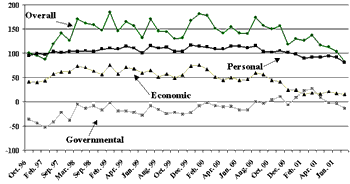
Princeton, NJ -- Overall investor optimism plunged 22 points to its lowest level ever this month and now registers 82, significantly below the level of 100 when the PaineWebber/Gallup Index of Investor Optimism was instituted in October, 1996. The following month, the Index slipped to 95, and at the end of the next quarter, in February, it slipped even further to 87. In June 1997, the Index surged to 119 and remained above 100 until this month.
The Index consists of three dimensions: measures of optimism about one's personal financial situation, the economy, and governmental policies that affect the investment climate. The largest declines last month occurred on the personal and governmental dimensions, each down by 10 points from June. While the economic dimension dropped only two points, it now matches its lowest level ever, first reached in February of this year. Since then, the economic index has fluctuated within a narrow range, climbing as high as 21 points two months ago, but averaging just 17 over the past six months -- far below its initial level of 41 points in October, 1996, and its high in January of last year at 75.
| Index of Investor Optimism October 1996 to July 2001 |
 |
Concerns About Federal Budget
Optimism about governmental policies that could affect the investment climate surged in the wake of the presidential election, but has declined 41 points in the past four months, from a positive 27 to a negative 14. Declining optimism about the federal budget accounts for most of the drop. It is, perhaps, a reflection of new estimates that the budget surplus is not as large as anticipated, and of general uncertainty in Congress about the shape of the budget for the coming fiscal year. Continued controversy over the large tax cut enacted by Congress has made it even more difficult for Republicans and Democrats to achieve consensus on the shape of the budget, perhaps undermining investor optimism about what might result.
Last March, investors expressed a net optimism about the budget, by a margin of 50% optimistic to 31% pessimistic. This 19-point net optimism has been replace by a net pessimism of 12 points -- with only 33% of investors optimistic today, and 45% pessimistic.
Positive Long-Term View of the Stock Market
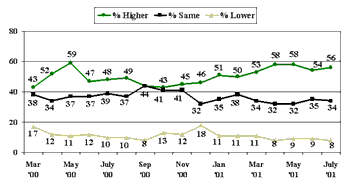
Despite the new low in the Index of Investor Optimism, investors remain bullish about the prospects of the economy and the stock market over the coming year. More than half of investors, 56%, expect the stock market to be higher next year than it is now, while just 8% say lower -- little changed over the past four months. In addition, investors' expectations for return on their investments over the next twelve months is an average of 10.4%, about the same as last month. Still, it is considerably higher that the actual average return of 4.9% reported by investors for the past year.
| Investors' Prediction of Stock Market Next Year Compared With This Year |
 |
Few Investors Expect to Spend Tax Rebate for New Purchases, But Say It Will Help Economy
One of the arguments in favor of the $300 to $600 federal tax rebate, which the federal government will send to most Americans beginning this week, was that the money would help stimulate the economy. But the current survey of investors reinforces a similar survey of the general public suggesting that the stimulus may not be as large as economists might prefer.
Ideally, to stimulate the economy, most Americans would spend the money for new purchases -- ones that they would not otherwise make. However, this survey of investors shows that just 17% expect to do that with their rebate -- identical to the figure obtained in a Gallup poll of the general public. Half of all investors expect either to save the rebate (42%) or invest it in the markets (8%). Another 29% say they expect to use the rebate to pay bills.
The vast majority of investors (89%) say the rebate will make little or no difference to them: 51% say it will have no real impact on them, while another 38% say it will help them only "a little bit." Just 3% say the rebate will help them "a lot," and another 8% say it will help a "moderate" amount.
Despite these views, a majority of investors (53%) think the rebate will have some positive impact on the economy: 5% say the rebate will help the economy a lot, while 48% say a little. A third (34%) think the rebate will have no impact one way or the other, while 12% say it will hurt the economy -- 8% a little, 4% a lot.
By a 58% to 38% margin, investors say it was better to send the tax rebates to the public than it would have been to spend the money on governmental programs like education and health.
Survey Methods
The results reported here are based on telephone interviews with a randomly selected national sample of 1,000 adult investors, 18 years and older, with at least $10,000 of investable assets, conducted July 1-15, 2001. For results based on this sample, one can say with 95 percent confidence that the maximum error attributable to sampling and other random effects is plus or minus 3 percentage points. In addition to sampling error, question wording and practical difficulties in conducting surveys can introduce error or bias into the findings of public opinion polls.
|
INDEX OF INVESTOR OPTIMISM |
||||
|
OVERALL |
PERSONAL |
ECONOMIC |
|
|
|
'01 July |
82 |
81 |
15 |
-14 |
|
'01 June |
104 |
91 |
17 |
-4 |
|
'01 May |
113 |
94 |
21 |
-2 |
|
'01 April |
116 |
92 |
16 |
8 |
|
'01 March |
137 |
92 |
18 |
27 |
|
'01 February |
126 |
89 |
15 |
22 |
|
'01 January |
130 |
98 |
24 |
8 |
|
'00 December |
118 |
101 |
24 |
-7 |
|
'00 November |
156 |
105 |
41 |
10 |
|
'00 October |
150 |
102 |
44 |
4 |
|
'00 September |
157 |
104 |
56 |
-3 |
|
'00 August |
174 |
115 |
59 |
* |
|
'00 July |
140 |
111 |
46 |
-17 |
|
'00 June |
141 |
114 |
44 |
-17 |
|
'00 May |
154 |
114 |
50 |
-10 |
|
'00 April |
141 |
108 |
44 |
-11 |
|
'00 March |
151 |
109 |
51 |
-9 |
|
'00 February |
178 |
113 |
67 |
-2 |
|
'00 January |
181 |
114 |
75 |
-8 |
|
'99 December |
167 |
116 |
74 |
-23 |
|
'99 November |
132 |
103 |
55 |
-26 |
|
'99 October |
130 |
103 |
49 |
-22 |
|
'99 September |
144 |
112 |
57 |
-25 |
|
'99 August |
145 |
110 |
51 |
-16 |
|
'99 July |
171 |
115 |
65 |
-9 |
|
'99 June |
131 |
100 |
59 |
-28 |
|
'99 May |
156 |
110 |
68 |
-22 |
|
'99 April |
165 |
114 |
71 |
-20 |
|
'99 March |
145 |
108 |
57 |
-20 |
|
'99 February |
184 |
110 |
76 |
-2 |
|
'98 December |
147 |
108 |
56 |
-17 |
|
'98 September |
158 |
104 |
63 |
-9 |
|
'98 June |
162 |
105 |
71 |
-14 |
|
'98 March |
171 |
104 |
73 |
-6 |
|
'97 December |
126 |
103 |
62 |
- 39 |
|
'97 September |
141 |
101 |
62 |
- 22 |
|
'97 June |
119 |
104 |
57 |
- 42 |
|
'97 February |
87 |
97 |
43 |
- 53 |
|
'96 November |
95 |
99 |
40 |
- 44 |
|
'96 October |
100 |
95 |
41 |
- 36 |
Have you heard about the tax rebate that the Internal Revenue Service, or IRS, is going to be sending to taxpayers this summer as part of the tax cut passed by Congress, or have you not heard of it?
|
01 July |
|
|
% |
|
|
Yes |
97 |
|
No, have not |
3 |
|
Don't Know/Refused |
0 |
|
100% |
Do you expect that you will, or will not, receive a rebate, or are you not sure about this? [BASED ON THOSE WHO HAVE HEARD ABOUT THE TAX REBATE; N = 964; MARGIN OF ERROR = +/- 3%]
|
01 July |
|
|
% |
|
|
Expect to receive rebate |
62 |
|
Expect not to receive rebate |
15 |
|
Not sure/DK/Refuse |
23 |
|
100% |
What are you most likely to do with the rebate? Are you most likely to (read 1-4)? [BASED ON THOSE WHO EXPECT TO RECEIVE A TAX REBATE OR AREN'T SURE; N = 846; MARGIN OF ERROR = +/- 4%]
|
01 July |
|
|
% |
|
|
Pay off bills or personal debt |
29 |
|
Make special purchases you would not otherwise have made |
17 |
|
Invest it in the markets |
8 |
|
Save it |
42 |
|
(Other) |
3 |
|
DK/Refused |
1 |
|
100% |
What impact will the tax rebate have on you, personally? Will it 1) help you a lot, 2) help you a moderate amount, 3) help you a little bit, OR 4) have no real impact? (Read 1-4 or read 4-1)? [BASED ON THOSE WHO EXPECT TO RECEIVE A TAX REBATE OR AREN'T SURE; N = 846; MARGIN OF ERROR = +/- 4%]
|
01 July |
|
|
% |
|
|
Help you a lot |
3 |
|
Help you a moderate amount |
8 |
|
Help you a little bit |
38 |
|
Have no real impact |
51 |
|
DK/Refused |
* |
|
100% |
What impact do you think the tax rebate will have on the nation's economy? Do you think it will 1) help the economy a lot, 2) help the economy a little, 3) have no impact one way or the other, 4) hurt the economy a little, OR 5) hurt the economy a lot? (Read 1-5 or read 5-1)? [BASED ON THOSE WHO HAVE HEARD ABOUT THE TAX REBATE; N = 964; MARGIN OF ERROR = +/- 3%]
|
01 July |
|
|
% |
|
|
Help the economy a lot |
5 |
|
Help the economy a little |
48 |
|
Have no impact one way or the other |
34 |
|
Hurt the economy a little |
8 |
|
Hurt the economy a lot |
4 |
|
DK/Refused |
1 |
|
100% |
Which do you think is better for the economy? 1) To send the tax rebate to the public, as will happen this summer, OR 2) To use the money to increase government spending on programs like the education and healthcare? (Read and rotate 1-2)
|
01 July |
|
|
% |
|
|
Send the tax rebate to the public |
58 |
|
Use the money to increase gov't spending on programs |
38 |
|
DK/Refused |
4 |
|
100% |
* -- Less than 0.5%