GALLUP NEWS SERVICE
PRINCETON, NJ -- Just prior to the Sept. 11 attacks, Gallup's economic data began to show a sharp drop in consumer perceptions of the economy. It seemed as though the only area of economic strength still resisting recession -- consumer optimism/consumer spending -- was finally beginning to crumble. As a result, it is not surprising that most economic observers simply assumed that the terrorist attacks would accelerate this deteriorating trend and send consumer perceptions of the economy to recessionary lows.
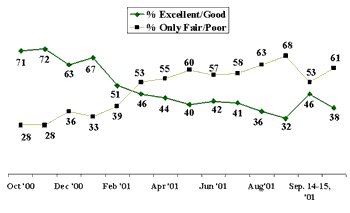
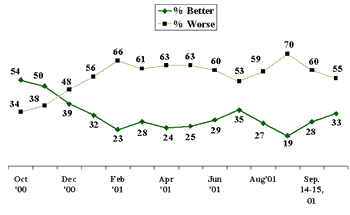
In fact, it appears as though the attacks had just the opposite effect. They seem to have halted the downward spiral in consumer perceptions of the economy and restored them to mid-summer levels. This may be, at least in part, a result of the so-called "rally effect," as Americans have sent approval ratings of the president and Congress to exceptionally high levels. Today, 38% rate the economy in positive terms -- excellent or good -- up slightly from 32% in a Gallup survey taken Sept. 7-10. Thirty-three percent say economic conditions as a whole are getting better in the United States, up from 19% just before the attacks.
Clearly, at least a partial explanation for these findings comes from the generally more supportive and upbeat environment among the American public found after the attacks. This weekend's Gallup poll (Oct. 11-14) shows that two out three Americans (67%) say they are satisfied with the way things are going in the United States at this time. This is the highest level of satisfaction in the United States since January of 2000 when the economy was still enjoying good times. Job approval for President George W. Bush has also maintained itself at a near record level and job approval ratings for Congress are higher than at any time in the last 27 years.
The fact that consumer perceptions have held up after Sept. 11 -- albeit it at low levels -- might also be the result of many Americans' re-evaluation about what is most important to them and their families. Maybe consumers have simply put the economy into a longer-term context. Maybe they have new confidence that the president and Congress will act to help the economy. Maybe the economic concerns troubling Americans prior to Sept. 11 suddenly don't seem as bad in contrast to the problems facing the nation's security. Or, maybe they feel that the terrorist attacks were aimed at damaging our economy, and economic pessimism helps accomplish that terroristic aim. Whatever the reasons, consumers are telling those who poll them that they are no less positive about the economy today than they were in early September.
Of course, the real question for the future is whether this leveling of consumer perceptions about the economy will positively impact consumer spending going into the Christmas season. Unfortunately, at this point no one can answer that question. What we do know is that even after leveling off, consumer perceptions of the economy remain very weak.
"Rally Effect" Has Some Staying Power
Gallup poll economic data gathered just before the Sept. 11 attacks (Sept. 7-10) showed that when consumers were asked to rate economic conditions in the country, only about one out of three (32%) said the economy was good or excellent. The Gallup poll (Sept. 14-15) immediately following the attacks showed a significant "rally effect" -- 45% of consumers rated the economy as good or excellent. By this past weekend (Oct. 11-14), some of the "rally effect" had dissipated, as 38% of consumers rated the economy as good or excellent. As a result, consumer perceptions of the economy are now back at their July-August levels.
Overall, it appears that the terrorist attacks and the associated "rally effect" have resulted in a leveling-off of consumer perceptions of the economy at a time when they appeared to be nose-diving. Although this is clearly a positive for the economic outlook, today's consumer perceptions are still quite poor when contrasted with those of a year ago (Oct. 6-9, 2000), when nearly three out of four consumers (71%) rated the U.S. economy as good or excellent.
| How would you rate economic conditions in
this country today -- as excellent, good, fair, or only
poor? October 2000 - October 2001 |
 |
Gallup Poll economic data gathered Sept. 7-10, just before the attacks, showed 70% of Americans saying economic conditions in the country were getting worse, while only 19% said they were getting better. The following poll (Sept. 14-15) showed that consumer perceptions -- instead of falling further -- had actually returned to their August 2001 level. Sixty percent of Americans said economic conditions in the country were getting worse while only 28% said they are getting better. This past weekend's poll (Oct. 11-14) shows a further improvement in consumer perceptions -- back to July 2001 levels -- with 55% of Americans saying economic conditions in the country are getting worse while 33% say they are getting better.
Still, even these October ratings stand in sharp contrast to consumer perceptions of just a year ago (Oct. 6-9, 2000), when 54% of consumers said economic conditions were getting better and only 34% said they were getting worse.
| Right now, do you think that economic
conditions in the country as a whole are getting better or getting
worse? October 2000 - October 2001 |
 |
"Rally Effect" May Not Prevent Recession, But . . .
Following the events of Sept. 11, most economic observers, in and out of government, pronounced that we were in a recession. According to this weekend's Gallup poll, only about half of all Americans (49%) agree. This is virtually unchanged from the 51% of Americans who felt we were in a recession prior to the terrorist attacks. It is far below the more than three-quarters of all Americans who acknowledged that we were experiencing a recession during the last U.S. recession of 1991-92.
All in all, if the United States moved into a recession in the aftermath of the Sept. 11 attacks, it is more likely to be the result of a disruption in business as opposed to a shattering of consumer optimism. Even now, the idea that the United States is experiencing its first recession in almost a decade has not filtered into the consciousness of the average American. As a result, the consumer sector may just continue to be the brightest aspect of the U.S. economy in the weeks and months ahead.
Do you think the economy is now in a recession, or not?
|
Yes |
No |
No opinion |
||
|
% |
% |
% |
||
|
2001 Oct 11-14 |
49 |
49 |
2 |
|
|
2001 Sep 21-22 |
52 |
43 |
5 |
|
|
2001 Sep 7-10 |
51 |
43 |
6 |
|
|
2001 May 10-14 |
33 |
62 |
5 |
|
|
2001 Apr 6-8 |
42 |
52 |
6 |
|
|
2001 Mar 5-7 ^ |
31 |
64 |
5 |
|
|
2001 Feb 1-4 ^ |
44 |
49 |
7 |
|
|
1994 May 20-22 |
35 |
61 |
4 |
|
|
1994 Feb 26-28 |
34 |
62 |
4 |
|
|
1993 Dec 4-6 |
45 |
50 |
5 |
|
|
1992 Sep 11-15 |
79 |
19 |
2 |
|
|
1992 Jan 3-6 |
84 |
14 |
2 |
|
|
1991 Mar |
81 |
16 |
4 |
|
|
^ |
Based on half sample. |
|||
Survey Methods
These results are based on telephone interviews with a randomly selected national sample of 1,011 adults, 18 years and older, conducted Oct. 11-14, 2001. For results based on this sample, one can say with 95 percent confidence that the maximum error attributable to sampling and other random effects is plus or minus 3 percentage points. In addition to sampling error, question wording and practical difficulties in conducting surveys can introduce error or bias into the findings of public opinion polls.