GALLUP NEWS SERVICE
PRINCETON, NJ -- The public opinion context for President Bush's proposed budget, the details of which were released yesterday, appears to be positive. Americans favor the president's approach to the budget over the approach of the Democrats in Congress by a 50% to 38% margin, and almost six in 10 Americans agree with the president that military spending should be given the highest priority in the budget. At the same time, there are significant partisan differences -- Republicans are much more likely than independents and Democrats to favor making defense spending the highest priority. Americans are also split on the necessity of running a federal budget deficit.
The Bush administration budget proposes over $2.1 trillion in spending for the next fiscal year, including up to $369 billion for military spending, and as much as $38 billion for homeland security. The budget would limit spending in other, non-defense areas, and would also return the nation to deficit spending for the first time in several years. Some Democrats in Congress are responding negatively to the proposed budget. They criticize the return to deficit spending, and contend that the budget would dip into the Social Security surplus.
Perhaps not surprisingly, given his 84% job approval rating and overall positive standing in the eyes of the public, Bush has the apparent upper hand with the American public in terms of budgetary matters:
When it comes to dealing with the tough choices involved in the federal budget, BOTH in deciding how much Americans should pay in taxes AND funding needed federal programs, whose approach do you prefer -- [ROTATED: President Bush's (or) the Democrats in Congress]?
BASED ON -- 527 -- NATIONAL ADULTS IN FORM A; ±5 PCT. PTS.
|
|
|
BOTH |
NEITHER (vol.) |
No |
|
|
(NA) 2002 Jan 11-14 |
50% |
38 |
1 |
2 |
9 |
Bush's approach is chosen by half of all Americans, compared to 38% who choose the Democrats.
The public's support is even stronger for giving defense spending a dominant place in the budget. Asked directly if "defense spending should be given the highest priority, or are there other programs which deserve a higher priority," 58% of Americans come down on the side of defense spending, while just 38% choose "other programs."
Thinking about all of the programs the federal government spends money on, do you think defense spending should be given the highest priority, or are there other programs which deserve a higher priority?
|
|
Defense deserves highest priority |
Other programs deserve higher priority |
No |
|
(NA) 2002 Jan 25-27 |
58% |
38 |
4 |
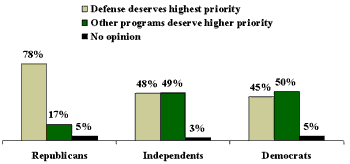
There are big partisan differences in response to this question, however. An overwhelming 78% of Republicans back defense spending as the highest priority, as compared to just 48% of independents and 45% of Democrats. These partisan differences may well presage battles in Congress as debate on the budget heats up in the months ahead.
| Top Federal Spending Priority: Defense Spending or Other Programs? |
 |
| Jan 25-27, 2002 |
The new budget would return the country to deficit spending for the first time in several years. Although the Bush administration contends that deficit spending is a necessity in the current wartime environment (and while the country is mired in a recession), the American public is roughly split on the issue. About half of Americans, given a choice, agree that a deficit is necessary "when the country is in a recession and is at war," while almost as many, 46%, say that it is still important to balance the budget. Republicans are -- interestingly -- a little more likely than Democrats to support the idea of running a deficit, by a 60% to 47% margin.
Which of the following comes closer to your view of the budget deficit -- [ROTATED: the government should run a deficit if necessary when the country is in a recession and is at war, (or) the government should balance the budget even when the country is in a recession and is at war]?
BASED ON -- 527 -- NATIONAL ADULTS IN FORM A; ±5 PCT. PTS.
|
Run a deficit |
Balance |
No |
|
|
(NA) 2002 Jan 11-14 |
51% |
46 |
3 |
Survey Methods
These results are based on telephone interviews with a randomly selected national samples of 1,008 adults, and 1,011 adults, 18 years and older, conducted January 11-14, and January 25-27 2002. For results based on these samples, one can say with 95 percent confidence that the maximum error attributable to sampling and other random effects is plus or minus 3 percentage points. In addition to sampling error, question wording and practical difficulties in conducting surveys can introduce error or bias into the findings of public opinion polls.
(vol.) -- Volunteered response