New Gallup poll economic data (April 8-11)* show that for the second month in a row, more Americans (53%) say that economic conditions in the country as a whole are getting better as opposed to getting worse (37%). This is a dramatic positive change since last year in the direction of consumer expectations about the economy. For example, in response to a poll conducted April 6-8, 2001, nearly 63% of Americans said economic conditions were getting worse, and only 24% said things were getting better. Even more importantly, Americans remain very positive about the outlook for their own personal financial situations this April, with 54% saying their situation is getting better and only 27% saying it is getting worse -- about the same percentages as observed last month.
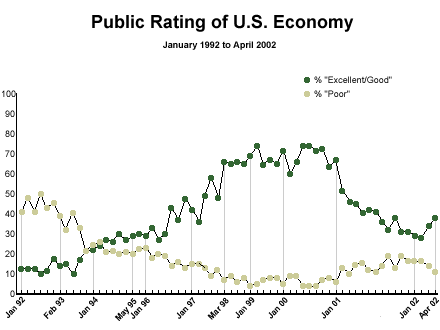
The key question is whether economic reality will turn out to justify the average American's continued optimism about the coming recovery. In this regard, consumers say they have just begun to see the improvements usually associated with an economic upturn. Their ratings of the current overall economy have improved since March. However, consumers also tell Gallup that their own personal financial situations have not improved since last month, and that they do not intend to change their spending and savings plans very much from late last year. Clearly, although American consumers are again serving to maintain the current level of economic activity, it does not appear that consumer will increase their spending levels and lead the economic recovery of 2002. This in turn suggests that the recovery may be much more modest than many prognosticators expect.
Consumer Expectations Remain Positive
Americans' expectations about the economy continue to be quite positive. Fifty-seven percent (57%) currently say that economic growth will increase over the next six months, while 18% predict it will decrease. This ratio is down somewhat from last month's ratio of 61% to 14%, but still represents a strong expectation of economic growth.
Of course, stronger economic growth -- not to mention the potential for an oil shock -- suggests that both inflation and interest rates will increase from their current low levels. About six out of 10 American consumers believe that inflation (58%) and interest rates (59%) will go up over the next six months, while fewer than 15% expect either of them to decline. Still, even as they expect the economy to improve during the coming months, there are more consumers who expect the unemployment rate to go up (47%) than who expect it to go down (32%).
Although fewer than half of Americans (45%) believe the stock market will rise over the next six months, only 26% say they expect it to decline. These figures are somewhat less positive than they were last month, when more Americans said they expected the stock market to rise over the next six months than fall by a margin of 56% to 13%. However, the April outlook is still very strong considering the situation in the Middle East, the war on terrorism, and ongoing concerns about "Enronitis."
SUMMARY TABLE: FINANCIAL OUTLOOK
|
2002 April 8-11 |
Total |
Remain |
Total |
|
% |
% |
% |
|
|
Stock Market |
45 |
23 |
26 |
|
Economic Growth |
57 |
23 |
18 |
|
Unemployment |
47 |
20 |
32 |
|
Inflation |
58 |
29 |
10 |
|
Interest Rates |
59 |
24 |
14 |
Consumers Have Yet to Note Improved Economic Conditions
Although consumer expectations for the economy's future remain strong, the public's sentiment toward current economic conditions is up only moderately from last month. Overall, 38% of Americans rate the current economy as excellent or good, while 11% rate it as poor. This is up slightly from March when 34% rated the economy excellent/good and 14% rated it poor. While this is the highest percentage of Americans who have rated the economy as excellent or good since October 2001, it remains below even the relatively weak level seen a year ago, when 45% gave ratings of excellent or good. Two years ago (April 3-9, 2000), 60% of American consumers rated economic conditions as excellent or good.
About half of all Americans (52%) currently rate their own financial situations as excellent/good. This figure hasn't changed since last month, but is down slightly from January, when 54% of Americans rated their own financial situations as excellent/good.
Despite Rising Incomes, Consumers Are Saving More While Borrowing/Spending Less
In April 2002, 41% of consumers say they will decrease the amount of money they owe "a lot" or "a little" over the next six months -- not much different from January's figure of 44%. In April, only 13% of consumers say they will increase their debt level -- not a good sign for retailers. Similarly, 40% of consumers say they expect to increase their monthly savings a lot or a little over the next six months, about the same as in January (42%). In April, only 10% of consumers said they expect to decrease the amount they save monthly a lot or a little.
Still, 44% of consumers say they expect their incomes to increase a lot or a little over the next six months, down slightly from January (48%). In the April survey, fewer than one in 10 consumers (8%) said they expect their incomes to go down a lot or a little over the next six months.
Finally, 24% of consumers currently say their level of spending will decrease over the next six months. This is down from the 27% in January and 29% in November. Twenty-three percent (23%) of consumers say their spending will increase -- about equal to the number who say their spending will decrease. With just as many consumers saying that their spending during the next six months will decrease as increase, it is hard to believe that consumer spending alone could result in anything more than a modest economic recovery in 2002.
PERSONAL FINANCIAL SITUATION TABLE
|
Percentage Increasing "a Lot" or "a
Little" |
Apr |
Jan 7-9 |
Dec |
Nov |
Oct |
|
% |
% |
% |
% |
% |
|
|
Level of income |
44 |
48 |
45 |
35 |
39 |
|
Level of monthly savings |
40 |
42 |
40 |
35 |
33 |
|
Percentage Decreasing "a Lot" or "a
Little" |
Apr |
Jan 7-9 |
Dec |
Nov |
Oct |
|
% |
% |
% |
% |
% |
|
|
Level of spending |
24 |
27 |
26 |
29 |
28 |
|
Level of debt |
41 |
44 |
44 |
36 |
43 |
*These results are based on telephone interviews with a randomly selected national sample of 1,002 adults, aged 18 and older, conducted April 8-11, 2002. For results based on this sample, one can say with 95% confidence that the maximum error attributable to sampling and other random effects is ±3%. In addition to sampling error, question wording and practical difficulties in conducting surveys can introduce error or bias into the findings of public opinion polls.