GALLUP NEWS SERVICE
PRINCETON, NJ -- The latest CNN/USA Today/Gallup poll shows that Democrats have moved ahead of Republicans in the race to control the U.S. House of Representatives, and that Democrats now enjoy a slight lead on handling the economy. The poll also suggests that recent news reports of corporate abuses may be hurting the electoral chances of Republicans, who are perceived as more likely to represent large corporations than to represent the interests of ordinary Americans.
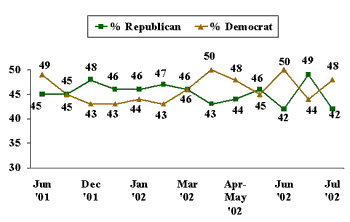
The poll was conducted July 26-28, and shows that Democrats now lead Republicans on the generic ballot by six percentage points among registered voters, 48% to 42%. However, there has been a great deal of volatility on this measure of voter intention over the past several weeks, with Republicans leading by five points in a June 28-30 poll, and Democrats leading by eight points a week before that. Among registered voters in the current poll who say they are "certain" to vote, the margin in favor of Democrats is just four percentage points, 48% to 44%.
| If the elections for Congress were being
held today, which party's candidate would you vote for in your
Congressional district? (Among Registered Voters) |
 |
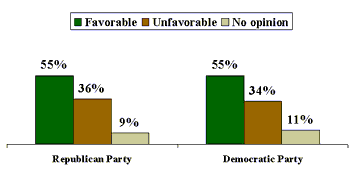
The volatility is likely to continue for the next several weeks, as many voters have yet to focus on the issues that will dominate the election. Despite the current Democratic lead on the ballot question, the poll shows that the parties are viewed equally favorably. Fifty-five percent of Americans say they have a favorable opinion of each of the two parties -- 36% say they are unfavorable about the Republican Party and 34% about the Democratic Party.
| Opinion of Political Parties |
 |
| Jul 26-28, 2002 |
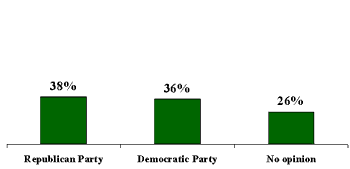
In addition, about an equal number of Americans say each party would do the better job in dealing with what they indicate is the most important problem facing the country.
| Which political party do you think can do a better job of handling the problem you think is most important -- the Republican Party or the Democratic Party? |
 |
| Jul 26-28, 2002 |
These results show that at a general level, the two parties elicit about the same overall level of support. This conclusion is further reflected in the party identification. The current poll shows that the number of Americans who identify with each of the two major parties is about the same: 32% Republicans, 33% Democrats and 34% independents.
Republicans Harmed Only Slightly by Corporate Abuses
Despite the similar levels of overall support, on different issues the parties are viewed quite differently, and the November election will depend very much on which issues dominate the campaign. If the election were to focus primarily on the war on terrorism, for example, Republicans would probably win handily. A Gallup poll last month showed that by an overwhelming margin of 35 percentage points, 57% to 22%, Americans thought the Republicans more than the Democrats would do the better job of dealing with terrorism. But Democrats have been very careful to indicate their support for the war on terrorism, and for the most part there has been little disagreement between the parties on this issue.
On other issues, however, there are major inter-party differences. And on some of the most salient of these issues, Democrats are perceived more favorably than Republicans. In a June 28-30 poll, Democrats were seen as better able to deal with the problems of corporate behavior ("making sure large corporations act responsibly"), Social Security and prescription drugs for older Americans by margins of 10 to 17 percentage points.
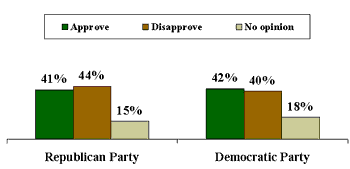
The current poll suggests that the issue of corporate responsibility may be up for grabs, though Democrats still seem to have an advantage. Overall, 44% of Americans disapprove of the way Republicans in Congress have handled the issue of corporate corruption, compared with 41% who disapprove of the Democrats. These results show only a slight advantage for the Democrats.
| Opinion of Party's Handling of Corporate Corruption |
 |
| Jul 26-28, 2002 |
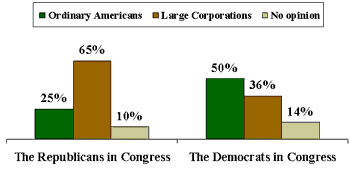
At the same time, Americans appear to have more confidence in the Democrats than the Republicans to represent their interests against large corporations. As shown in the next chart, the public perceives Democrats as representing "ordinary Americans" much more than do Republicans.
| Political Parties: Protecting Interests of Large Corporations or Ordinary Americans? |
 |
| Jul 26-28, 2002 |
While Democrats enjoy a 14-point margin in favor of ordinary Americans over large corporations, Republicans have a 40-point margin in favor of large corporations.
Democrats Now Enjoy Slight Lead Over Republicans in Handling the Economy
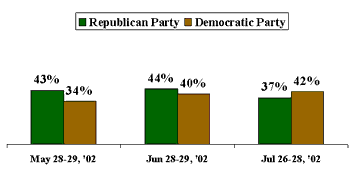
In the past two months, the public's perceptions about which party can best deal with the economy have shifted. Currently, 42% of all Americans say Democrats in Congress would do a better job than Republicans in dealing with the economy, while 37% take the opposite point of view -- a five-point advantage to the Democrats. Two months ago, the Republicans enjoyed a nine-point lead, and last month a four-point lead.
| Which Party Would Do a Better Job Dealing With the Economy? |
 |
Among registered voters, Democrats enjoy a seven-point lead, but among people who say they are "certain" to vote, the lead is just three percentage points.
Survey Methods
The results reported here are based on telephone interviews with a randomly selected national sample of 1,004 adults, 18 years and older, conducted July 26-28, 2002. For results based on the total sample of national adults, one can say with 95% confidence that the margin of sampling error is +/- 3 percentage points.
Results reported on registered voters are based on the subsample of 886 survey respondents who indicated they were registered to vote or didn't need to register. For results based on the sample of registered voters, one can say with 95% confidence that the margin of sampling error is +/- 4 percentage points.
If the elections for Congress were being held today, which party's candidate would you vote for in your Congressional district -- [ROTATE: 1) The Democratic Party's candidate or 2) The Republican Party's candidate]?
As of today, do you lean more toward -- [ROTATE: 1) The Democratic Party's candidate or 2) The Republican Party's candidate]?
|
Democratic |
Republican |
Undecided/ |
|
|
% |
% |
% |
|
|
National Adults |
|||
|
(NA) 2002 Jul 26-28 |
47 |
40 |
13 |
|
(NA) 2002 Jun 28-30 |
44 |
46 |
10 |
|
(NA) 2002 Jun 21-23 |
48 |
40 |
12 |
|
(NA) 2002 May 28-29 |
44 |
45 |
11 |
|
(NA) 2002 Apr 29-May 1 |
47 |
43 |
10 |
|
(NA) 2002 Apr 5-7 |
50 |
40 |
10 |
|
(NA) 2002 Mar 22-24 |
45 |
43 |
12 |
|
(NA) 2002 Feb 8-10 |
42 |
44 |
14 |
|
(NA) 2002 Jan 25-27 |
45 |
44 |
11 |
|
(NA) 2002 Jan 11-14 |
44 |
44 |
12 |
|
(NA) 2001 Dec 14-16 |
44 |
46 |
10 |
|
(NA) 2001 Nov 2-4 |
43 |
44 |
13 |
|
(NA) 2001 Jun 8-10 |
50 |
43 |
7 |
|
Registered Voters |
|||
|
(RV) 2002 Jul 26-28 |
48 |
42 |
10 |
|
(RV) 2002 Jun 28-30 |
44 |
49 |
7 |
|
(RV) 2002 Jun 21-23 |
50 |
42 |
8 |
|
(RV) 2002 May 28-29 |
45 |
46 |
9 |
|
(RV) 2002 Apr 29-May 1 |
48 |
44 |
8 |
|
(RV) 2002 Apr 5-7 |
50 |
43 |
7 |
|
(RV) 2002 Mar 22-24 |
46 |
46 |
8 |
|
(RV) 2002 Feb 8-10 |
43 |
47 |
10 |
|
(RV) 2002 Jan 25-27 |
44 |
46 |
10 |
|
(RV) 2002 Jan 11-14 |
43 |
46 |
11 |
|
(RV) 2001 Dec 14-16 |
43 |
48 |
9 |
|
(RV) 2001 Nov 2-4 |
45 |
45 |
10 |
|
(RV) 2001 Jun 8-10 |
49 |
45 |
6 |
Do you think the Republicans in Congress or the Democrats in Congress would do a better job of dealing with the economy?
|
|
|
NO DIFFERENCE (vol.) |
No |
||
|
2002 Jul 26-28 |
37% |
42 |
13 |
8 |
|
|
2002 Jun 28-30 |
44% |
40 |
10 |
6 |
|
|
2002 May 28-29 ^ |
43% |
34 |
13 |
10 |
|
|
^ |
Asked of a half sample. |
||||
Do you approve or disapprove of the way [ROTATED] are handling the issue of corporate corruption?
A. The Republicans in Congress
|
Approve |
Disapprove |
No opinion |
|
|
2002 Jul 26-28 |
41% |
44 |
15 |
B. The Democrats in Congress
|
Approve |
Disapprove |
No opinion |
|
|
2002 Jul 26-28 |
42% |
40 |
18 |
Q.15/Q.16 SPLIT SAMPLED
Do you think -- [ITEMS ROTATED] -- are more interested in -- [ROTATED: protecting the interests of ordinary Americans (or are they more interested in) protecting the interests of large corporations]?
BASED ON --496-- NATIONAL ADULTS IN FORM A
A. The Democrats in Congress
|
Ordinary Americans |
Large corporations |
No opinion |
|
|
2002 Jul 26-28 |
50% |
36 |
14 |
|
2002 Jun 28-30 |
55% |
36 |
9 |
B. The Republicans in Congress
|
Ordinary Americans |
Large corporations |
No opinion |
|
|
2002 Jul 26-28 |
25% |
65 |
10 |
|
2002 Jun 28-30 |
30% |
62 |
8 |