The professional sports world was shocked by the death of Baltimore Orioles pitcher Steve Bechler, who died of heat stroke after a spring training workout on Feb. 17. A Florida medical examiner later announced that the 23-year-old's death was linked to his use of a dietary supplement containing the controversial substance ephedra, which Bechler was taking in an attempt to lose weight. Although the herb ephedra (and drugs containing it, such as ephedrine and Xenadrine RFA-1 -- the supplement Bechler used) is available without a prescription and not currently banned by Major League Baseball, the U.S. Department of Health and Human Services has warned that ephedra-based products could present serious health risks.
Many baseball team owners have spoken out in favor of banning the use of ephedra among players, but the powerful baseball players' union currently opposes such a ban. It appears that the majority of Americans would side with the owners in this dispute. In a Feb. 26 poll*, Gallup asked Americans whether they would "favor or oppose a decision by Major League Baseball to ban the use of the dietary supplement known as ephedrine by its players." Nearly two-thirds of respondents (65%) said they would favor a ban, while 23% said they would oppose it, and 12% had no opinion.
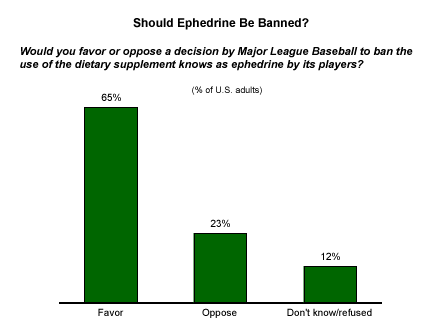
Although a majority of Americans in virtually every key demographic group think that Major League Baseball should ban the supplement, there are some differences of opinion by education level, as well as income. Seventy-six percent of college graduates favor a ban on ephedrine, yet only 55% of Americans with a high school education or less feel that ephedrine should be banned. While the smaller level of support on the part of those with a high school education or less is partly due to the fact that they are less likely to express an opinion on the matter, members of this group are twice as likely to oppose a ban (32%) than college graduates are (15%). A similar dichotomy exists when it comes to income: 77% of those with an annual household income of $75,000 or more support the ban, compared with 55% of those whose household income is $30,000 or less.
Bottom Line
Ephedrine has already been banned by the NFL, the NCAA, and the International Olympic Committee, and the public outcry over Bechler's death suggests that Major League Baseball may not be far behind. But what about all of the average Americans who buy ephedra products over the counter every day? It appears that the publicity surrounding this tragic death could affect them, too. On Feb. 28, the U.S. Food and Drug Administration proposed putting warning labels on pills containing ephedra, stating that it can cause heart attacks, strokes, and death, and U.S. Department of Health and Human Services Secretary Tommy Thompson has not ruled out a full ban on the substance.
*Results are based on telephone interviews with 1,003 national adults, aged 18 and older, conducted Feb. 24-26, 2003. For results based on the total sample of national adults, one can say with 95% confidence that the maximum margin of sampling error is ±3%.