"… the president's tax cut proposal continues to be a non-starter for the public. Just a quarter of Americans say they have been following news about the president's tax cut plan very closely, and just 40% approve of it."
Initially, the report (as well as the e-mail message sent out by Pew Director Andrew Kohut) compared the 40% approval figure with the 60% of Americans who approved of Bush's tax cut in April 2001. However, Pew subsequently deleted the comparison between the results of May 2003 and April 2001.
In February 2001, Pew had also asked the public's opinion on Bush's tax proposal, using the same wording as in the current poll. The question in the April 2001 poll specifically mentioned that Bush's tax cut amounted to $1.6 trillion, while the questions in the other two polls mentioned no specific figure (noted in the chart as the "basic" question).
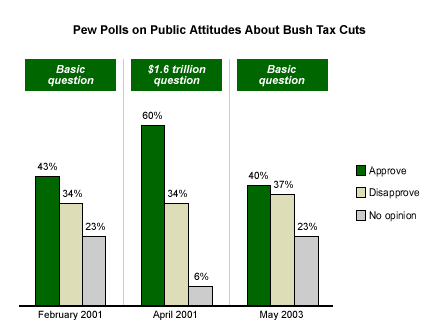
In a conversation with me on Monday, Kohut said he deleted the comparison between April 2001 and May 2003 because, in retrospect, he questioned the usefulness of the comparisons. He gave two reasons:
- Unlike the question in April 2001, the question in May 2003 was preceded by a question that asked how much people had heard of the tax cuts. After 46% had just indicated a low level of knowledge, 23% -- an unusually high number -- then said they had no opinion of the tax cut. The preliminary question that highlighted a person's lack of knowledge could have suppressed the respondents' willingness to give an answer to the subsequent tax question.
- Respondents in April 2001 were asked a very different question from the one asked in May 2003. Mentioning the actual size of the tax cuts in the former could have elicited greater support than the more neutral question asked in the latter survey.
No one can say for sure which factors best account for the difference in results between April 2001 and now, barring some split sample experiments. However, the difference in question wording seems especially likely. As the chart shows, in the February 2001 poll, support for tax cuts was about the same as measured in May 2003, and the "no opinion" response is identical in the two polls. It's only when the actual size of the tax cut is mentioned in the April 2001 poll, that the no opinion response is very low (6%), and approval is high (60%).
Still, it is quite possible that even had Pew mentioned the size of the tax cuts to the respondents, approval for the current tax-cut proposal would have been lower now than approval for the tax-cut proposal of two years ago. In April 2001 and April 2003, CBS polls asked respondents the same question, "Given the way things are going right now, do you think a large tax cut would be good for the economy, bad for the economy, or wouldn't it make much difference one way or the other?" By 35% to 22%, Americans said good rather than bad in 2001, but those percentages were at 25% good and 28% bad last month.
What accounts for the differences between the two CBS polls? In this case, the differences are probably "real," that is, due to real world events and not to the question wording or the other questions that were asked at the same time. The real world events that could account for the difference include the fact that the current tax-cut proposal is lower than the one two years ago, and the first one has also been passed -- giving people time to assess how much they and the country need new cuts. Moreover, much has happened in the past two years, including the 9/11 terrorist attacks, and the wars in Afghanistan and Iraq, changing the economic and political context in which the cuts are being proposed.
Next week:
A scourge of polling, Arianna Huffington, will address members of the American Association for Public Opinion Research at their annual meeting this coming weekend. Many members are irate, and others pleased, that such a visible critic was invited to speak. Next week's PollTalk will report on the fireworks.