Lori Petters isn't comfortable with the idea of walking alone at night near her home in Council Bluffs, Iowa. Although the city's population itself is roughly 60,000, it is part of the larger Omaha, Neb., metro area of 735,000 -- and Petters spent her life in a small town before recently moving there. "I used to walk for exercise at night, and was never afraid. Now, I don't know anyone that I meet while walking. That makes me nervous. There are also bridges to go under, and it's dark and scary under there!" But ask her 16-year-old daughter, Tessa Christensen, if she's afraid to walk near her home alone at night, and she'll flatly tell you "no."
Petters is a typical, cautious mother. And many mothers may have become even more cautious as stories of abducted teens mounted this spring. But a recent Gallup Youth Survey* finds that Christensen's opinion is shared by the majority of teens -- 54% of teens said no when asked, "Is there any area right around your home in which you would be afraid to walk alone at night?" Forty-six percent said yes.

But not every kid has Christensen's confidence. Fear of walking alone at night varies with race, geography, and especially gender.
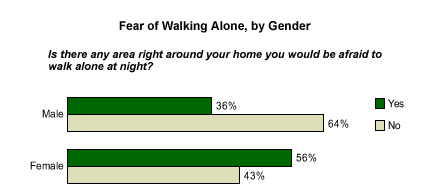
Not remotely surprisingly, boys are less nervous. Only 36% admitted to being afraid to walk alone at night, as did 56% of girls. Girls may be more aware of potential dangers -- or have more dangers to fear -- than boys do. It may also be that girls are more willing than boys to admit they are afraid. Boys tend to be overconfident or project overconfidence about their safety, as thousands of psychologists, parents, and car insurance agents could attest. Gallup polling of adults also consistently shows greater expressed fear among women than men.
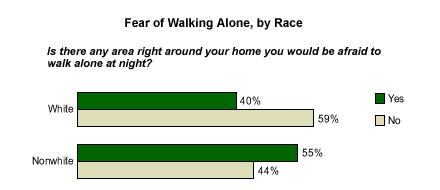
Whites are much less afraid than nonwhites to walk alone at night near their homes. Forty percent of white teens said they would be afraid, as did only 55% of nonwhite teens. Again, one might suppose that teens are analyzing risk. White families, on average, tend to be wealthier than nonwhite families, and wealthier neighborhoods tend to see less crime.
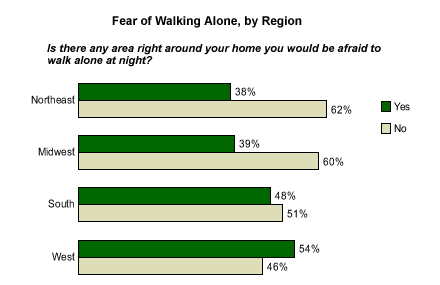
Several major Northeastern cities are known for high crime rates. Yet, teens who live in the Northeast (38%) reported the lowest levels of fear of walking alone at night among the major regions of the country, along with Midwestern teens (39%). Teens residing in the West were most likely to express fear (54%), and almost half (48%) of Southern teens said they are afraid to walk alone at night.
Bottom Line
Christensen says that her neighborhood is safe because "everything is pretty much well-lit." But streetlights alone won't make Petters see things her daughter's way, and it probably never will. The two will have spent their adolescence in very different towns, but there's another difference -- one that comes with age. "I think the only thing that has really changed is my awareness and my loss of youthful naïveté. Having been born and raised in a smaller community where I knew everyone and everyone knew me, I was very trusting. But as I've grown older, I've grown more wary," she said.
*The Gallup Youth Survey is conducted via an Internet methodology provided by Knowledge Networks, using an online research panel that is designed to be representative of the entire U.S. population. The current questionnaire was completed by 1,200 respondents, aged 13 to 17, between Jan. 23-Feb. 10, 2003. For results based on the total sample, one can say with 95% confidence that the maximum margin of sampling error is ±3%. For a complete description of the sampling and weighting procedures used to conduct the survey, click here.