Facing their worst economic crises in decades, state governments nationwide arduously toiled to balance their budgets this year. In every state except Vermont, laws require a balanced state budget, but the economic slowdown of recent years left many states facing a difficult reckoning. States from coast to coast were presented with two equally difficult options -- raise taxes or cut spending. To varying degrees, most attempted to do both.
When Gallup recently presented Americans with those two options -- spending cuts or tax hikes -- and asked which they thought states should concentrate on when dealing with their budget crises, they came down squarely on the side of reduced spending. But that sentiment wavered among spending cut advocates when it came to cuts specifically targeting education or healthcare.
Read Their Lips, No New Taxes
Generally, a majority of Americans will seldom advocate a tax increase, nor will they often oppose a tax decrease. That general pattern holds true in this case. When asked what action the state governments should take to balance their budgets, a May 30-June 1 Gallup Poll* shows a majority of Americans (79%) favored cutting spending and just 13% favored raising taxes. The public responded similarly when the question was first posed in April.
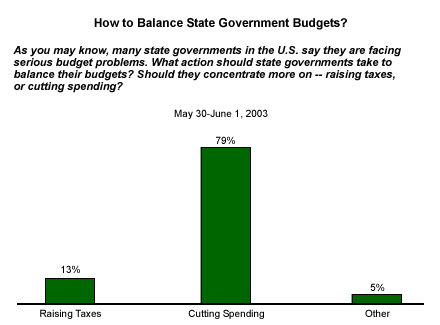
Opinion about the right solution to state budget problems varies most notably by political ideology. Just 5% of conservatives thought state governments should concentrate more on raising taxes to balance the budget, compared to 14% of moderates and 25% of those with a liberal ideology. Still, a majority of liberals (68%) said cutting spending is the best course of action (89% of conservatives favor reduced spending).
Hands Off Education and Healthcare
State lawmakers who see classrooms and health services as areas ripe for budget cutting should prepare for some public backlash. Just 22% of those who said state governments should focus on spending cuts (which translates to 18% of all Americans) would be willing to cut state funding for education, compared to 77% who said they would not be willing to do so. Similar percentages said the same about cutting healthcare funding.
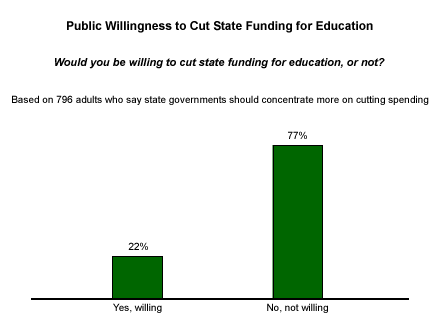
Men are most likely to accept cuts in state education funding. Three in 10 men who favor budget cuts over tax increases say they would be willing to cut education funding, compared to just 15% of women who favor budget cuts. Women tend to be more sensitive to education issues because they affect children, which may factor into this percentage difference.
When the state healthcare budget is placed on the chopping block, just 21% of those who favored state spending cuts said they would be willing to swing the proverbial ax. A majority (78%) said it would not be willing to cut healthcare spending.
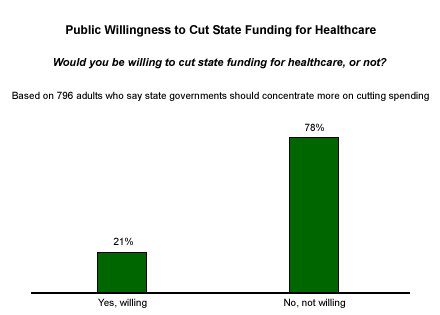
Household income is a significant variable in public willingness to cut state healthcare spending. Those with the higher household incomes (who are most likely able to afford healthcare) are more likely to express willingness to cut state healthcare funding. Specifically, 27% of those with annual household incomes over $50,000 say they would be willing to cut state healthcare funds, compared to 16% of those with household incomes under $50,000.
Bottom Line
As their states face the largest budget crises in a generation, Americans favor a reduction in government spending rather than a tax increase. However, what looks good in the abstract does not always keep its luster when it comes to the specifics. When asked to consider state funding of education and healthcare, most spending cut advocates lose their will to cut.
*Results are based on telephone interviews with 1,019 national adults, aged 18 and older, conducted May 30-June 1, 2003. For results based on the total sample of national adults, one can say with 95% confidence that the margin of sampling error is ±3%.