The U.S. Centers for Disease Control and Prevention (CDC) reports that in 1999, 63% of heart disease deaths were sudden cardiac arrests, and 47% of cardiac deaths occurred outside the hospital. The key to saving lives in these cases is response time. According to the American Medical News, the likelihood of successful resuscitation decreases by 7% to 10% with every minute of delay, and is very low once the 10-minute threshold is reached.
Unfortunately, quick response by emergency medical service personnel is not always possible. In many parts of the country, emergency vehicles can take several minutes to arrive at the scene of an emergency, and the odds of surviving a cardiac arrest after such a delay are slim. If a person suffers a cardiac arrest, his or her chances of survival go up if someone trained in cardiopulmonary resuscitation (CPR), and/or an automated external defibrillator (AED), is nearby.
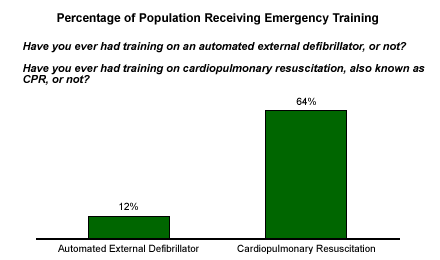
A February 2003 CNN/USA Today/Gallup poll* asked Americans if they have received training in the use of an automated external defibrillator (a device designed to recognize and treat certain abnormal heart rhythms), or in cardiopulmonary resuscitation. Not surprisingly, significantly fewer people have been trained in how to use an AED, a relatively new method of resuscitation, than have been trained in CPR.
After decades of promotion by health officials, nearly two-thirds of American adults (64%) say they have received some training in CPR. This is a high number, although it still means that one in three people, if faced with an emergency cardiac arrest, could do nothing but call 911 and hope for the best. Just 12% of Americans have received training in how to use an AED.
Although AEDs are extremely easy to use, training in the use of an AED is more prevalent among those with more education. Seventeen percent of Americans with at least some college education said they have been trained, compared to 5% of those with a high school education or less. Related to this is the finding that 19% of people with annual household incomes of $50,000 or more have been trained to use an AED, compared with 7% of those earning less than $50,000.
Preparing to Save a Life
When confronted with a heart attack victim, there are four key steps in the "Chain of Survival" that the American Heart Association recommends to follow to maximize the likelihood of survival:
- Call 911.
- Provide early CPR.
- Provide early defibrillation.
- Get advanced care quickly.
Gallup's findings indicate that those who are trained in CPR are relatively certain about their ability to save a person's life. Of those who said they have been trained in CPR, 88% said they are confident that they could successfully perform the procedure in a medical emergency, and 43% are "very confident."

Only 12% of Americans have been trained to use an AED. Although training in this method of resuscitation will not benefit a victim unless an AED is accessible at the time of the emergency, using an AED is much easier than performing CPR -- AEDs are nearly impossible to misuse. The machine automatically analyzes heart rhythms and "decides" whether or not to shock the victim's heart. It then gives step-by-step verbal prompts and picture instructions. If more people were trained to use AEDs --and if AEDs were available in more public places --countless lives could be saved.
What Can You Do?
If you want to help reduce the number of cardiac deaths in America, there are two important things that you can do:
- Support the expansion of public access defibrillator programs in your community.
- Enroll in training for both CPR and in the use of an AED. The American Heart Association has more than 3,000 community training centers, and the course takes approximately four hours.
*Results are based on telephone interviews with 462 national adults and 541 national adults, aged 18 and older, conducted Feb. 24-26, 2003. For results based on these samples, one can say with 95% confidence that the maximum margin of sampling error is ±5 percentage points.