GALLUP NEWS SERVICE
New Gallup Poll economic data show the public's confidence in the economy falling back to levels seen in early March, when the "major action" in Iraq was just beginning. At the same time, most economic forecasters are talking about the economy having its best performance since 1999 during the last half of this year. And, when the Federal Open Market Committee (FOMC) meets today to discuss these contradictory economic trends, the markets expect the Fed to leave interest rates unchanged. That's because so-called productivity gains are expected to keep inflationary pressures at bay even as the U.S. economy expands at a healthy rate.
So why is consumer confidence declining as the economy builds positive momentum? More importantly, why aren't economic forecasters worried about consumer spending falling as consumer confidence declines? Will consumers continue to spend even if their confidence in the economy continues to tumble?
More Consumers Rate Current Economic Conditions as Poor
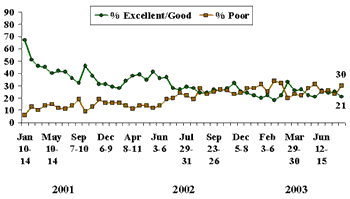
In September, more consumers rate current economic conditions as "poor" (30%) than say they are "good" or "excellent" (21%) -- a differential of –9 percentage points. This is down from a differential of +2 percentage points in August, when 25% of consumers rated current economic conditions as "good" or "excellent" and 23% rated them as "poor."
As a result, consumer perceptions of the current economy are now where they were just prior to the major combat in Iraq. In early March, this differential was –10 percentage points. Consumer perceptions improved immediately following the beginning of the war, with 33% of the public rating economic conditions as good or excellent and 20% saying they were poor, for a differential of +13 percentage points in Gallup's March 24-25 poll. During early April, this differential declined to +5 percentage points as Baghdad fell. By early May, it was –6 percentage points before declining to –10 percentage points in mid-May. During the summer, consumers' assessments of the economy improved, as the differential ranged between +2 and –2 percentage points.
| Rating of Current Economic Conditions |
 |
A Majority Also Says Things Are Getting Worse
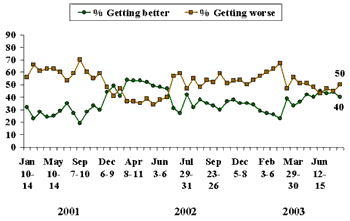
Currently, more consumers are saying economic conditions are getting worse (50%) than say they are getting better (40%) -- a differential of –10 percentage points. This means consumers are less optimistic about future economic conditions than they were this summer, when the differential ranged between +2 and –4. Still, consumer expectations are nowhere near as bad as they were just prior to the war, when this differential was –44 percentage points.
| Economic Conditions Getting Better or Getting Worse? |
 |
Still, Consumers' Spending Intentions Show Modest Decline
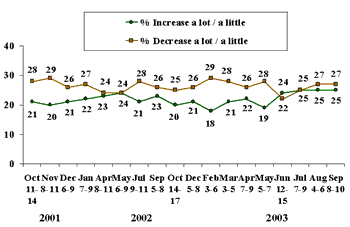
More consumers (27%) say they will decrease their spending over the next six months than say they plan to spend more (25%). This differential of –2 percentage points is the same as August's and reflects slightly lower spending intentions than those of June (+2 differential) and July (0). Still, September's differential remains much more positive than that of May, when many more consumers (28%) said they planned to decrease their spending than said they planned to increase it (19%), for a comparatively large negative differential of –9 percentage points.
| In the Next Six Months, Will Your Overall Spending Level Increase or Decrease? |
 |
Wealth Effects Are Offsetting Unemployment Fears
Gallup's September survey shows that nearly half the public (46%) expects unemployment to increase over the next six months. Only a third (33%) expect it to decline, even as economists expect the economy to grow at its best rate in years. This is fully consistent with Gallup's August poll findings that included a third of employees (34%) saying their employer had laid off workers during the previous six months; 19% of employees saying they were personally worried about being laid off in the near future; and 9% of employees saying they were worried that their employers would send their jobs overseas.
Traditional economic analysis suggests that when consumers get concerned about losing their jobs, they reduce their spending. In turn, this slows the economy until job-market conditions improve.
However, this may no longer be the case. The most recent UBS/Gallup Index of Investor Optimism poll provides new evidence supporting the idea that significant increases in individual investor net-worth levels -- wealth gains -- have a positive impact on consumer spending intentions. For example, more than one out of five investors (22%) currently owning stocks say that their spending is being impacted by the surge in stock prices during most of the past year. And these "wealth effects" are produced not only by increasing stock prices but by increasing housing prices as well. Nearly one out of five investors (18%) currently owning their own home say that the increase in housing prices is affecting their spending.
For the moment, it appears as though the wealth gains of some Americans, and their positive impact on consumer spending -- particularly for major purchases -- are offsetting whatever negative effects unemployment fears are having on the rest of the consuming public's spending.
Evidently, many economists assume that productivity gains and the wealth benefits they provide can keep this process and the economy going even if the job market continues to suffer. Whether or not they are right will have a lot to do with how the economy fares later this year and in 2004.
Survey Methods
Results are based on telephone interviews with 1,025 national adults, aged 18+, conducted Sept. 8-10, 2003. For results based on this sample, one can say with 95% confidence that the margin of sampling error is ±3 percentage points. In addition to sampling error, question wording and practical difficulties in conducting surveys can introduce error or bias into the findings of public opinion polls.