GALLUP NEWS SERVICE
Overall investor optimism declined in September, giving back all of its August gains, according to the Index of Investor Optimism -- a joint effort of UBS and The Gallup Organization. Both the Personal and Economic Dimensions of the Index showed declines.
Why is investor optimism falling even as economists are revising their economic growth forecasts for the remainder of the year upward? Are investor perceptions simply reflecting a justifiable skepticism of the accuracy of economic forecasts, especially in light of the false signals of the past couple of years? Are investors afraid that the equity markets have advanced too far too fast and are due for a significant fall? Or is something else troubling them? And if so, what?
Overall Investor Optimism Declines in September
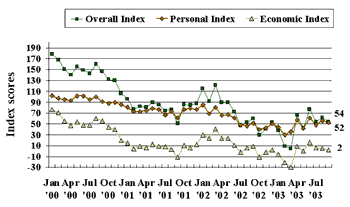
The Index of Investor Optimism decreased seven points in September, falling to 54. This decrease puts the Index back at its July level. Investor optimism is now just about where it was last December (52). The Personal Dimension of the Index decreased four points in September and now stands at 52. It remains above where it was in July (48). On the other hand, the Economic Dimension of the Index fell to 2 -- down from 5 in August and 6 in July. This suggests that investors overall remain essentially neutral about the economic outlook for the next 12 months.
| Index of Investor Optimism –
U.S. January 2000 – September 2003 |
 |
Optimism About Economic Growth Remains Unchanged
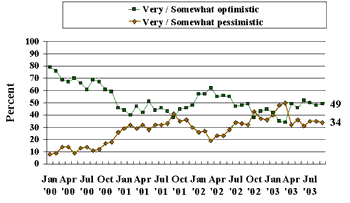
Half of all investors (49%) say they are somewhat or very optimistic about the economy's ability to grow over the next 12 months. This is essentially the same as in August (48%) and not much below July (50%) and June (52%). While investors are not nearly as enthusiastic as economists are about the economy's growth prospects in the months ahead, they remain more optimistic than pessimistic. Clearly, concerns about economic growth are not the reason investor optimism declined in September.
| Rating Economic Growth January 2000 – September 2003 |
 |
Optimism About the Stock Market Increases
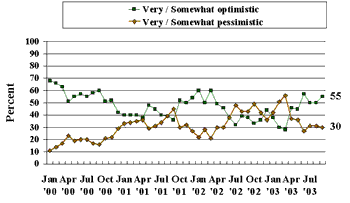
More than half of all investors (55%) also say that they are optimistic about the prospects for the stock market over the next 12 months. This is up from August (50%) and July (50%) and just about where investor optimism about the market stood in June (57%). It does not appear that investors are worried that the stock market has gone too high too fast, as least as far as the outlook for the next year is concerned.
| Rating Stock Market Performance January 2000 – September 2003 |
 |
Pessimism About Inflation Increases
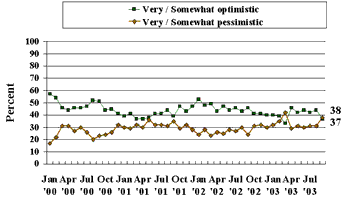
In contrast, 38% of investors say they are somewhat or very pessimistic about the outlook for inflation over the next 12 months. This is up from 31% in August and July and 30% in June. One reason some investors are less optimistic about the investment environment has to do with an increase in inflation fears as the federal budget grows and the Federal Reserve continues to keep interest rates low.
| Rating Inflation January 2000 – September 2003 |
 |
Pessimism About the Job Market Increases
Even though investors remain optimistic about economic growth
and the performance
of the stock market, they are increasingly pessimistic about the
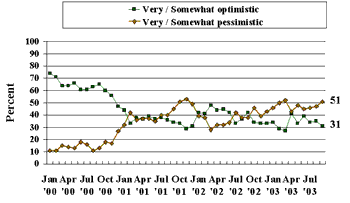
job market. Half of
all investors (51%) also say that they are pessimistic about the
prospects for the unemployment rate over the next 12 months. This
is up from August (47%), July (46%), and June (45%).
| Rating the Unemployment Rate January 2000 – September 2003 |
 |
Reasons for the Decline in Optimism
It doesn't appear as though the September decline in investor optimism is due to investors' justifiable skepticism of economic forecasters' predictions, as investor optimism about economic growth is unchanged in September. Nor does it seem that investors fear that the stock market is due for a major fall, as they show more -- not less -- optimism about the outlook for the stock market over the next 12 months. Instead, investor optimism seems to be declining primarily due to growing investor concerns about inflation and the job market.
Evidently, many investors now buy into the somewhat
unconventional idea that the
U.S. economy can accelerate its growth, prices can increase, and
the stock market can continue to perform well even as the job
market deteriorates. Obviously, this may be the case if so-called
productivity gains continue to increase faster than the economy
grows. But, can it be maintained politically and economically if
what was once called the "Misery Index" -- inflation plus
unemployment -- surges upward?
Survey Methods
Results for the "Index of Investor Optimism -- U.S." are based on telephone interviews with a randomly selected U.S. sample of 812 investors, 18 years and older, with at least $10,000 of investable assets, conducted Sept. 1-14, 2003. For results based on these samples, one can say with 95% confidence that the maximum error attributable to sampling and other random effects is ±4 percentage points. In addition to sampling error, question wording and practical difficulties in conducting surveys can introduce error or bias into the findings of public opinion polls.