In the face of weak capital expenditures and reductions among businesses, consumer spending has almost single-handedly driven the American economic recovery for the last two years. And new Gallup figures indicate that even as businesses are finally beginning to spend again, consumer spending intentions remain strong.
Two More Quarters of Strong Consumer Spending
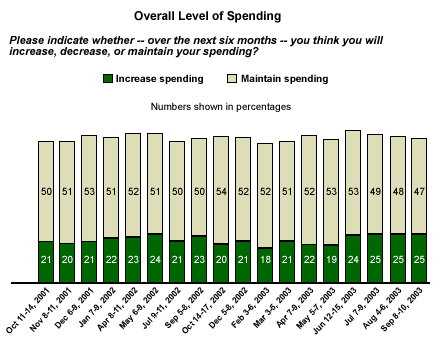
According to a September 2003 Gallup Poll*, 72% of Americans intend to maintain or increase their overall level of spending in the next six months, including 25% who intend to increase it. The percentage expecting to maintain or increase spending has been in the 70% range since the recession officially ended in November 2001, and the percentage expecting to increase their spending has been consistent since June.
Even though a recent U.S. Department of Commerce release indicates that retail sales grew at a slower pace in August, the results of the September poll suggest it is likely that consumer spending will remain strong over the next two quarters. And while some economists have dismissed the National Retail Federation's forecast of a 5.7% increase in retail sales this holiday season as overly optimistic, our data provide some support for this scenario.
Buy Now, Pay Later
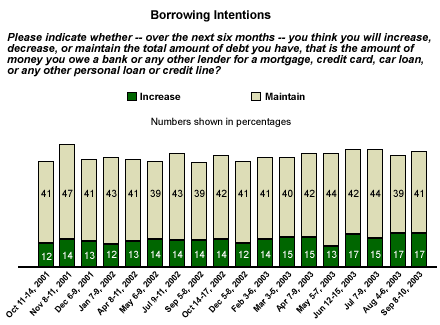
With the great American shopping spree likely to continue, it is not surprising that the majority of consumers intend to maintain their existing debt or borrow more. In the recent poll, 58% of all Americans said they expect to maintain (41%) or increase (17%) their existing levels of debt. In October 2001, at the tail end of the recession, this level was 53%. While low interest rates and the refinancing boom enabled consumers to lower their cost of borrowing, the increased liquidity from refinancing has been used primarily to fuel spending -- so overall household debt levels have continued to spiral.
Bottom Line
The 2001 recession and recovery have been atypical in that consumer spending and borrowing remained high throughout the cycle. Traditionally, household spending and borrowing decrease as the economy enters a recession and then rebound to drive an economic recovery. However, for the first time in post-World War II history, consumer balance sheets show overspending as a broad economic recovery gains momentum. The Federal Reserve's aggressive monetary policy and the refinancing boom that ensued as consumers rotated their stock market investments into real estate assets has left household balance sheets vulnerable to inevitable increases in long-term rates. If rate hikes gain steam, many American consumers may find themselves heading to the mall less often than they have in a long time.
*These results are based on telephone interviews with a randomly selected national sample of 1,025 adults, aged 18 and older, conducted Sept. 8-10, 2003. For results based on this sample, one can say with 95% confidence that the maximum error attributable to sampling and other random effects is ±3 percentage points. In addition to sampling error, question wording and practical difficulties in conducting surveys can introduce error or bias into the findings of public opinion polls.
