GALLUP NEWS SERVICE
PRINCETON, NJ -- New Gallup Poll economic data collected in early October continue to show more consumers giving the economy "poor" ratings than giving it "good" or "excellent" ratings combined. In addition, just as many consumers tell Gallup that economic conditions in the country are "getting worse" as say they are "getting better."
In sharp contrast, the new Federal Reserve Current Economic Conditions survey shows 10 of the 12 Federal Reserve Banks reporting stronger economic activity during September and early October. As with many economic prognosticators, the Fed says its new survey findings suggest that the economic recovery from the 2001 recession is finally gathering momentum.
So why aren't consumers jumping on the economic optimism bandwagon as the economy appears to be building positive momentum? More importantly, will consumers continue to spend even if their optimism about the economy doesn't improve?
Consumers Rate Current Economic Conditions
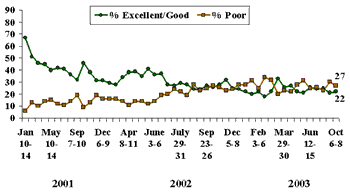
In early October, more consumers continued to rate current economic conditions as "poor" (27%) than said they were "good" or "excellent" (22%) -- a differential of –5 percentage points. This is a slight improvement from the differential of –9 percentage points in September, when 30% of consumers rated current economic conditions as "poor" and 21% rated them as "good" or "excellent." On the other hand, the October ratings remain below those of August, when the differential -- with 25% "good" or "excellent" ratings and 23% "poor" ratings -- was +2 percentage points.
Currently, consumer perceptions of the economy are just about where they were in mid-January and again in early May -- in both months, the differential was –6 percentage points. In fact, consumer perceptions were actually slightly better a year ago, when the differential was only –1 percentage point.
| Rating of Current Economic Conditions |
 |
Consumer Perceptions of the Economy's Direction
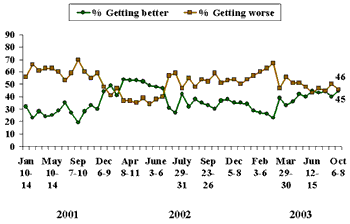
Currently, as many consumers say economic conditions are "getting worse" (46%) as say they are getting better (45%) -- a differential of –1 percentage point. Consumers are more optimistic today about the future prospects for the U.S. economy than they were in September, when the differential was –10 percentage points. And they are about as optimistic about future economic conditions as they were this summer, when the differential ranged between +2 and –4. Still, even as optimism grows among economic forecasters, less than half of consumers continue to say they think economic conditions are getting better, rather than worse.
| Economic Conditions Getting Better or Getting Worse? |
 |
Consumers' Spending Intentions
More consumers now say they will increase their spending over the next six months (27%) than say they plan to spend less (24%), for a differential of +3 percentage points. This is only the second time the differential in spending intentions has been positive since Gallup began tracking consumer spending intentions in October 2001. The other positive differential, +2, was recorded in June of this year.
Traditional economic analysis suggests that when consumer optimism is relatively weak, as it is today, consumers are likely to hold back on their spending. In turn, this tends to further slow the economy until economic conditions and consumer perceptions improve.
Gallup attitudinal economic data, however, suggest that this is no longer the case. Whether it is the result of stock-market and home-equity wealth effects or some other reason, there appears to be a growing disconnect between consumers' perceptions of how well the economy is performing and their willingness to spend. Of course, the big question for the future of the economy is whether this disconnect in traditional consumer behavior can be maintained for an extended period -- at least until the job market starts to show significant improvement.
Survey Methods
Results are based on telephone interviews with 1,017 national adults, aged 18+, conducted Oct. 6-8, 2003. For results based on this sample, one can say with 95% confidence that the margin of sampling error is ±3 percentage points. In addition to sampling error, question wording and practical difficulties in conducting surveys can introduce error or bias into the findings of public opinion polls.