GALLUP NEWS SERVICE
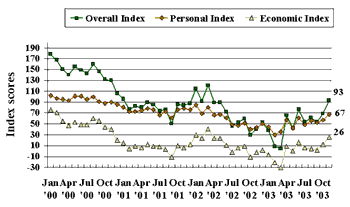
Not surprisingly, investor optimism surged in November, according to the Index of Investor Optimism -- a joint effort of UBS and The Gallup Organization. The overall Index and its Economic Dimension are now at their highest points in 20 months; the Personal Dimension, at its highest point in 18 months.
Even as more investors jump on the optimism bandwagon, however, there are signs that investor confidence in corporate America remains fragile. Investor confidence has still not recovered from the corporate abuses of recent years. Add the unfolding mutual-fund debacle, and the cautious optimism being reflected by today's equity markets seems well advised.
Investor Optimism Surges
The Index of Investor Optimism surged 24 points in November -- on top of its 15-point increase in October -- and now stands at 93. This puts the Index at its highest level since March 2002, when it was at 121.
The Personal Dimension of the Index increased 10 points in November, on top of its 5-point increase in October, and now stands at 67. This is its highest level since May 2002, when it also stood at 67. The equity market gains of 2003 have significantly improved this dimension of investor well-being.
The Economic Dimension of the Index increased 14 points in November, on top of its 10-point increase in October, reaching 26. Investors are far more optimistic about the economic outlook than they were just two months ago, when the Economic Dimension of the Index was at 2.
| Index of Investor Optimism - U.S. January 2000 - November 2003 |
 |
Investors Continue to Lack Confidence in Corporate America
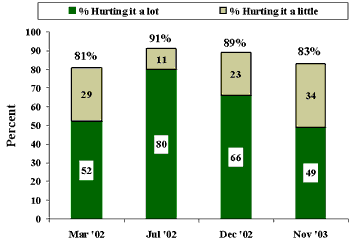
In early 2002, there was an investor crisis of confidence building in the financial markets. In March of that year, the Gallup/UBS Index of Investor Optimism survey found that 8 out of 10 investors felt that questionable accounting practices were hurting the U.S. investment climate. Essentially, investors did not know whether they could believe in the accounting reports and corporate governance of corporate America.
More importantly, the Gallup/UBS Index of Investor Optimism survey for November 2003 shows that investor confidence in corporate America remains weak. Overall, 8 out of 10 investors still believe that questionable accounting practices are hurting the U.S. investment climate.
Of course, this percentage is not as high as the 9 out of 10 investors who felt this way about corporate America during the second half of 2002. Nor is the intensity as great as it was in July 2002, when 8 out of 10 investors said these accounting issues were hurting the investment climate "a lot." Still, the new survey does show that despite all the efforts to correct the situation, there remains an overwhelming lack of investor confidence in corporate America.
| How Are Questionable Business Accounting Practices Affecting the U.S. Investment Climate? |
 |
Accounting Practices Lead List of Issues Hurting Investment Climate
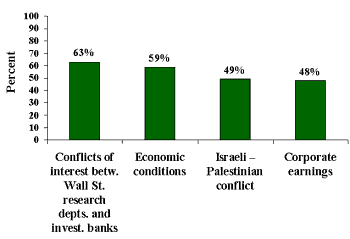
Not only are investor concerns over questionable accounting practices in corporate America surprisingly high in comparison to where they were a year ago, they are also high in comparison to a number of other major situations that are affecting the current investment climate.
For example, more investors point to the issue of questionable accounting (83%) as hurting the U.S. business climate than point to the federal budget deficit (76%), the current situation in Iraq (75%), and the threat of more terrorist attacks (73%). Similarly, more investors point to the issue of conflicts of interest between Wall Street firms' research departments and investment banks (63%) than to general economic conditions in the United States (59%), the conflict between the Israelis and the Palestinians (49%), and corporate earnings (48%).
| Situations Hurting the U.S. Investment Climate % Saying "hurting it a lot" or "a little" |
 |
| Nov. 1-13, 2003 |
| Situations Hurting the U.S. Investment Climate % Saying "hurting it a lot" or "a little" |
 |
| Nov. 1-13, 2003 |
A Very Fragile Optimism
The Index of Investor Optimism confirms Gallup's consumer confidence findings from earlier this month, but does so among the nation's investors. According to a Nov. 3-5 Gallup Poll, consumer confidence reached its highest level in more than a year and a half earlier this month. At the same time, consumer spending intentions were more positive than they have been at any point since Sept. 11.
The new Index survey also confirms the findings of the annual investor survey of the Securities Industry Association (SIA), released in early November. The SIA survey found that 60% of investors pointed to accounting fraud as their major concern when investing in the stock market -- again topping the list of investor concerns, as it did in 2002. In addition, 43% of investors said dishonesty is the main issue facing the securities industry -- roughly equal to the number recorded in 2002, but up from 8% in 2001.
The current lack of investor confidence is likely to increase as the growing mutual-fund debacle continues to unfold. In this regard, an Oct. 24-26 Gallup Poll shows 55% of Americans saying they have money invested in a mutual fund. While recent stock mutual-fund inflows seem fairly good, 71% of those with mutual funds said they definitely (20%) or probably (51%) would move their money if their mutual-fund company became subject to investigation.
Right now, it seems clear that investor and consumer optimism is surging as the U.S. economy exhibits every indication that it is finally on the road to a real recovery from the recession of 2001. At the same time, it also seems clear that investor confidence in corporate America and the financial markets has still not recovered from the abuses of recent years, and remains extremely fragile. The question for the future is whether investor and consumer optimism can continue to increase even as the abuses uncovered on Wall Street continue to mount.
Survey Methods
Results for the "Index of Investor Optimism -- U.S." are based on telephone interviews with a randomly selected U.S. sample of 801 adult investors, 18 years and older, with at least $10,000 of investable assets, conducted Nov. 1-13, 2003. For results based on these samples, one can say with 95% confidence that the maximum error attributable to sampling and other random effects is ±4 percentage points. In addition to sampling error, question wording and practical difficulties in conducting surveys can introduce error or bias into the findings of public opinion polls.