In 1815, David Ricardo demonstrated to the British Parliament that the country's Corn Laws, which imposed high tariffs on corn imports, were detrimental to the British economy. In his Essay on the Influence of a Low Price of Corn on the Profits of Stock, Ricardo expressed regret that "considerations for any particular class, are allowed to check the progress of the wealth and population of the country." Ricardo's ideas on free trade formed the basis of the Law of Comparative Advantage. Today, economists continue Ricardo's tradition, and despite their many disagreements remain fierce advocates of free trade between nations.
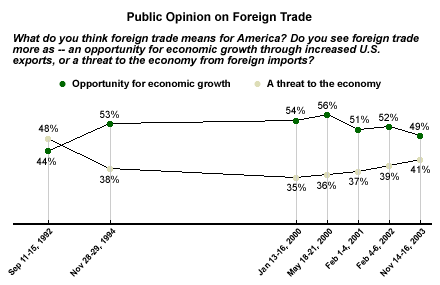
While most economists argue that protectionism is inefficient, a Nov. 14-16 Gallup Poll* indicates that most Americans are relatively uncertain whether foreign trade is an opportunity or a threat. When asked whether foreign trade represents "an opportunity for economic growth" or "a threat to the economy," 49% of Americans say it represents an opportunity for growth, and 41% say that foreign trade represents a threat.
In March 2002, President Bush imposed controversial safeguard duties on steel imports. This month, in a show of commitment to "America's workers," the Bush administration announced safeguard quotas on bathrobes, knit fabrics, and bras imported from China. With elections around the corner, there has been widespread speculation that the move was motivated in part by political expediency. But history has shown that protectionism cannot be a sustainable solution to unemployment, the trade deficit, or a troubled manufacturing industry.
Foreign Trade: An Opportunity or Threat?
Gallup has asked this question about foreign trade several times in the last decade, and public opinion on the issue seems to vary somewhat with the business cycle. The percentage of Americans who view foreign trade as an opportunity for economic growth was just 44% in 1992, when the question was first asked, as the economy struggled in the aftermath of a recession and the North American Free Trade Agreement was under debate. In 1994, as the economy experienced unprecedented growth in gross domestic product, the tide turned and 53% of Americans said foreign trade was an opportunity for economic growth. Through the Clinton era and the bubble economy of the 1990's, the majority of Americans were in favor of foreign trade, with the percentage viewing it in positive terms reaching as high as 56% in May 2000. As the economy began to falter again, that figure dropped, to 51% in 2001 and 52% in 2002. In the most recent poll, for the first time in a decade, less than half of all Americans view foreign trade as a growth opportunity.
Bottom Line
Last week, Federal Reserve Chairman Alan Greenspan warned against creeping protectionism in light of an increasing current account deficit. The Bush administration has pursued increasingly protectionist policies in the last few years -- as is evident in its trade policy with respect to the domestic agriculture, steel, and textile manufacturing industries. And while these tariffs and subsidies might placate certain groups in the short term, they will eventually result in rising interest rates, higher prices, and reduced real incomes.
The labor turnover rate for private industry in the country was 43% in 2003, according to the Bureau of Labor Statistics -- testament to an efficient economy that dynamically allocates labor to industries in which America has comparative advantage. While economists dismiss the job losses in uncompetitive domestic industries as a short-term phenomenon, the reality is that Americans don't like any job losses, and, with an election year right around the corner, short-term conditions could result in long-term changes.
*Results are based on telephone interviews with 1,004 national adults, aged 18 and older, conducted Nov. 14-16, 2003. For results based on the total sample of national adults, one can say with 95% confidence that the margin of sampling error is ±3 percentage points.