Despite the "jobless" nature of the current economic recovery, the first CNN/USA Today/Gallup poll of 2004, conducted Jan. 2-5, shows consumer optimism continuing to surge upward:
- Consumer perceptions of the current economy are at their highest point in more than two years;
- Consumer expectations for the future are at a four-year high; and
- Nearly three out of four consumers say they are somewhat or very optimistic about the economy.
Consumers Give Higher Ratings to Current Conditions
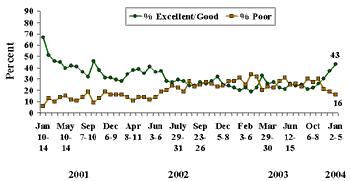
More consumers say current economic conditions are "good" or "excellent" (43%) than at any time since Sept. 11, 2001. This percentage of positive ratings is nearly twice the 22% recorded in January 2003 and is 14 percentage points above the January 2002 rating. Still, it is far below the levels recorded in January 2001 (67%) and January 2000 (71%).
| Ratings of Current Economic Conditions |
 |
Consumer Optimism About Economic Direction Also Increases
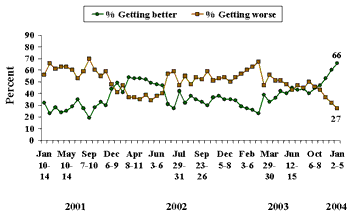
Two out of three consumers say economic conditions are "getting better," up from 60% in December and the fifth consecutive monthly increase in consumer expectations for the economy. This is nearly twice the level of January 2003 (34%) and the highest percentage of consumers saying things are getting better since January 2000 (69%).
| Economic Conditions Getting Better or Getting Worse? |
 |
Most Consumers Do Not See Recession
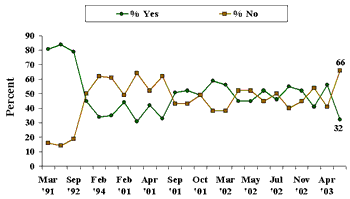
Two out of three consumers do not think the economy is currently in a recession. This contrasts sharply with the 56% of consumers who felt the U.S. economy was experiencing a recession as recently as April of last year. Instead, it is more consistent with the way consumers rated the economy back in 1994.
| Is the Economy in a Recession or Not? |
 |
Still, a Significant Minority of Consumers Have Worries
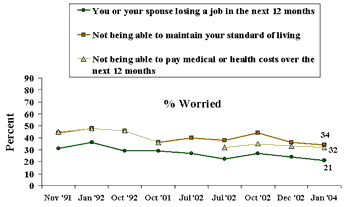
Even with the strong economic growth of the second half of 2003, one out of five consumers say they are worried that they or their spouse will lose their jobs within the next 12 months. This is not as bad as the roughly one in three consumers who had this worry during the recession of 1991-1992, but is still a disturbingly high number.
The same is true as far as other consumer worries are concerned. For example, one in three consumers say they are worried that they will not be able to maintain their current standard of living and a similar percentage of consumers fear they will not be able to pay their medical or health costs over the next 12 months.
| Americans’ Economic Worries |
 |
Conference Board Report Out of Date
About two weeks ago, the Conference Board said that its consumer confidence index fell in December. It added the suggestion that job worries were the reason consumer confidence was not continuing to increase. The Labor Department's report last Friday that the economy is not creating new jobs might seem to give these findings some face validity.
Gallup's early January results, however, suggest that the Conference Board's reading of consumer confidence is already outdated. And, the results build on Gallup's previous findings that consumer optimism actually increased during early December. In sharp contrast to the Conference Board's report, the Gallup data suggest that consumer optimism is building with the expanding economy despite the latter's failure to produce new jobs.
This is not to ignore the job fears of one in five Americans or the feeling of one in three that we are still in a recession. Instead, the Gallup data suggest that these fears of a significant minority are outweighed -- as far as consumer optimism is concerned -- by the optimism of the majority. In turn, it is this optimism that explains why:
- Holiday sales were the best in four years -- up 4% from the year before, according to the Goldman Sachs index of same store sales;
- The Dow has surpassed 10,000 and remains above it; and
- The general consensus in the markets is that U.S. economic growth will remain strong in 2004.
Survey Methods
Results are based on telephone interviews with 1,029 national adults, aged 18 and older, conducted Jan. 2-5, 2004. For results based on this sample, one can say with 95% confidence that the margin of sampling error is ± 3 percentage points. In addition to sampling error, question wording and practical difficulties in conducting surveys can introduce error or bias into the findings of public opinion polls.