PRINCETON, NJ -- Jan. 19 marks the end of George W. Bush's third year as president, a year that was largely focused on the U.S. war with Iraq. For that third year, Bush averaged a 59.6% job approval rating, which is average by historical standards, but considerably lower than Bush's first two yearly averages. Bush's most recent quarterly average was among the lowest of his presidency and probably would have been the lowest if not for a small rally following the capture of Saddam Hussein in December. Nevertheless, Bush remains above the crucial 50% approval mark (at 53% in the latest Gallup Poll out today) as he seeks a second term in office.
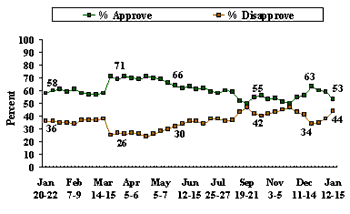
A closer look at the trend line on Bush's third year in office shows Bush hovering around the 60% approval mark as the year began. Following the commencement of the war with Iraq on March 19, his approval rating jumped to 71%, the high point for the year. Bush's popularity slowly declined through the summer and into the fall as the United States experienced difficulties in Iraq. In mid-September, shortly after Bush announced that he was seeking additional money to help the situation in Iraq, his approval rating fell to a term-low of 50%. It stayed in the low to mid-50s (including another 50% reading in a mid-November poll) until it jumped to 63% immediately after the capture of Saddam Hussein. Subsequently, in Gallup's two most recent polls, his job approval has settled back down into the mid- to high 50s.
| George W. Bush's Job Approval Rating
— Third Year in Office |
 |
Bush Year Three in Historical Context
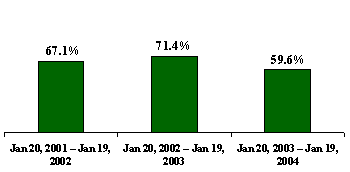
Bush's third-year average of 59.6% job approval ranks 27th out of 61 "presidential years" dating back to the Truman administration. His averages for his first two years in office, 67.1% and 71.4%, were much higher. Both of those years rank in the top 11 yearly approval averages Gallup has measured since 1945.
| George W. Bush's Yearly Job Approval
Ratings % "Approve" |
 |
Bush's third-year average is middling when compared to other presidents' third-year scores. Since the Truman presidency, four presidents have had higher third-year averages than Bush: Dwight Eisenhower (72%), John Kennedy (62%), Lyndon Johnson (65%), and the elder George Bush (70%). Six recent presidents have had lower averages than the current president: Harry Truman (58%), Richard Nixon (50%), Gerald Ford (49%), Jimmy Carter (37%), Ronald Reagan (45%), and Clinton (47%).
Of the presidents whose fourth year in office coincided with their re-election bid, Eisenhower, Nixon, Reagan, and Clinton won second terms in office, while Carter and the elder Bush were unsuccessful in their attempts. Bush therefore begins his re-election year in better shape than most recent incumbents.
Presidential Approval Ratings, Average for Third Year in Office
|
President |
Average Approval Rating |
Dates |
Number of Polls |
|
% |
|||
|
Truman |
57.5 |
Jan. 20, 1947-Jan. 19, 1948 |
8 |
|
Eisenhower |
72.1 |
Jan. 20, 1955-Jan. 19, 1956 |
15 |
|
Kennedy |
61.8 |
Jan. 20, 1963-Nov. 22, 1963 |
12 |
|
Johnson |
65.4 |
Jan. 20, 1965-Jan. 19, 1966 |
18 |
|
Nixon |
49.6 |
Jan. 20, 1971-Jan. 19, 1972 |
13 |
|
Ford |
48.8 |
Jan. 20, 1976-Jan. 19, 1977 |
8 |
|
Carter |
37.4 |
Jan. 20, 1979-Jan. 19, 1980 |
24 |
|
Reagan |
44.9 |
Jan. 20, 1983-Jan. 19, 1984 |
22 |
|
George H. W. Bush |
69.5 |
Jan. 20, 1991-Jan. 19, 1992 |
40 |
|
Clinton |
47.1 |
Jan. 20, 1995-Jan. 19, 1996 |
22 |
|
George W. Bush |
59.6 |
Jan. 20, 2003-Jan. 19, 2004 |
41 |
Bush's Quarterly Averages
Bush's latest quarterly average of 55.4% is one of the lowest of his presidency. Bush's most recent rating is similar to those for his 2nd and 11th quarters as president, but not statistically different. Of the 12 quarters that Bush has been in office, in only 4 has he averaged less than a 60% approval rating. The historical average for presidents is 57%, so even Bush's lowest quarters are average ratings at worst.
| George W. Bush's Quarterly Job Approval
Ratings % "Approve" |
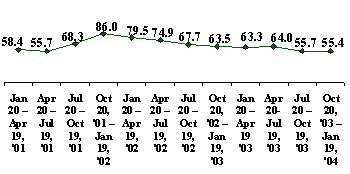 |
Had Bush not been the beneficiary of a short-lived rally in support following the capture of Hussein, this latest quarterly rating probably would have been the lowest of his presidency. From the start of Bush's 12th quarter in office on Oct. 20 until the Hussein capture, Bush averaged a 53.2% approval rating.
Survey Methods
These results are based on telephone interviews with randomly selected national samples of approximately 1,000 adults, aged 18 and older. For results based on these samples, one can say with 95% confidence that the maximum error attributable to sampling and other random effects is ±3 percentage points. In addition to sampling error, question wording and practical difficulties in conducting surveys can introduce error or bias into the findings of public opinion polls.