GALLUP NEWS SERVICE
Over the past few weeks, President George W. Bush has been pummeled by his critics about the war in Iraq, the absence of weapons of mass destruction there, and even his service in the National Guard. A new Gallup Poll, conducted Feb. 9-12, however, suggests that none of these issues is of greatest concern to the public right now. Instead, the most important problem facing the country is the economy, including unemployment or jobs.
How President Bush deals with the jobs issue may well be a major factor in the outcome of the election later this year. Nine in 10 Americans think the president's policies affect national economic conditions. Even more significantly, 8 in 10 believe that the president's policies affect their own personal economic situations. Clearly, the public sees job creation as part of the presidential job description.
Most Important Problem
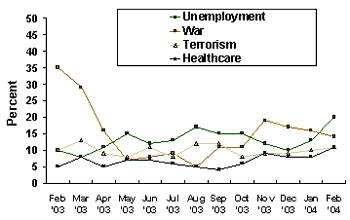
At times over the last two and a half years, significant numbers of Americans have seen terrorism and, more recently, the war in Iraq as the most important problems facing the country. Despite this fact, the economy has persisted as a major perceived problem. The percentage of Americans mentioning the economy in general as the nation's top problem fell slightly in November, December, and January. But this month, perceptions of economic troubles have grown again, to the point where 46% of those surveyed now mention some aspect of the economy as the nation's top problem. And, more specifically, one in five Americans currently point to unemployment or jobs as the most important problem -- twice the number who said this a year ago, and the highest spontaneous mention of jobs as the nation's top problem in over 10 years.
| Most Important Problem |
 |
Consumer Optimism Declines
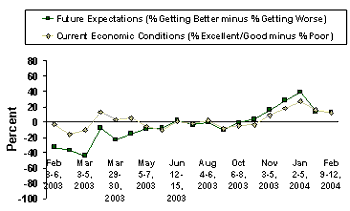
As concern about jobs has increased, consumer confidence in the economy has declined. At the beginning of this year, 43% of consumers rated current economic conditions as "good" or "excellent" and 16% rated them as "poor," for a difference of 27 percentage points. Now, just a little more than a month later, only 33% of consumers say the economy is good or excellent, while 21% say it is poor, for a difference of 12 percentage points.
At the same time, the difference between the percentage of consumers saying economic conditions are getting better and the percentage saying they are getting worse has decreased considerably. In early January, this difference (66% "getting better" vs. 27% "getting worse") was 39 percentage points. In the new poll, the difference has fallen to just 13 percentage points (53% "getting better" vs. 40% "getting worse").
| How would you rate economic conditions in this country today -- as excellent, good, only fair, or poor? Right now, do you think that economic conditions in the country as a whole are getting better or getting worse? |
 |
Approval of President's Handling of Economy Is Down
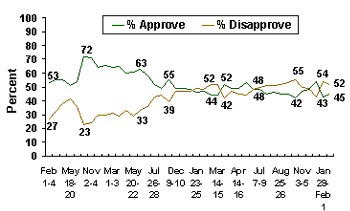
Declining consumer confidence and increasing job fears have led to a reversal in the public's approval of the way Bush is handling the economy. In early January, 54% approved of Bush's performance on the economy and 43% disapproved. Today, only 45% approve, while 52% disapprove.
| George W. Bush's Job of Handling the Economy |
 |
Can Bush Handle the Economy's Structural Change?
During the last half of 2003, the U.S. economy enjoyed a very strong recovery, with economic growth averaging 6% and the stock market surging past the 10,000 mark. Conventional wisdom suggests that this kind of strong economic performance, combined with economists' forecasts that the economy will continue its expansion in 2004, would remove the economy as an issue in the presidential election.
Instead, it appears that the unusual nature of the current economic expansion may itself become a major political issue.
Right now, it appears that the Bush administration's economic policymakers are simply hoping that continued economic growth will eventually produce significant new job creation. Is this "laissez faire" approach the best way to deal with the structural economic changes taking place in the U.S. economy and the job market? Federal Reserve Board Chairman Alan Greenspan and many others argue that it is. If current economic trends continue, however, this November may end up being a test of whether the voting public agrees.
Survey Methods
Results are based on telephone interviews with 1,029 national adults, aged 18 and older, conducted Jan. 2-5, 2004, and on telephone interviews with 1,002 national adults, aged 18 and older, conducted Feb. 9-12, 2004. For results based on these total samples, one can say with 95% confidence that the margin of sampling error is ±3 percentage points.