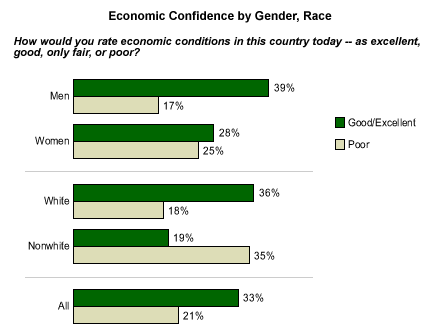
Over the past five weeks, consumer confidence in current economic conditions has tumbled. The latest Gallup Poll* (conducted Feb. 9-12) shows that the percentage of Americans rating economic conditions as "good" or "excellent" has declined 10 percentage points, from 43% in early January to 33% in the latest reading. At the same time, the percentage of consumers rating the economy as "poor" has increased five percentage points, from 16% to 21%.
Typically, this type of decline in the public’s perception of the state of the economy would be expected to take some of the luster off the strong economic outlook for 2004. This year, however, that is not necessarily the case. Because of the substantial differences in how various segments of the population view current economic conditions, the overall public opinion averages are not as meaningful -- at least as predictors of future economic conditions -- as they once were.
The unusual nature of today’s economic recovery favors some segments of the population more than others. As a result, Americans’ ratings of the current economy depend on where they fit within it.
Men and Whites More Optimistic
Thirty-nine percent of men rate current economic conditions as good or excellent, while only 28% of women rate it this way. On the other hand, one in four women (25%) rate the economy as poor, compared with 17% of men who do so.
Current economic outlook also varies significantly by race. Thirty-six percent of whites rate current economic conditions positively. Only 19% of nonwhites rate economic conditions positively, while 35% of nonwhites rate conditions as poor.
Higher Income and More Optimism?
Optimism about current economic conditions is distributed unevenly by household income. Forty-four percent of Americans with annual household incomes of $75,000 or more rate current economic conditions as good or excellent, while only 15% rate them as poor. In sharp contrast, fewer than one in four (23%) of those with annual household incomes of less than $30,000 rate the current economy as good or excellent, compared with one in three (32%) who rate conditions as poor.
Party Lines
Americans’ levels of optimism about the economy could relate to the way they plan to line up in this year’s elections. Fifty-four percent of Republicans rate current economic conditions as good or excellent, and 7% rate them as poor. Republicans’ more positive estimations could be related to the fact that a Republican Congress and White House is currently driving economic policy. Democrats, are far less enthusiastic -- just 17% give a good or excellent rating to the economic conditions, while 39% label them as poor. Independents are much more evenly divided, with 29% providing good or excellent ratings and 17% providing poor ratings.
Evidently, the "jobless" recovery has not convinced many Democrats (or independents, for that matter) that the current economy is in good shape. Changing these perceptions could be a key to the Bush administration’s re-election efforts.
*Results are based on telephone interviews with 1,002 national adults, aged 18 and older, conducted Feb. 9-12, 2004. For results based on these total samples, one can say with 95% confidence that the margin of sampling error is ±3 percentage points.